By Jin Yan
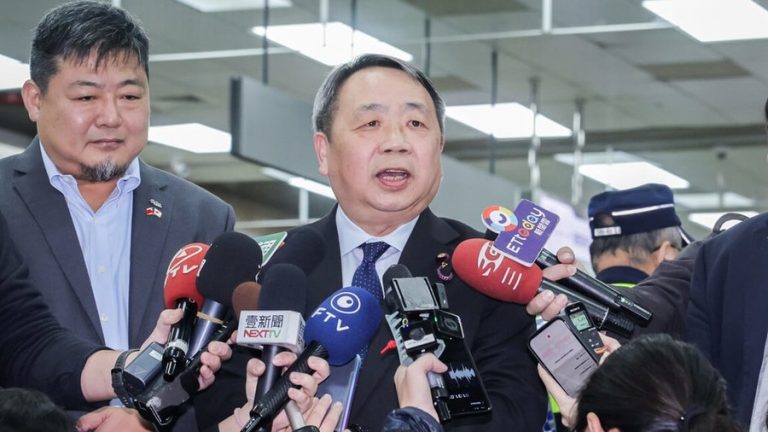
Japanese Ishin Party Senator of Chinese descent, Hei Seki, arrived at Taipei Songshan Airport on the morning of Jan. 6, responding to an invitation from an Indo-Pacific strategic think tank to attend a seminar and participate in a series of activities.
At the airport, he gave a brief statement, saying passionately: “Today, I am able to set foot on Taiwan’s soil smoothly, which fully proves that the People’s Republic of China and the Republic of China are completely different countries. Taiwan is absolutely not a part of China. Taiwan is Taiwan—it is the Republic of China and has no relation to the People’s Republic of China. The purpose of this visit is to make this clear to the world and tell everyone that Taiwan is an independent country.”
Seki’s statement at the airport was not sudden but consistent with his long-standing position. At the end of last year, when he announced his planned visit to Taiwan on the social platform X, he explicitly stated: “Being banned from entering China, I can freely enter Taiwan, which is enough to prove that Taiwan is an independent country unrelated to the People’s Republic of China.”
During this visit, supporters at the airport held banners welcoming him, though there were a few protesters, but the overall atmosphere was lively. Taiwanese media reported extensively, saying his remarks “directly contradict Beijing’s One-China Principle.”
High-profile declaration at Songshan Airport
Success
You are now signed up for our newsletter
Success
Check your email to complete sign up
On the eve of his visit, Seki was interviewed by commentator Chen Pokong. In the interview, Seki reiterated his firm stance on Taiwan. He stated that the visit had two clear objectives: first, to prepare for the upcoming regular session of the Japanese Parliament by exchanging views with Taiwanese figures on the Taiwan Strait situation and the possibility of strengthening Japan-Taiwan defense cooperation; second, to use the fact that he is sanctioned by China yet can freely enter Taiwan to demonstrate to the world that Taiwan is independent and has sovereign status. Seki emphasized: “I am banned from entering the People’s Republic of China but can smoothly set foot on Taiwan—this in itself is the strongest evidence.”
Commentator Cai Shenkun revealed that after the Chinese Ministry of Foreign Affairs announced sanctions in September last year, Beijing began paying attention to this Japanese-Chinese senator. Cai stated that he met Seki at his Tokyo office during a September trip to Japan and had a two-hour interview, during which Seki shared his personal journey of opposing the Chinese Communist Party (CCP).
Cai noted that Seki had primarily commented on China in Japanese media, with few in mainland China aware of him. The sanctions ironically “made him famous in China overnight” and raised his profile. More importantly, the sanctions cleared suspicions in Japan that he might “serve China.” During elections, Seki’s Chinese background had raised doubts about his loyalty, even causing him to consider withdrawing. After the sanctions, these concerns vanished. Cai jokingly said: “The Chinese Ministry of Foreign Affairs did Seki a huge favor, creating favorable conditions for his future political development.”
The Taiwan visit lasts four days and is mainly arranged by the Indo-Pacific strategic think tank. Seki will attend a seminar titled “How Should We Engage with China?” alongside former U.S. officials, Taiwanese and Mongolian scholars, and several Taiwanese legislators. He will also meet Taiwan’s Foreign Minister Lin Chia-lung, visit the Presidential Office, and participate in a Japanese seafood promotion event. The think tank’s executive director, Akio Yaita, said that as a Japanese politician who “truly understands China yet firmly stands in the democratic camp,” Seki’s visit will help deepen practical Taiwan-Japan exchanges and bring new perspectives to Indo-Pacific security issues.
International attention
Beijing reacted strongly to Seki’s visit. Foreign Ministry spokesperson Mao Ning responded coldly: “Not worth commenting on.” Taiwan Affairs Office spokesperson Chen Binhua called his remarks “nonsense.” Although Beijing did not announce new sanctions, public criticism surged.
International media closely followed the visit. France’s Radio International reported that Seki “declared that Taiwan is absolutely not part of China” at the airport. Deutsche Welle analyzed that his visit “highlights warming Taiwan-Japan relations.” Taiwanese outlets such as the Central News Agency and Liberty Times reported live from the airport.
Analysts noted that Seki’s visit comes at a sensitive time, as Japan’s China policy strengthens and Taiwan-Japan defense cooperation discussions intensify. While a personal action, it reflects some hardline voices in Japanese politics. Taiwan regards the visit as a diplomatic boost, reinforcing the “Taiwanese identity” narrative. Cai Shenkun suggested the visit may become a hot topic in Taiwanese public opinion, and Seki’s unique style of commentary could further provoke cross-strait relations.
During his stay in Taiwan, Seki is expected to continue making sensitive remarks. In the interview with Chen Pokong, he revealed that this trip will also prepare the Japanese Parliament by exchanging opinions on the Taiwan Strait situation and Japan-Taiwan defense cooperation.
From Peking University top student to Japanese senator
Seki’s personal background adds drama to the visit. Born in 1962 in Chengdu, Sichuan Province, China, he excelled academically and enrolled in Peking University’s Department of Philosophy. In 1988, he self-funded his study in Japan and earned a doctorate from Kobe University. After the 1989 Tiananmen Square incident, he was deeply shocked, personally participated in Osaka protests, and became thoroughly disillusioned with the CCP, deciding on a “spiritual farewell.” In 2007, he officially renounced Chinese nationality and naturalized as Japanese, becoming the first postwar adult Chinese immigrant in Japan to enter politics.
After naturalization, Seki became an active international affairs commentator, writing columns, publishing books, and sharply criticizing the CCP system. In Japan, he frequently appeared on TV, advocated vigilance toward China, strict immigration policies, and visited Yasukuni Shrine multiple times. In the July 2025 Japanese House of Councillors election, Seki ran as an Ishin Party proportional representation candidate. Despite domestic doubts over his Chinese background, he was elected with 47,939 votes, becoming the first Chinese-born Japanese senator.
Shortly after his election, in September 2025, the Chinese Ministry of Foreign Affairs announced sanctions against him for allegedly “spreading falsehoods” on issues including Taiwan, the Diaoyu/Senkaku Islands, history, Xinjiang, Tibet, and Hong Kong. Measures included freezing his assets in China and banning his entry into mainland China, Hong Kong, and Macau. Seki humorously responded: “I didn’t have much property in China anyway; the sanctions made me famous there.”
Cai further analyzed that shifts in Japan’s political landscape also benefited Seki. After Sanae Takaichi became prime minister, the Ishin Party joined the ruling coalition, giving Seki’s voice more influence. It is expected that when Seki seeks re-election in six years, past doubts will no longer exist.