By Li Jingyao
China’s first major anti-corruption case of 2026 has emerged. The Chinese Communist Party (CCP) announced that Tian Xuebin, former member of the Party Leadership Group and Vice Minister of Water Resources, is under disciplinary inspection and supervisory investigation by the Central Commission for Discipline Inspection (CCDI)—the Party’s top anti-corruption body—and the National Supervisory Commission, China’s state anti-graft agency.
In CCP political terminology, senior officials are often referred to as “tigers,” in contrast to lower-level “flies.” As the first senior official investigated this year, Tian’s case has drawn particular attention.
Some analysts argue that Tian’s political background and the timing of his investigation send deep political signals, pointing to intensifying elite struggles within China’s leadership compound, commonly referred to as Zhongnanhai.
Former Vice Minister Tian Xuebin becomes the ‘first tiger’ of 2026
On Jan. 5, the CCDI announced on its official website that Tian Xuebin was suspected of serious violations of Party discipline and Chinese law and had been placed under investigation.
Success
You are now signed up for our newsletter
Success
Check your email to complete sign up
He thus became the first high-ranking official (tiger) taken down by China’s anti-corruption authorities in 2026, a designation that is closely watched by political observers for its symbolic significance.
Public records show that Tian Xuebin was born in December 1963. Over his career, he served as a secretary within the General Office of the CCP Central Committee and the General Office of the State Council, positions that place officials close to the Party’s administrative core. He later became a member of the Party Leadership Group of the State Council Research Office and served as its deputy director.
In July 2015, Tian was appointed Vice Minister of Water Resources and a member of the ministry’s Party Leadership Group. He was also a member of the 14th National Committee of the Chinese People’s Political Consultative Conference (CPPCC), China’s top political advisory body, and served on its Agriculture and Rural Affairs Committee.
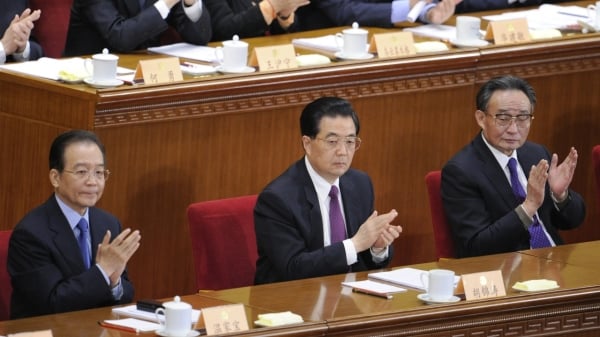
Previously served as a secretary to Wen Jiabao
Tian Xuebin is widely reported to have served as a secretary to Wen Jiabao, China’s premier from 2003 to 2013. In an article titled “Recollections of Premier Wen’s Inspection Tour of Fucheng,” Duo Fangru, former chairman of the CPPCC in Fucheng County, Hebei Province, mentioned Tian as accompanying Wen in his role as secretary.
At the 2004 National People’s Congress, Wen Jiabao once told delegates from Gansu Province’s Huining County, “Huining is a county known for producing top scholars. My secretary is also from Huining.”
As a result, Tian’s downfall has sparked renewed discussion of his identity as a “Wen Jiabao aide.” However, this characterization has been contested online. Some commentators argue that Tian was not Wen’s personal secretary but rather one of many officials holding secretarial positions within the General Office system.
They note that Wen Jiabao’s long-serving chief secretary and administrative manager was Qiu Xiaoxiong, and that Tian never served as a deputy secretary-general, a rank that would have granted closer access to the premier’s inner circle.
Under this interpretation, Tian would be better described as a peripheral or “outer-circle” secretary, with limited involvement in Wen’s core decision-making.

Tian Xuebin’s fall and its ‘deeper’ political implications
Independent political commentator Cai Shenkun wrote on X (formerly Twitter) that political maneuvering ahead of the CCP’s upcoming 21st Party Congress is expected to intensify in 2026. According to Cai, the security and influence of retired senior leaders—known in Chinese politics as “party elders”—may increasingly come under scrutiny.
Among these figures, Wen Jiabao is considered to be in relatively good health and remains influential due to his populist image while in office. He was also notable for being the only premier in recent decades to openly discuss political reform.
Cai argued that the investigation of a longtime associate at the very beginning of the year sends a clear warning: retired leaders who continue to exert influence should not act rashly.
Since the Third Plenum of the CCP’s 20th Central Committee, rumors have circulated suggesting that Xi Jinping’s authority may have weakened. The establishment in July of last year of a “Central Decision-Making and Coordination Body” has been interpreted by some observers as a de facto revival of the now-defunct Central Advisory Commission, potentially sidelining the Politburo Standing Committee led by Xi.
The membership of this body has not been publicly disclosed, and the CCP has offered no official explanation of its role.
An X account known as “Party Faction Commentary” claimed that Tian Xuebin had longstanding ties to Ling Jihua, former director of the CCP General Office during the Hu Jintao era, and later served as a deputy director of the State Council Research Office as well as an aide to Wen Jiabao.
According to this account, if the new decision-making body is indeed controlled by Wen Jiabao, then Tian’s detention would suggest that internal struggles have escalated to a zero-sum confrontation.
The same account further alleged that Tian was connected to the Liu Zhijun corruption case—involving the former railways minister—and had frequent dealings with Ding Shumiao, a businesswoman implicated in multiple high-profile corruption scandals.
Other analysts argue that although Tian’s investigation appears on the surface to be part of China’s ongoing high-pressure anti-corruption campaign, his political background and the timing of the case point to deeper undercurrents. Investigating a Wen Jiabao–era official two years after retirement suggests not only persistent corruption within the water resources system, but also an intensifying power struggle at the highest levels of the Party.

Multiple officials in the water resources system have fallen
In recent years, a number of officials connected to China’s water resources system have been investigated. These include senior figures from the Ministry of Water Resources, its affiliated commissions, and major state-owned water infrastructure projects.
Since the start of 2026, China’s anti-corruption campaign has shown no signs of slowing. On January 4 alone, four centrally managed officials were expelled from the CCP, including former executives from Sinochem and China Eastern Airlines, as well as senior inspection and provincial advisory officials.
According to official CCDI statistics, during the first three quarters of 2025, disciplinary authorities nationwide opened cases against 90 ministerial-level officials, 3,704 bureau-level officials, and tens of thousands of lower-ranking cadres. Hundreds of thousands of individuals across government, rural areas, and state-owned enterprises were disciplined.