By Jingyao Li
From Jan. 12 to 14, the Chinese Communist Party convened the Fifth Plenary Session of the 20th Central Commission for Discipline Inspection (CCDI) in Beijing. Compared with CCDI plenary sessions in previous years, Xi Jinping’s speech at this meeting was markedly shorter—nearly 50 percent shorter than his address two years ago. Notably, he also issued no specific directives or requirements related to anti-corruption work.
Commentators say these changes point to a significant erosion of Xi’s authority over the Party’s anti-corruption apparatus, long regarded as a central pillar of his power. One analyst remarked that the only remaining visible symbols distinguishing Xi from other senior leaders were the two teacups placed before him.
Xi’s speech cut by nearly half
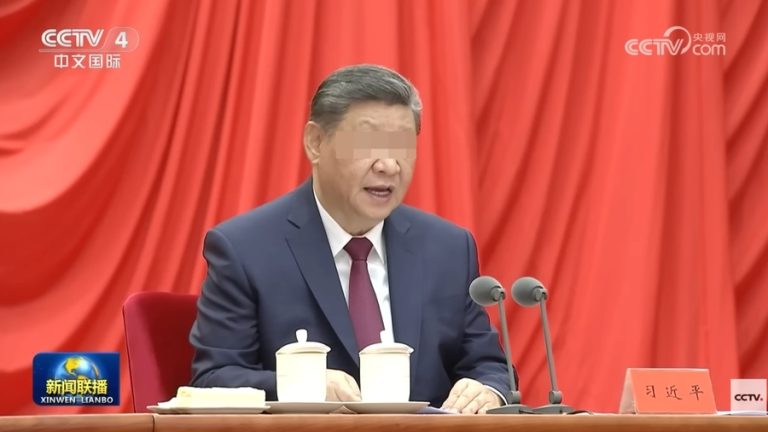
On Jan. 12, Xi Jinping attended the opening session of the Fifth CCDI Plenary Session and delivered a speech. The meeting was attended by the six other members of the Politburo Standing Committee—Li Qiang, Zhao Leji, Wang Huning, Cai Qi, and Ding Xuexiang—and was presided over by CCDI Secretary Li Xi.
Political commentator Li Yanming observed that Xi’s address this year differed from his speeches at the previous Fourth and Third CCDI plenary sessions in four notable respects.
Success
You are now signed up for our newsletter
Success
Check your email to complete sign up
First was the sharp reduction in content. According to official Xinhua News Agency coverage, Xi’s speech consisted of five paragraphs totaling approximately 1,290 Chinese characters.
By contrast, at the Fourth CCDI Plenary Session in January 2025, Xinhua reported Xi’s remarks in ten paragraphs totaling about 1,690 characters. At the Third Plenary Session in January 2024, the report ran to twelve paragraphs and roughly 2,240 characters.
Over the past three years, the length of Xi’s CCDI speeches has steadily declined, with the overall content reduced by nearly half.
No targets or requirements for anti-corruption work
The second change was Xi’s failure to outline concrete objectives or operational requirements for anti-corruption efforts.
In this year’s speech, Xi did not specify any tasks, targets, or enforcement priorities. Instead, he reiterated familiar slogans, such as “the fight against corruption is a major battle we cannot afford to lose and must not lose,” and warned that “the situation in the anti-corruption struggle remains severe and complex.”
This stood in contrast to the Fourth CCDI Plenary Session in 2025, when Xi laid out explicit demands, including focusing investigations on “key problems, key sectors, and key targets,” pursuing both bribe-takers and bribe-givers, and pushing anti-corruption work “down to the grassroots level.”
At the Third Plenary Session in 2024, Xi proposed “grasping nine key issues” and called for harsh punishment of corruption involving collusion between officials and business interests. He also ordered intensified scrutiny of sectors where power, capital, and resources are concentrated, including finance, state-owned enterprises, energy, healthcare, and infrastructure.

No longer exceptional, required to submit to the center
The third change lay in the themes highlighted in Xi’s speech, as reflected in Xinhua’s subheadline. The summary of Xi’s remarks was identical to the title of the CCDI work report delivered later that day by Li Xi.
Xinhua’s subheadline described Xi as calling for advancing anti-corruption efforts “with higher standards and more concrete measures” to safeguard the implementation of the “15th Five-Year Plan.” This wording exactly matched the title of Li Xi’s report.
Such overlap is uncommon. In previous years, Xinhua headlines summarizing Xi’s speeches differed clearly from the titles of Li Xi’s reports. At the Fourth CCDI Plenary Session in 2025 and the Third in 2024, Xi’s remarks emphasized “fighting hard” and “winning” a protracted anti-corruption struggle, while Li Xi’s reports focused on advancing discipline inspection to support what the Party terms Chinese-style modernization or institutional development of supervision mechanisms.
U.S.-based political commentator Chen Pokong interpreted the identical wording as a sign that, following the Third Plenum, the principle of collective leadership has been reasserted. In his view, even Xi must now submit to the Party center, with no individual enjoying a special status above the collective.
No longer in a position to issue directives to the CCDI
The fourth change was that Li Xi, in his own remarks, made no reference to Xi issuing clear instructions or binding requirements for anti-corruption work.
Li Yanming noted that at the Fourth CCDI Plenary Session in 2025, Li Xi explicitly stated that Xi’s speech had “put forward clear requirements” for resolutely waging the tough and protracted fight against corruption. At the Third Plenary Session in 2024, Li Xi said Xi had set out nine specific practical requirements.
At this year’s Fifth Plenary Session, however, Li Xi made no mention of Xi providing any such guidance.
Chen Pokong interpreted this omission as further evidence that “Xi no longer has the standing to issue demands to the CCDI.” He argued that many officials swept up in recent purges were figures personally promoted by Xi. According to Chen, the senior generals brought down in the military all belonged to Xi’s own camp. Xi personally promoted more than 70 generals, he said, and a roughly equivalent number have since fallen. The same pattern, he added, applies to officials removed from Party and government positions.

Authority further weakened, leaving only two teacups
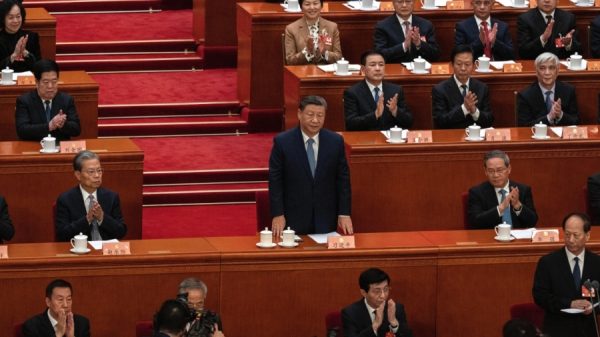
Observers also noted that Xi appeared thinner and more fatigued at this year’s CCDI plenary session. Two teacups were placed on the table in front of him—one apparently containing tea or water, the other medicine—suggesting that his medication could not be interrupted without serious consequences.
At the same time, members of the Politburo seated below him no longer appeared uniformly tense, as they had in earlier years when officials were seen constantly taking notes. Some continued to write, but more were observed looking directly at Xi, creating what observers described as an atmosphere of “watching to see how you perform.”
Taken together, these details reinforced the impression that Xi’s authority has further diminished, leaving the two teacups as the final visible markers of his distinct status.
Li Yanming concluded that, alongside the successive downfalls of senior figures from Xi’s own faction, the Fifth CCDI Plenary Session displayed multiple anomalies. The sharp shortening of Xi’s speech, his failure to articulate concrete anti-corruption goals, and the absence of references to his directives suggest that, after losing control over the military and personnel appointments, Xi may now have been stripped of authority over anti-corruption work as well.