China’s Belt and Road Initiative (BRI)—a sweeping global infrastructure program launched by Beijing in 2013 and promoted as a cornerstone of China’s overseas influence—has long been framed as a win-win model of development. Yet a growing body of reporting by foreign media paints a far darker picture: one marked by fatal accidents, chronic delays, mounting debt, and public backlash across multiple continents.
One of the latest flashpoints is the China–Thailand high-speed railway, a project long touted by Chinese officials as a flagship BRI success. In January, it became the site of a deadly industrial disaster involving a joint venture between Italian-Thai Development Public Company Limited (ITD) and the Thai subsidiary of China Railway No. 10 Engineering Group, a state-owned Chinese construction firm. South Korean media report that this case is far from isolated, pointing instead to a troubling pattern of safety failures across BRI projects worldwide.
China–Thailand high-speed rail accident leaves 32 dead
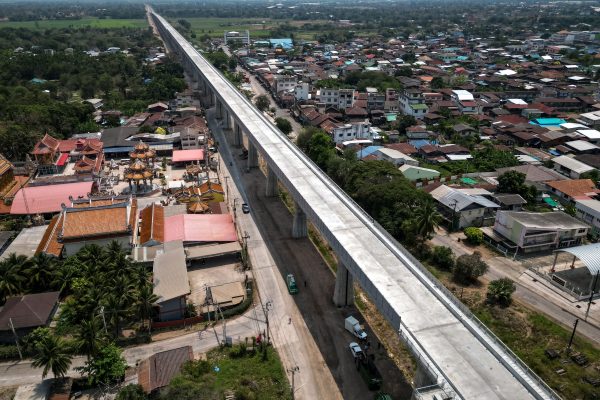
South Korea’s Chosun Ilbo reported that the China–Thailand high-speed railway, which broke ground in 2017, has been beset by funding shortages and frequent design changes since its inception. Originally scheduled for completion in 2021, the project’s timeline has now been pushed back to 2030—a delay of nine years.
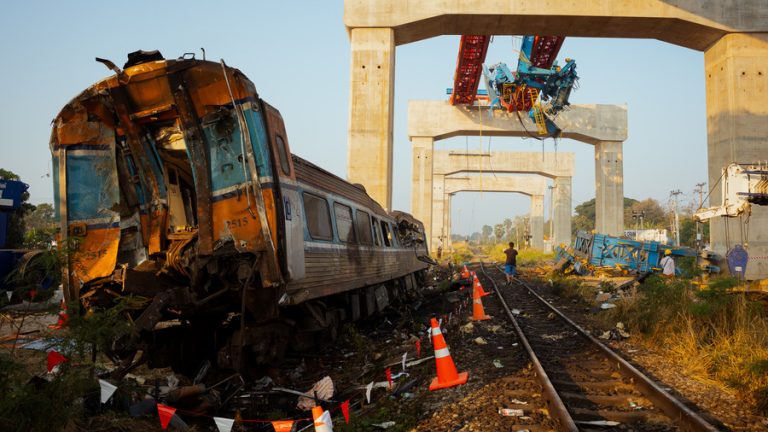
On Jan. 14, at a construction site in Nakhon Ratchasima Province, a critical segment of a Chinese-backed rail corridor envisioned as part of the Pan-Asia Railway network, a massive crane suddenly collapsed. The crane struck a passing passenger train, causing it to derail and sustain catastrophic damage. Of the nearly 200 passengers on board, as many as 32 were killed.
Less than 24 hours later, the same contractor was involved in another crane collapse—this time at an expansion site on Bangkok’s Rama II Expressway, a major southern artery. While the second incident was not part of the BRI, Thai media emphasized that the contractor was the same ITD–CREC joint venture implicated in the deadly rail accident the previous day. The back-to-back failures triggered widespread public outrage and renewed scrutiny of Chinese-linked infrastructure projects in Thailand.
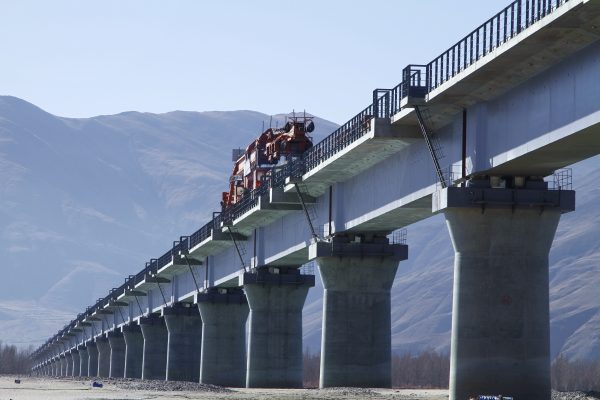
Indonesian high-speed rail derailment kills two workers
Success
You are now signed up for our newsletter
Success
Check your email to complete sign up
Comparable incidents have been reported elsewhere in Southeast Asia. Indonesia’s Jakarta–Bandung high-speed railway, another signature BRI project, spans 140 kilometers and was completed in 2023. From the outset, however, construction problems plagued the line, creating political and financial risks for the Indonesian government.
In December 2022, during a state visit by Chinese leader Xi Jinping, the railway was prominently showcased with a test ride intended to symbolize Sino-Indonesian cooperation. Just two months later, a derailment occurred during trial operations, killing two workers.
The project was also marred by land acquisition disputes and repeated delays, which drove up costs and increased the state’s financial burden. Public dissatisfaction grew steadily. In October of last year, Indonesia’s Corruption Eradication Commission launched a formal investigation into the project, signaling that the controversy had moved beyond technical failures into the political realm.
Laos–China railway controversy and mounting debt
The Laos–China railway, which began operations in 2021, has likewise drawn sustained criticism. During construction, an estimated 7,000 households were reportedly forced to relocate, often with limited compensation. Tensions between Chinese workers and local residents persisted throughout the project, while reports of pollution leaks near Vang Vieng—a major tourist destination—raised alarm over environmental damage.
Financed through a joint venture in which China holds a 70 percent stake, Laos relied heavily on loans from Chinese banks to cover its share. Analysts warn that this financing structure has left the country dangerously exposed. According to The Straits Times, while the railway has brought an influx of Chinese tourists, Laos remains burdened by heavy debt, fueling economic uncertainty and contributing to an increase in outward migration as citizens seek opportunities abroad.
Kenya’s modern railway strains the economy
In Africa, similar patterns have emerged. Kenya completed a modern railway under the BRI framework in 2017, linking the port city of Mombasa with the capital, Nairobi. Eight years later, the project has become a growing strain on the national economy.
Kenya’s debt to China has risen to approximately $9.6 billion, with repayment obligations this year alone reaching $1 billion. Funding shortages have delayed the second phase of the railway, leading many Kenyans to deride it as a “railway to nowhere”—a costly symbol of unmet promises rather than economic transformation.
Serbian station collapse kills at least 15
Europe has not been spared. In November 2024, a major industrial accident occurred in Serbia when a concrete canopy outside a railway station in Novi Sad, the country’s second-largest city, collapsed, killing at least 15 people. The station had recently been renovated as part of a BRI-linked rail modernization project carried out by a Chinese contractor.
The deadly collapse came just five months after the station reopened. It triggered widespread public anger, with citizens questioning both construction quality and government oversight. What began as demands for accountability soon escalated into months-long anti-government protests. Under mounting political pressure, Serbian Prime Minister Miloš Vučević announced his resignation in January last year.
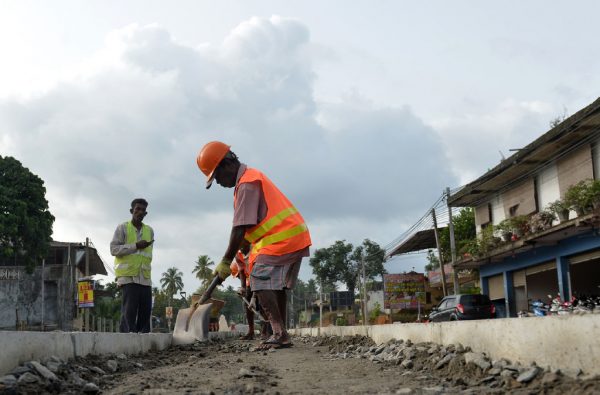
China–Kyrgyzstan–Uzbekistan railway stalled for decades
As skepticism deepens over BRI railway projects—many of which suffer chronic delays or fail to progress beyond planning stages—the China–Kyrgyzstan–Uzbekistan railway stands as a telling example.
The proposed line, roughly 523 kilometers long, would run from Uzbekistan through Kyrgyzstan before connecting to Kashgar in China’s Xinjiang region. Although a groundbreaking ceremony was held late last year, the project’s origins trace back to a 1997 memorandum of understanding among the three countries. Beijing has long labeled it a core BRI undertaking.
For nearly three decades, however, disputes over cost-sharing and concerns that the route could facilitate drug trafficking and militant activity repeatedly stalled progress. Despite the recent ceremonial launch, many observers remain skeptical that the railway can be completed by its stated 2030 deadline.
Experts cited in the foreign media reports argue that the Belt and Road Initiative is not merely a geopolitical effort to counter a U.S.-led international order, but also a mechanism for exporting China’s excess industrial capacity and surplus labor. In promoting what Beijing describes as a “Chinese model of development,” these experts contend, Chinese firms and authorities have often sidelined institutional safeguards, construction standards, and risk management—failures that have repeatedly surfaced in the form of deadly accidents and public scandals.
Taken together, these incidents highlight persistent structural problems facing the Belt and Road Initiative, particularly in railway construction. Rail projects sit at the heart of Beijing’s global infrastructure ambitions, yet accidents during construction and failures during operation continue to emerge with troubling regularity—leaving behind not only unfinished tracks, but also a growing trail of human and political cost.
Editor’s Note: This article is based on reporting by foreign media outlets and publicly available information. Casualty figures, project assessments, and evaluations of China’s Belt and Road Initiative (BRI) cannot be independently verified and are presented as reported by the cited sources.