By Fu Longshan
To understand the true nature of Chen Yun and Li Xiannian—two of the Chinese Communist Party’s most enduring political “roly-polies” (不倒翁)—one cannot rely on officially sanctioned Party histories. One must enter the sealed power chambers behind the red walls of Zhongnanhai, where real decisions are made and survival is engineered.
Why did they survive every political campaign? Why were they neither toppled nor physically destroyed, even during the bloodletting of the Cultural Revolution? And how did they emerge afterward not only intact, but as decisive kingmakers at the very center of power?
Chen Yun and Li Xiannian did more than survive Mao’s purges. In the post–Cultural Revolution era, they became the hidden architects of leadership succession in Zhongnanhai—true “makers of kings.” Their longevity rested not only on revolutionary credentials, but on cold, precise political calculation. The logic of their survival can be summarized in several key dimensions.
Chen Yun: the Red Dynasty’s chief steward and the ‘Birdcage Economy’
Among Communist Party elders, Chen Yun occupied a singular position. He was the only figure who could stand on nearly equal footing with both Mao Zedong and Deng Xiaoping. His power came from absolute control over two lifelines of the regime: the purse strings and the grain supply.
Success
You are now signed up for our newsletter
Success
Check your email to complete sign up
During the Cultural Revolution, Liu Shaoqi was purged and Lin Biao was destroyed. Yet Mao Zedong never removed Chen Yun. According to accounts circulating within the Party, when China’s economy teetered on the edge of collapse, Mao once remarked bitterly: “When it comes to economic work, Chen Yun still has the methods.”
Chen Yun famously advocated the “birdcage economy” (鸟笼经济): the market could exist, but only as a bird confined within the cage of central planning. This formula—never abandoning socialism while allowing limited economic oxygen—became the Communist Party’s refuge in every systemic crisis. It was not reform for freedom, but reform for regime survival.
Equally important was Chen Yun’s mastery of political withdrawal. When factional struggles reached a fever pitch, he would routinely “fall ill,” retreating from the front lines. This tactic of non-struggle as struggle allowed him to evade countless political whirlpools while others were destroyed.
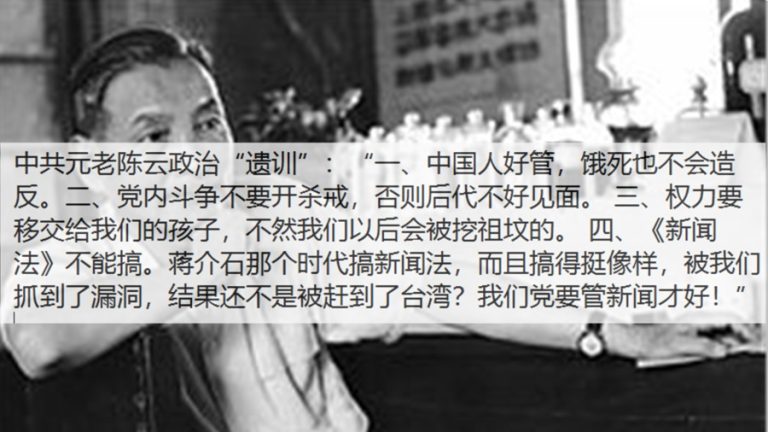
Chen Yun is also remembered for several blunt statements that revealed his worldview: “The country was won by us.”
“Our own children are the most reliable; successors won’t dig up our ancestral graves.”
These words did more than protect his own position. They opened the door for the “red second generation”—the children of revolutionary elites—to take full control of state-owned enterprises and the political system. Chen Yun became, in effect, the patron saint of the princeling class (太子党), laying the ideological foundation for hereditary power within a nominally revolutionary party.
Put plainly, Chen Yun was the spokesperson for the collective interests of China’s ruling elite. Once this is understood, it becomes clear why he enjoyed such extraordinary political durability.
Li Xiannian: The regime’s craftiest survivor
If Chen Yun was the regime’s chief steward, Li Xiannian was its most cunning political survivor.
One of the very few leaders who held high office continuously from the early Cultural Revolution through the Jiang Zemin era, Li owed his survival in part to the personal protection of Zhou Enlai. As long-time vice premier and finance minister, Li was Zhou’s most trusted executor of state affairs.
Li Xiannian never chose the wrong side. When Mao moved to destroy someone, Li neither led the charge nor openly opposed it. When Deng Xiaoping returned to power, Li was among the first elders to declare support. During the arrest of the Gang of Four in 1976, he played a crucial behind-the-scenes liaison role—another contribution later credited as having “saved the Party.”
Li’s most consequential intervention came during the rise of Jiang Zemin. Internal accounts suggest that Jiang’s ascent was not Deng Xiaoping’s first choice, but the result of bargaining between Chen Yun and Li Xiannian.
While serving in Shanghai, Jiang Zemin cultivated Li with almost servile devotion. According to persistent accounts, Jiang once stood for hours in heavy snow simply to deliver a cake to Li Xiannian during the Lunar New Year. This display of personal loyalty paid dividends. At an elders’ meeting, Li reportedly vouched for Jiang: “Comrade Jiang Zemin is politically reliable, understands the economy, and—most importantly—listens.”
Chen Yun, for his part, valued Jiang’s rigid Party discipline and his decisive suppression of the liberal World Economic Herald in Shanghai. To Chen, Jiang was a system conservative who would “not make big moves”—precisely what the birdcage economy required.
Deng Xiaoping initially leaned toward Li Ruihuan or continued observation. But to secure the elders’ backing—especially their acquiescence to using the military—Deng ultimately accepted Jiang Zemin. This explains why, in his early years, Jiang was forced to oscillate carefully between Chen Yun and Deng Xiaoping.
‘Rule by the Eight Elders:’ The dark logic of elite stability
The enduring power of Chen Yun and Li Xiannian rested on a grim but stable internal logic—a balance of terror combined with class consensus. From this angle, it also becomes easier to understand why they were never “tortured to death” the way Liu Shaoqi was.
1. Control of the system’s core codes
Both men controlled vital institutional levers. Chen Yun knew every senior cadre’s résumé and vulnerabilities. Li Xiannian controlled the state’s operating funds. To remove either man would have meant dismantling the Party’s skeletal structure.
2. Pillars of factional balance
Although Deng Xiaoping was the paramount leader, power functioned as a three-headed arrangement: Deng cleared the path through reform, Chen applied the brakes to ensure no departure from socialism, and Li handled coordination and execution. Any attempt to destroy one pillar risked capsizing the entire regime.
3. The post-Mao elite pact: ‘Fight without breaking’
After the Cultural Revolution, top Party elders reached an unspoken contract: internal struggles would no longer involve physical annihilation at the highest level. Everyone knew each other’s dark histories—from wartime stains to economic problems. The new rule was simple: fight over policy, not bodies; no purges, no family destruction. This collective security pact became their immunity talisman.
According to non-official Party accounts, during the 1989 crisis Chen Yun and Li Xiannian held a secret meeting in Beijing’s Western Hills. Their consensus was unequivocal: “We must not retreat. Retreat means the red regime cannot be preserved.”

The legacy they left behind
Chen Yun and Li Xiannian are long dead, but the system they built remains fully operational.
Chen Yun left behind an extremely conservative political censorship apparatus and a monopolistic structure binding politics and economics into one. Li Xiannian left a tradition of factional spoils-sharing and the powerful “Shanghai clique” centered on Jiang Zemin.
They were “roly-polies” and “kingmakers of Zhongnanhai” for one fundamental reason: they valued the Communist Party’s signboard above all reform. They were the firewall of China’s authoritarian system.
As long as the Chinese Communist Party seeks to maintain dictatorship, and as long as elite interests depend on extracting wealth beneath the Party’s red banner, Mao Zedong’s giant portrait will remain hanging over Tiananmen—and the political spirits of Chen Yun and Li Xiannian will continue to be venerated.