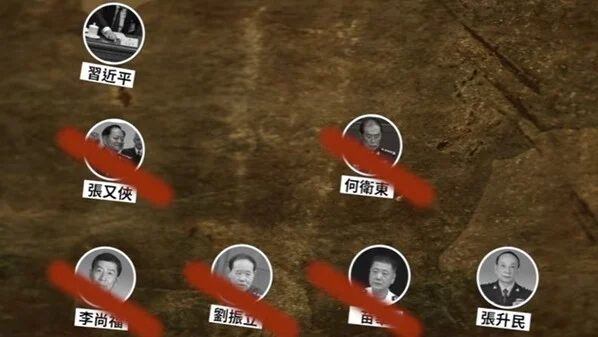
An unprecedented announcement—and abrupt retraction—of a Central Military Commission purge has exposed severe fractures at the apex of the Chinese Communist Party. The disappearance of an official disciplinary notice points not to consolidation of power, but to a dangerous escalation in Xi Jinping’s struggle with the military elite.
By Chen Jing
A Political Earthquake—and a “Ghost Announcement”
Beijing was shaken yesterday by what observers describe as the most dramatic political upheaval in years. Without warning, the Chinese Communist Party (CCP) announced that Zhang Youxia, vice chairman of the Central Military Commission (CMC), and Liu Zhenli, a CMC member, were under investigation for “serious violations of discipline and law.”
What initially appeared to be a swift, decisive purge quickly descended into a political Rashomon. A string of bizarre publish-and-delete maneuvers across official websites turned the episode into an enigma that has stunned veteran China watchers. Analysts argue that this unprecedented propaganda breakdown not only violates long-established CCP norms for purging senior officials, but also exposes a seismic power struggle inside Zhongnanhai. Xi Jinping’s confrontation with entrenched military power brokers has failed to establish unchallenged authority—and may instead have triggered a backlash edging toward a failed mutiny.
An Unprecedented Publicity Breakdown
On the afternoon of January 24, Beijing time, China’s propaganda system staged an almost farcical display, laying bare deep confusion and factional conflict at the top.
- 3:00 p.m.: The Ministry of National Defense website published a bombshell notice titled “Zhang Youxia and Liu Zhenli Placed Under Investigation for Serious Violations of Discipline and Law.”
- 3:10 p.m.: The ministry followed up with a statement by spokesperson Jiang Bin, formally confirming the purge and attempting to cement the narrative.
- 3:50 p.m.: The Central Commission for Discipline Inspection–National Supervisory Commission (CCDI–NSC), the CCP’s highest internal disciplinary body, reposted the identical notice on its official website.
Success
You are now signed up for our newsletter
Success
Check your email to complete sign up
Then came the most disturbing turn. Within minutes, the CCDI link vanished. Readers were greeted by a blunt message: “The content you are trying to access does not exist or has been deleted.”
This “instant deletion” sent shockwaves through the observer community. Veteran journalists pointed out that under CCP propaganda discipline, every word of an announcement involving a figure of Zhang Youxia’s stature—a Politburo member and CMC vice chairman—must be vetted by the Politburo Standing Committee. There is no plausible scenario in which such a notice could be accidentally released or quietly withdrawn because of a technical error.
The episode directly contradicts the CCP’s established playbook for high-level purges. In previous cases—from Zhou Yongkang to Guo Boxiong and Xu Caihou—the authorities relied on a slow, methodical “peeling the onion” strategy: months or even years of enforced disappearance and internal control before any public disclosure, once outcomes were fully locked in. By contrast, rumors surrounding Zhang Youxia circulated outside China for only days before the regime rushed to announce an investigation—only to have the CCDI apparently retract its own statement.
Analysts see only two credible explanations. One is a preemptive strike gone awry: Xi Jinping sought to create a fait accompli by abruptly announcing the purge in order to strip Zhang and Liu of military authority, only to encounter fierce resistance from the propaganda system or higher levels of power. The other is far more ominous: anti-Xi forces may be mounting a coordinated counteroffensive, even seizing partial control of official channels, producing fatal contradictions in the party line. Chinese netizens mocked the spectacle with dark humor: “Two factions are fighting over the keyboard—an online prison break in progress.”
Breaking the “Red Aristocrat” Pact
Commentator Wen Rui argues that this announcement marks Xi Jinping’s decisive rupture with the final tacit understanding binding him to the CCP’s elite. By moving against Zhang Youxia, Xi has pried open a destructive “Pandora’s box.”
Zhang is no ordinary general. He sits at the intersection of three formidable power blocs, each capable of shaking the party’s foundations.
A Vast Military Network
Zhang Youxia has spent more than fifty years in uniform. His father, Zhang Zongxun, was a founding general of the People’s Liberation Army (PLA), and the Zhang family has cultivated military influence for nearly a century. Protégés and allies are embedded throughout the armed forces. Xi’s move amounts to a “better kill a thousand by mistake” gamble, pushing not only the Zhang faction but a large segment of the military high command into open opposition.
The Last Line of Defense for the “Red Second Generation”
As the highest-ranking “princeling” (hong erdai) in the PLA, Zhang’s fall signals the collapse of the group’s long-assumed immunity. With their “golden amulet” shattered, princeling networks may see a life-or-death confrontation with Xi as their only remaining path to survival.
A Backlash from Party Elders
Xi’s relationship with retired party elders has long been strained. Purging Zhang Youxia will be widely interpreted as a final liquidation of the elders’ political legacy, virtually guaranteeing a comprehensive and explosive confrontation.
The CMC leadership is now close to paralysis. Of its seven members, only Chairman Xi Jinping and discipline chief Zhang Shengmin remain nominally in place, with only a handful of active-duty full generals still serving. Wen Rui likens Xi’s gamble to “a snake trying to swallow an elephant”—a reckless, all-or-nothing move that may herald the collapse of CCP rule itself.
Taiwan, Internal Dissent, and a “Soft Coup”
What drove former allies into open confrontation? Deeper explanations have emerged from Shen Mingshi of Taiwan’s Institute for National Defense and Security Research and Australia-based journalist Jiang Wangzheng.
According to these accounts, the immediate trigger was a sharp split over the use of force against Taiwan. Sources cited by The Epoch Times claim that Zhang Youxia strongly opposed launching an imminent military assault. Based on professional military assessments, he warned that Taiwan’s defenses surpass those of Ukraine and that the likelihood of intervention by the Five Eyes intelligence alliance is extremely high. A hasty war, he argued, would mire the PLA in a prolonged conflict and risk domestic instability. Xi Jinping, impatient for decisive action, reportedly dismissed such assessments as “undermining military morale.”
Other analysts suggest that Zhang Youxia and Liu Zhenli may have attempted to leverage their command authority ahead of upcoming political meetings to force Xi to step down or accept power-sharing—amounting to a “soft coup.” After obtaining evidence of this challenge, Xi resorted to extreme intra-party purges. What he appears to have gravely underestimated was the depth of resistance within the military.
Armed Confrontation in Beijing?
As official notices vanished and information devolved into chaos, explosive rumors began circulating from a well-known whistleblower known as “Old Lantern.” While these claims cannot yet be independently verified, they align disturbingly well with the CCDI’s visible panic.
According to these reports, events did not unfold as Xi intended, but instead escalated into armed confrontation.
- A Midnight Raid: On January 19, special units under Public Security Minister Wang Xiaohong allegedly launched a nighttime operation to detain Zhang Youxia and his family, surrounding the August 1 Building—the PLA’s headquarters—and briefly arresting seventeen senior officers.
- A Lightning Rescue: Liu Zhenli reportedly evaded capture and led an elite detachment of the 82nd Group Army in a rapid rescue operation on Beijing’s highways, successfully transferring Zhang to a combined-arms brigade base in Changping.
- Return to the Core: The most startling claim is that Zhang Youxia, under military protection, has since returned to the August 1 Building and resumed command, with PLA units now locked in a tense standoff with Wang Xiaohong’s security forces.
If these reports are accurate, Beijing has become a powder keg.
Xi Jinping’s “Lin Biao Moment”
The CCDI’s “disappearing notice” may mark the first domino in a broader collapse of CCP authority. Xi Jinping’s attempt at a preemptive lightning purge appears to have underestimated both the strength and the resolve of his opponents.
If reports of Zhang Youxia’s rescue and return to command prove true, this is no longer a routine party purge but the opening act of a de facto military coup—or the prelude to internal armed conflict. Far from asserting his dominance, Xi may have sealed his own fate through a failed political gamble. With the PLA’s command structure fractured and in disarray, the coming days could bring upheavals in Beijing—and across China—that stun the world.
With the official announcement of Zhang Youxia’s fall as the CCP’s de facto number two, Xi Jinping’s own exit may not be far behind. Regardless of who ultimately prevails, the foundations of CCP rule have already been shattered by this internal struggle.
History offers a stark lesson. Every dictator who has sought to centralize power by purging core allies has ended in isolation and ruin. The Lin Biao Affair marked the beginning of Mao Zedong’s fall from his pedestal. The Zhang Youxia affair may well become Xi Jinping’s own “Lin Biao moment.”