By Li Jingyao, Vision Times
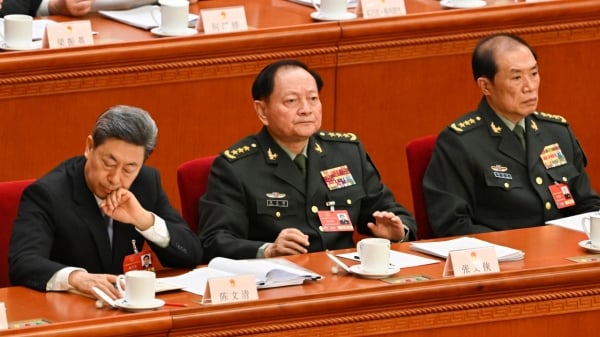
On Jan. 24, Chinese authorities announced that Politburo member and Central Military Commission (CMC) Vice Chairman Zhang Youxia, along with CMC member and Joint Staff Department Chief Liu Zhenli, were placed under investigation for “serious violations of discipline and law.” The Politburo serves as the top ruling body within the Chinese Communist Party (CCP).
Analysts say the sweeping purge has left elites on edge. While it may consolidate Xi Jinping’s power, it also injects uncertainty into China’s military and political decision-making. With Zhang removed, Xi has lost a seasoned commander known for speaking candidly, thereby raising the risk of “strategic misjudgment.”
RELATED: Who Comes After Zhang Youxia? Inside Xi Jinping’s Military Purge and Power Consolidation
CCP elites on edge
Former CIA official Dennis Wilder told Bloomberg Television’s Insight that Zhang’s downfall carries far-reaching implications for Xi’s grip on power. Wilder described the move as one of the largest shakeups of senior PLA leadership since Xi took office — one likely to unsettle party elites and amplify concerns about Xi’s methods.
Success
You are now signed up for our newsletter
Success
Check your email to complete sign up
According to Wilder, Xi’s campaign now spans the military, the Party, and business circles, complicating succession calculations beyond 2027 and fueling internal doubts about whether Xi will continue in office.
Brookings Institution analyst Jonathan Czin said the purge has reached the “asteroid belt” of Xi’s political solar system, meaning that even deep personal ties no longer provide protection. In short, everyone is vulnerable.
At the PLA’s Military Discipline Inspection Commission expanded meeting in 2026, CMC Vice Chairman Zhang Shengmin said last year’s anti-corruption drive had achieved “significant results,” and pledged to advance the campaign in 2026 “with higher standards and more concrete measures,” maintaining “high pressure” against corruption. The message signaled that further senior-level purges are likely.
Implications for Taiwan
Czin and Neil Thomas of the Asia Society agree the shakeup has complex implications for the Taiwan Strait. A sweeping purge suggests Xi is unlikely to pursue a near-term military escalation. With the seven-member CMC effectively reduced to two (Xi and Zhang Shengmin) and command chains “hollowed out,” the PLA needs time to “clear the runway” and rebuild systems, making short-term adventurism risky and difficult to control.
Wilder noted Zhang Youxia’s extensive influence and loyal following. Replacing the CMC wholesale and elevating new commanders could disrupt morale and the chain of command. In the short run, this likely dampens PLA options against Taiwan; over the longer term, it could distort leadership decision-making.
Texas’s Sam Houston State University professor Yung Li‑Wen warned that once the purge ends, the next generation of commanders may lack Zhang’s battlefield experience and willingness to voice dissent, rendering Beijing’s Taiwan policy more unpredictable and potentially more aggressive.
Regionally, Wilder cautioned Xi may compensate by taking a harder line in the South China Sea to demonstrate readiness, while remaining highly sensitive to Japan’s military posture.
Purges stack up
Former Pentagon China desk chief Drew Thompson, now a senior visiting fellow at Singapore’s Lee Kuan Yew School of Public Policy, wrote that Zhang’s removal is more than an internal purge: it deprives Xi of the one military adviser with combat experience who dared to speak plainly.
Thompson recalled accompanying Zhang during a May 2012 U.S. visit when Zhang served as commander of the Shenyang Military Region. While other officers recited slogans, Zhang stood out for professionalism and confidence. At Fort Benning, he alone showed keen interest in weapons systems by personally firing an M240 machine gun and posing sophisticated tactical questions. Thompson also described Zhang as having “an aura of competence, where other PLA officers would stand straighter and respond faster around him.”
Because Zhang combined intelligence, battlefield experience, and a longstanding personal connection to Xi, Thompson argued, he could objectively assess U.S. and Taiwan capabilities and honestly report the PLA’s weaknesses and the costs of war.
With Zhang gone, Xi risks being surrounded by “good-news-only” reporting, skewing assessments of an attack on Taiwan and raising the danger of strategic miscalculation.
Editorial note: Views expressed in this article are the opinions of the author and do not necessarily reflect the views of Vision Times.