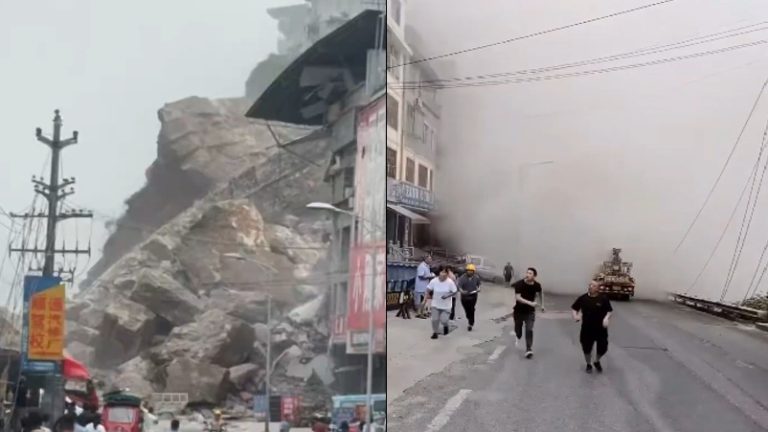
A steep, rocky slope collapsed onto a riverside neighborhood in southwest China on the morning of July 17, burying several occupied apartment buildings and, according to residents, a passing coach. State media reported ten people pulled from the rubble alive, but neighbors who watched the disaster said far more buildings came down than the official account acknowledged. The collapse landed in the middle of a rainy season that has already produced one deadly landslide in China this month, and it came hours before forecasters warned of severe storms across the region.
The slope failed at around 9:10 a.m. on July 17 in the Sanqiao area of Pengshui County, part of Chongqing, the sprawling municipality in southwestern China. The buildings stood along the Wujiang River, a major tributary of the Yangtze, in the county seat’s Hanjia subdistrict.
Chinese outlet The Paper reported that multiple homes were buried and people were trapped. Other on-the-scene reports described somewhere between a dozen and twenty buildings knocked down, with some tumbling into the river below. Photographs and video from the site showed a field of shattered concrete where a row of buildings had stood. By midday the area had lost water and power, roads were blocked, and residents had been moved to safety.
Most of the buildings were the same kind common along riverbanks in the region: ground floors given over to shops selling construction materials, with families living in the apartments stacked above.
Residents describe repeated collapses ‘like an explosion’
According to The Paper, a worker at a furniture mall next to the site, identified by his surname Wang, said he was inside the building when he heard a loud bang, ran out, and saw that the hillside had come down and crushed the buildings beside him. “There were several of them, roughly five or six stories each, and people lived there,” he said. He saw that people had been buried but did not know how many. Fire trucks and ambulances had arrived by the time he and others reached safety.
Success
You are now signed up for our newsletter
Success
Check your email to complete sign up
A shopkeeper near the collapse told local media that the failure came minutes after he had walked a customer past the spot to a warehouse. The buried section sat two or three buildings away from his own, he said, and roughly four and a half buildings were completely covered. “The ground floors were all building-materials stores, with residents upstairs,” he said. “Each building was at least five or six stories. People were buried. I don’t know how many. I heard a bus was buried underneath.”
A local resident surnamed Hu, whose home is a few kilometers away, told another local outlet that he heard the same loud bang and rushed over to find rescuers already stringing up a cordon and carrying at least one survivor toward a hospital. A city bus driver surnamed Chen said he watched the slope give way from two or three hundred meters (about 700 to 1,000 feet) off. “I was driving past, and I heard a boom,” he said. “It felt like the ground was shaking.”
Several residents said the site sat next to a fireworks and firecracker factory, and that the rock came down with a roar that many first mistook for a blast. Xie Shanshan, who lives near Sanqiao, told local reporters that the hillside collapsed several times in succession. In her account, an earlier explosion had loosened the ground, and the slope then came apart in stages. “After the blast, the geology was already loose, and then it kept sliding down bit by bit,” she said. Her claim about the cause has not been confirmed by any official investigation.
Residents were consistent on one point that cuts against the idea of a rain-triggered slide: the days before the collapse had been clear. One shopkeeper said the region had been sunny, with only a little light rain the previous evening, and that the slope directly behind the buildings was steep and made of bare rock. Xie put the number of collapsed buildings at twelve or thirteen, and, like others, said a passing coach had been pinned somewhere beneath them.
READ MORE:
- Guangxi Flood Disaster Raises Questions Over Infrastructure, Emergency Response
- Guangxi Flood Survivors Call Dam Collapse a Man-Made Disaster, Dispute Official Death Toll
- As Guangxi Flood Victims Waited for Rescue, Beijing Announced New Aid to Venezuela
State media reported eight rescued, and no deaths
China News Service, a state-run news agency, reported that as of 11:38 a.m. Beijing time, rescuers had pulled ten trapped people from the debris and taken them to hospitals, with none said to be in life-threatening condition. The search, it said, was continuing.
That update described only rescues and named no fatalities, even as residents on the scene spoke of many buildings brought down, an unknown number of people buried, and a bus somewhere under the rubble. The gap between the two pictures, an official tally of ten recovered and residents’ accounts of a far larger disaster, was still unresolved as rescue work went on.
Heavy rain warnings, and a second deadly landslide this month
The collapse arrived as forecasters warned of severe weather bearing down on Chongqing. China’s weather service predicted a band of heavy rain moving west to east across the municipality from the early hours of July 17 through the morning of July 19, with bursts of intense rainfall reaching 60 to 90 millimeters (2.4 to 3.5 inches) an hour, thunderstorm winds of force eight to ten on the Beaufort scale, roughly 40 to 60 miles per hour, and the heaviest rain overnight on July 17, when some areas were expected to see 50 to 130 millimeters (2 to 5 inches). From 10 a.m. on July 17, Chongqing authorities activated a municipal level-IV flood response, the lowest tier in China’s four-level emergency system, for 25 districts and counties, including Chengkou, Kaizhou, and Pengshui.
The Pengshui collapse follows a far deadlier slide earlier in the month. Before dawn on July 7, a hillside collapsed in Ren’zang village, in the town of Nanhe in Dangchang County, part of Longnan in Gansu Province, in China’s northwest. Thirty-three people were initially reported missing. By the morning of July 8, local authorities said the search had ended, with 21 people dead, 7 slightly injured, and 5 unharmed.