By Lu Yixin
A “Cross–Strait Exchange and Cooperation Prospects Forum,” jointly organized by think tanks affiliated with Taiwan’s Kuomintang (KMT)—the island’s main opposition party—and the Chinese Communist Party (CCP), China’s ruling party, is scheduled to open in Beijing on Feb. 2. The announcement has ignited controversy in Taiwan after media reports cited national security officials who alleged the forum was contingent on the KMT’s cooperation in blocking key defense spending—specifically U.S. arms purchases—inside Taiwan’s Legislative Yuan, the island’s unicameral parliament.
The KMT has categorically denied the accusation. Human rights activists and China critics, however, argue that the episode underscores a deeper reality: Beijing’s political leverage in Taiwan now extends far beyond formal party-to-party channels and no longer depends on the KMT’s elite mediation.

A repackaged KMT–CCP forum
According to Liberty Times and Newtalk, two Taiwan-based media outlets, the Feb. 2–4 event is effectively a rebranded version of the long-running “KMT–CCP Forum,” now recast as a think tank–level exchange. Both the KMT and the CCP announced the forum simultaneously on the morning of Jan. 28.
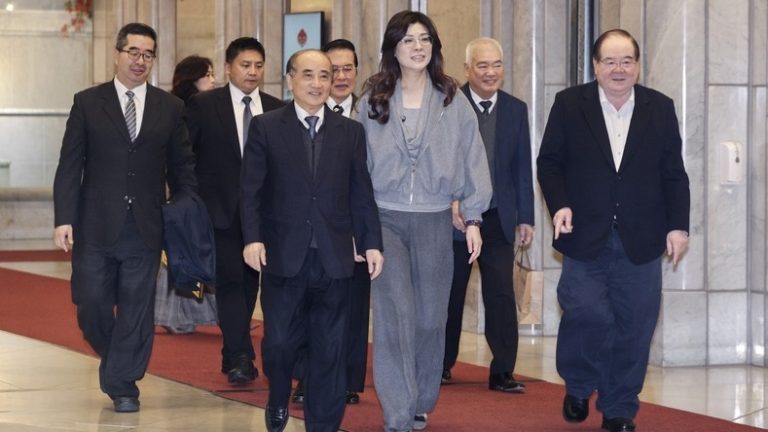
Hsiao Hsu-tsen, a vice chairman of the Kuomintang and a senior party spokesperson, and Lee Hong-yuan, deputy chairman of the National Policy Foundation, the KMT’s official think tank, held a press conference to address mounting criticism.
Success
You are now signed up for our newsletter
Success
Check your email to complete sign up
Hsiao stressed that all cross–strait interactions are conducted on the basis of “mutual trust.” He said KMT delegations traveling to China routinely interact with senior figures there and, as guests, follow the host’s arrangements. He added that there is currently no confirmed itinerary for Cheng Li-wen, the current chairwoman of the Kuomintang, to visit mainland China.
Taiwan is officially known as the Republic of China (ROC), which used to govern the entire country before being defeated on the Chinese mainland by the the CCP. Communist China claims Taiwan as a rightful part of its territory, while the vast majority of Taiwanese prefer their current government system.
Lee Hong-yuan framed the forum as narrowly focused on “livelihood and public policy issues,” not politics. He pointed to disaster-prevention cooperation during the Ma Ying-jeou administration—when Ma served as Taiwan’s president from 2008 to 2016—as evidence of past success, arguing that the forum should build on that experience to address climate change, natural disasters, and energy, which he described as pressing challenges for Taiwan.
The delegation, Lee said, will visit Tsinghua University in Beijing, one of China’s most elite state universities. While acknowledging that Chinese research capacity exceeds Taiwan’s in many fields, he argued that Taiwan also has distinct strengths. Exchange on non–national-security technologies, he said, could produce “win-win outcomes” and sustain the type of interaction seen during previous KMT governments.
Hsiao confirmed that Lee will lead a group of roughly 40 experts and scholars drawn from sectors including tourism, disaster prevention, and precision machinery. Lee emphasized that the group consists almost entirely of academics and professionals, with “virtually no politicians,” portraying the forum as “highly professional and pragmatic.”
Allegations of blocking arms purchases
The controversy intensified after Liberty Times reported on Jan. 27 that Beijing, operating through its Taiwan Affairs Office—the CCP body responsible for policy toward Taiwan—had conveyed explicit conditions to the KMT.
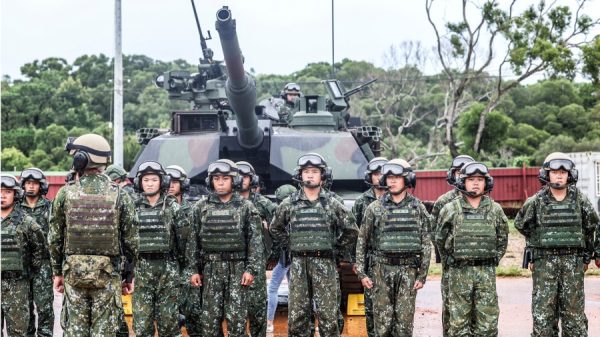
According to the report, the CCP proposed a phased arrangement for the forum on the understanding that the KMT would successfully block the Legislative Yuan from advancing a special defense budget bill tied to U.S. arms sales, a key pillar of Taiwan’s military deterrence strategy. The report further alleged that Beijing demanded continued obstruction of future arms procurement and a commitment to prevent Taiwan–U.S. supply-chain cooperation following tariff negotiations.
Hsiao dismissed the report outright, calling it a fabrication and confirming that the KMT has formally sued Liberty Times. He said preparations for the forum had been underway for months and involved detailed discussions of issues of mutual concern, “with absolutely no political content.”
He accused unnamed “national security sources” of hiding behind the media while inventing stories under the guise of “authoritative Chinese channels.” Hsiao urged the ruling Democratic Progressive Party (DPP)—Taiwan’s current governing party, known for its pro-sovereignty stance—to “show restraint” and stop politicizing cross–strait exchanges, arguing that cooperation on livelihood issues could bring tangible benefits to the Taiwanese public.
On defense spending, Hsiao insisted that rigorous scrutiny of arms purchases is a basic legislative duty. “Watching over the public’s money,” he said, “has nothing to do with cross–strait exchange.”

Academic exchanges under political constraint
The dispute has also exposed the tightening political environment surrounding travel to China. According to Liberty Times, no former senior officials applied to join the KMT think tank delegation. One public university department chair reportedly sought permission to travel with the group but was denied because, as a civil servant, the individual failed to provide sufficient detail about the itinerary.
Hsiao responded that the KMT was “deeply regretful” and again urged the DPP to stop using ideology to interfere with academic and professional exchanges. He argued that preventing scholars from traveling to China only further constrains Taiwan’s intellectual space.
Zhang Han, a spokesperson for China’s Taiwan Affairs Office, confirmed at a routine press briefing that the “KMT–CCP Think Tank Forum” would be held in Beijing on February 3. The event, he said, will be co-hosted by the Taiwan Research Center under the CCP Central Committee’s Taiwan Affairs Office and the KMT’s National Policy Foundation.
When pressed on whether the forum involved preparations for a meeting between Xi Jinping, the CCP’s general secretary and China’s top leader, and Cheng Li-wen, the KMT chairwoman, or whether it was linked to the KMT’s alleged obstruction of a special defense bill, Zhang declined to provide a direct answer.

‘After unification, there is no Republic of China’
Amid the political maneuvering, reports have emerged that Beijing has delivered an unambiguous message to the KMT: “After unification, there will be no Republic of China.”
For Lee Ming-che, a Taiwanese human rights activist who was detained, tried, and imprisoned for five years by the CCP on charges of “subversion of state power,” the message is hardly new.
Speaking to Liberty Times on Jan. 27, Lee said the CCP once cared about how Taiwanese society perceived it and viewed the KMT as politically useful. “Now,” he said, “even when the KMT goes to China, the ‘treatment’ they receive is getting worse.”
Lee argued that Beijing is increasingly bypassing Taiwan’s political elites altogether. Instead, it relies on cross–strait exchanges, religious networks, and other social channels to directly shape public opinion. “There are always conditions,” he said. “Especially when you seek economic or trade benefits, the CCP will make its demands.”
“China does not want Taiwan to move closer to the United States,” Lee said bluntly. “If the CCP intends to invade Taiwan, it obviously does not want Taiwan strengthening its defenses. Efforts to block arms purchases should surprise no one.”
According to Lee, CCP influence operations in Taiwan now run so deep that Beijing can transmit instructions directly or through local agents, “without any need to go through the KMT.”
He underscored that Beijing’s position has been explicit for years. The CCP has repeatedly stated that unification would eliminate the Republic of China and has insisted on ruling Taiwan under the “one country, two systems” framework, a governance model first applied to Hong Kong—leaving, in Lee’s words, “absolutely no space” for the ROC’s survival.