By Cai Siyun
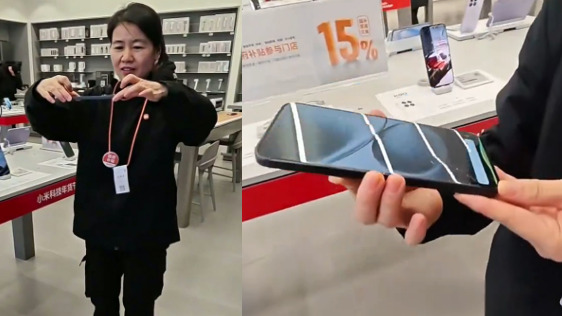
A live in-store demonstration intended to prove the durability of a Xiaomi smartphone collapsed into farce at a Xiaomi 3C store in China’s Hainan province, when the device’s screen visibly cracked after being dropped in front of customers.
Video footage circulated by Pengpai News, a Shanghai-based digital outlet, shows that on Jan. 26 a female sales clerk held a Xiaomi phone at chest height with the screen facing downward and then released it, allowing the device to fall straight onto the store floor. A sharp impact sound echoed as the phone struck the ground.
When the clerk picked it up seconds later, a crack was clearly visible in the lower-left corner of the screen. She let out an audible “aiyo,” her shock and embarrassment unmistakable.
The clip spread rapidly across Chinese social media platforms, triggering a wave of sarcastic and derisive responses from netizens.
Success
You are now signed up for our newsletter
Success
Check your email to complete sign up
Some mocked the timing: “Lei Jun was just talking about durability—and you dropped it for real?” Others ridiculed the demonstration itself, claiming the drop was “too high” or that the phone had landed on “the wrong kind of floor.”
More biting reactions went straight to the heart of Xiaomi’s marketing claims. “Every phone undergoes drop testing before launch. How did this one pass?” one user asked. Others labeled the incident “the most honest review of the year,” while some debated who should be responsible for the repair.
A blogger later said his social media account was reported after he reposted the video. He questioned whether the episode revealed unprofessional testing practices, uneven product quality, or a hastily improvised marketing routine.
He urged others to spread the footage further and warned consumers to “avoid the brand if possible.”

Consumer complaints extend beyond one phone
As the video continued to circulate, users began sharing their own experiences with Xiaomi products.
One wrote that a Redmi phone he bought failed within three months and was sold off soon after warranty repairs, prompting him to switch to Apple. Another said a Xiaomi 11 Lite purchased in Hong Kong developed failures in its power button and fingerprint sensor after a year of use.
Some commenters widened their criticism beyond smartphones, raising doubts about the quality, safety, and after-sales service of Xiaomi’s vehicles. Others recommended alternatives such as Honor or Samsung.

Xiaomi’s durability claims under scrutiny
Drop resistance has long been marketed as a flagship selling point of Xiaomi’s premium models. The company has repeatedly claimed that its devices are several times—and in some cases more than ten times—more durable than ordinary glass.
Promotional materials feature assertive slogans such as “2-meter granite drops without worry” and “load-bearing structural design.” The failed in-store demonstration, however, appeared to directly undermine those assurances.
Responding to the incident, the blogger Du Kan Global noted that smartphone drop-resistance testing is normally conducted under tightly controlled laboratory conditions, including fixed drop heights, specific surfaces, standardized angles, and, in some cases, specially optimized test units.
Xiaomi’s published durability metrics are typically labeled as “data from Xiaomi laboratories.” The test surfaces cited are often wooden floors, not the concrete or tile surfaces most consumers encounter in daily use.
Another blogger, Meng Zhong Xin Tian, cautioned that “drop-resistant” does not mean “unbreakable,” but only “more resistant than average.” Even phones built with premium materials can still suffer damage from falls off tables, impacts on steps, or deliberate drops—exactly as the store demonstration made plain.