By Li Deyan
After Chinese Communist Party leader Xi Jinping moved swiftly to detain Central Military Commission (CMC) Vice Chairman Zhang Youxia and Joint Staff Department Chief Liu Zhenli, he appeared to gain the upper hand. However, the move has reportedly triggered unexpected repercussions. According to circulating accounts, the transmission channels for top-level military orders within the People’s Liberation Army (PLA) have effectively broken down.
Sources say that although the CMC General Office issued at least two documents to units at various levels, multiple military regions failed to carry out the required study sessions or make public statements. With the CMC now reportedly reduced to only Xi Jinping and Vice Chairman Zhang Shengmin, foreign observers have described the PLA as facing a “massive leadership vacuum.”
Reports of command paralysis and grassroots resistance
According to individuals familiar with the matter who spoke to overseas Chinese-language media, on Jan. 24, 2026, the CCP Central Military Commission publicly announced—through a Ministry of National Defense notice and a PLA Daily editorial—that Zhang Youxia and Liu Zhenli were under “case filing and investigation.”
The PLA Daily editorial accused the two senior officers of seriously undermining the so-called CMC chairman responsibility system and endangering the CCP’s governing foundation.
Success
You are now signed up for our newsletter
Success
Check your email to complete sign up
The announcement sent shockwaves through the military. Multiple service members reportedly voiced doubts in private, questioning why two highly respected senior commanders—widely regarded within the PLA as “old leaders”—were detained without any publicly disclosed evidence.
Mr. Ruan, who is familiar with the CCP’s party–military system, told overseas media that Xi’s actions were widely interpreted within the armed forces as a political purge rather than a routine anti-corruption effort. This perception, he said, dealt a serious blow to internal trust in decision-making at the highest level of the CCP.
According to Ruan, on Jan. 24 the CMC General Office distributed at least two documents to PLA units, demanding alignment with the Party Central Committee and the CMC, and requiring study sessions and expressions of loyalty. The response, however, reportedly fell far short of expectations. Multiple military regions did not comply, with some units refusing to issue statements or organize internal study activities.

CMC General Office attempts to suppress backlash
On Jan. 25, the CMC General Office issued another document with similar content in an apparent attempt to suppress backlash within the military. The effort reportedly had little effect, as regional commands continued to treat the directives passively.
A source close to the PLA described what he said was a painful reality for Xi Jinping: “The channels for transmitting high-level military orders have completely collapsed. No one is responding. From commanding officers to ordinary soldiers, dissatisfaction and resistance toward the CMC are spreading. Orders are issued, but no one takes them seriously.”
Mr. Hu, a graduate of a CCP military academy, described the situation as extremely rare. “There was a coup during the Gang of Four period, but the military merely cooperated with Hua Guofeng,” he said. “This kind of bottom-up resistance is unprecedented.”
He noted that in the past, once the CMC issued an order, all theater commands would quickly issue statements and relay instructions down the chain. The current “collective silence” within the PLA, he said, is viewed internally as a direct rejection of Xi Jinping’s personal authority.
“If they don’t pull back from the brink, the consequences could be extremely serious,” Hu warned. “Although the arrests were carefully prepared, the level of resistance within the military was clearly underestimated.”
Hu cited warnings from insiders that if the CCP leadership continues to handle the cases of Zhang Youxia and Liu Zhenli without making substantive adjustments, the CMC risks losing effective control over the armed forces. The resulting political and security costs, he said, would far exceed those of detaining a handful of senior generals.
Unusual silence across the PLA
U.S.-based political commentator Zhang Tianliang said on his program Tianliang on Politics that compared with previous cases of fallen military leaders, the “silence across the entire PLA” following the detention of Zhang and Liu has been particularly striking.
He noted that under similar circumstances, theater commands and service branches typically issue public statements or editorials pledging loyalty to the top leadership within a short time. So far, however, aside from a unified PLA Daily editorial, there have been no waves of statements from the PLA’s five theater commands or major branches.
Zhang suggested that the unusual silence could reflect three possible conditions: senior officers choosing to wait for clarity, disruptions within parts of the command system, or a temporary suspension of power operations within the military.

CMC reduced to two members as leadership vacuum emerges
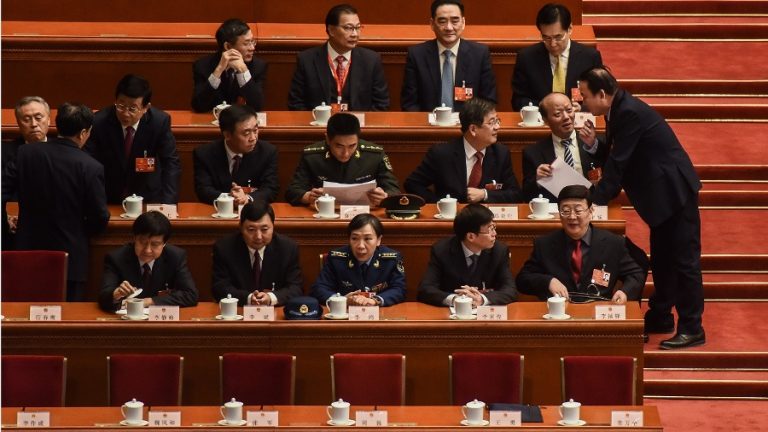
The Central Military Commission, the CCP’s highest military command body, was originally composed of seven members. Following Xi Jinping’s purge of perceived rivals within the armed forces, it is now reportedly left with only Xi himself and Vice Chairman Zhang Shengmin.
Whether such a two-person structure can effectively command the vast PLA has raised serious doubts. Military scholar Mr. Yuan said the current arrangement is ill-suited to directing real combat operations.
The PLA, he noted, has long been divided between clearly delineated military officer and political officer systems, with the former holding dominant influence. Zhang Shengmin, who was recently elevated to vice chairman, has spent most of his career in political and administrative roles and lacks combat experience.
Zhang Youxia and Liu Zhenli, by contrast, both participated in the Vietnam War and were the only two active-duty generals in the PLA with actual battlefield experience. Their removal, Yuan said, has had a profound impact on the military.
According to Yuan, Xi’s concentrated crackdown on the professional military officer system represented by Zhang and Liu is widely seen within the PLA as a disruption of long-standing internal balances. This, he said, has accelerated the spread of resistance sentiment.
The unprecedented situation of a two-member CMC has also drawn international attention. The BBC reported that Lyle Morris, a senior fellow at the Asia Society Policy Institute, described the current configuration—leaving only Xi Jinping and one other general—as virtually unprecedented.
Morris said the PLA is now “in a state of disarray” and faces a “huge leadership vacuum.” He warned that Zhang Youxia’s downfall presents Xi with long-term challenges, as the PLA is likely to experience major turbulence in the coming years, affecting both Xi and his leadership team.
The Wall Street Journal, citing analysts, reported that the leadership vacuum created by the downfall of multiple senior figures could undermine China’s external military effectiveness.
The newspaper quoted M. Taylor Fravel, director of the Security Studies Program at the Massachusetts Institute of Technology, as saying that given the scale and complexity of overseeing such a vast military organization, the current vacuum at the top is unsustainable. Fravel said this is likely to affect the PLA’s readiness to carry out major and complex military operations in the short to medium term.
Editor’s Note:
This article is based on disclosures from overseas Chinese-language media, commentary by analysts familiar with Chinese party–military affairs, and reporting by international media outlets. Claims regarding internal military command resistance, document circulation, and leadership dynamics within the Chinese Communist Party (CCP) cannot be independently verified and are presented as assertions attributed to the cited sources.