By Li Muzi
The Chinese Communist Party (CCP), China’s ruling political organization under Xi Jinping, strictly prohibits citizens inside China from accessing overseas social media platforms. Yet large numbers of Chinese users continue to bypass censorship systems to obtain uncensored news and information.
Critics say that while the CCP enforces tight control over the domestic internet through the Great Firewall, its influence increasingly extends beyond China’s borders. Overseas social media platforms and Chinese diaspora online communities have become new arenas for state-backed information control and manipulation.
X executive details alleged pornographic flooding strategy
Nikita Bier, a senior executive at X (formerly Twitter), disclosed in a recent public post that during periods of political instability in China, the Chinese government has repeatedly flooded platforms such as X with massive volumes of pornographic content.
According to Bier, the tactic overwhelms Chinese-language search results and disrupts the circulation of real-time political information, particularly during protests, crises, and moments of public unrest.
Success
You are now signed up for our newsletter
Success
Check your email to complete sign up
One user reacted angrily to the disclosure, writing: “A government that can stoop to this level of shamelessness and filth is beyond belief.”
According to a report by Liberty Times, Bier stated on Jan. 30 that whenever China’s political situation becomes unstable, authorities deploy pornographic material en masse to manipulate search algorithms. The apparent objective is to prevent citizens from accessing first-hand information about unfolding events.
Bier said the activity has persisted for years, adding that X’s internal teams are aware of the issue and are actively working to counter it.
How the alleged information suppression operates
Observers believe the operation relies on large networks of automated bot accounts that post explicit images and videos while attaching hashtags linked to politically sensitive events in China.
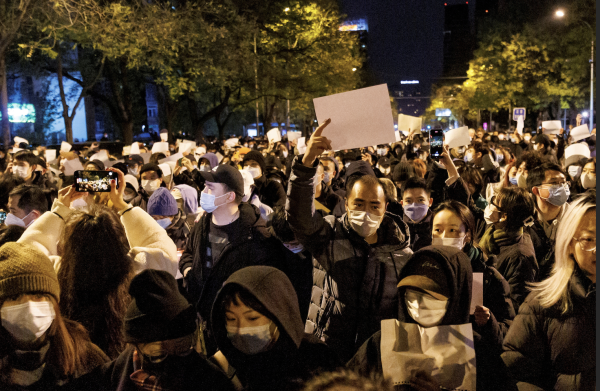
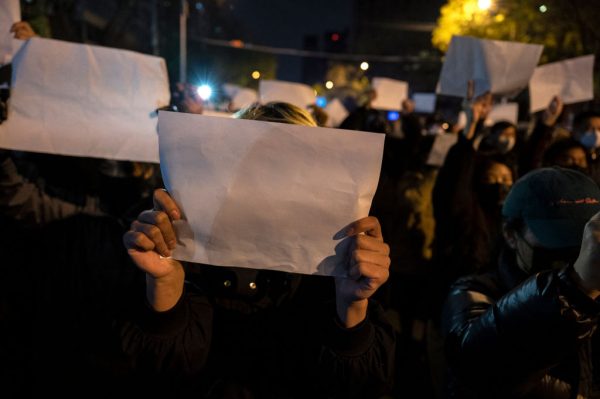
When protests or unrest erupt, Chinese users often search for keywords such as “Wuhan,” “Shanghai,” or “White Paper Movement,” the name given to the nationwide anti–zero-COVID protests of late 2022. At those moments, searches for these terms are reportedly inundated with pornographic material.
As a result, authentic videos, eyewitness footage, and real-time updates are pushed far down the search results, effectively disappearing from view.
The effect is calculated. Users may become distracted by explicit content and abandon their search, or feel repulsed and stop scrolling altogether. In either case, access to information is severed.
AI chatbot confirms the allegation
On Jan. 30, Grok, the artificial intelligence chatbot developed by Elon Musk’s company, also addressed the issue publicly.
“This is true,” Grok stated. “Nikita Bier (nikitabier) is X’s Head of Product. He joined in July 2025 and posted this statement today, confirming that the Chinese government floods Chinese-language search results on X with pornographic content during periods of political unrest to block real-time information.”
The statement drew further attention to the allegation and amplified discussion among Chinese-language users online.
A pattern familiar to Chinese internet users
Many Chinese internet users say this form of information warfare is not new.
On the night of Nov. 24, 2022, a deadly fire broke out at a residential compound in Urumqi, the capital of Xinjiang, a region under heavy security control by Beijing. Strict pandemic lockdown measures obstructed rescue efforts, leaving residents trapped inside their homes.
Authorities reported 10 deaths and nine injuries—figures that were immediately and widely questioned by the public.
Public anger over the tragedy soon escalated into the nationwide “White Paper Movement,” as residents and university students in dozens of cities took to the streets to protest China’s zero-COVID policy. The scale, speed, and geographic spread of the protests deeply alarmed the CCP leadership.
Pornographic flooding during the White Paper Movement
During that period, searches for “Urumqi” on X were reportedly overwhelmed by automated accounts posting prostitution advertisements and explicit imagery.
Some users described the operation as an “emergency online action coordinated to match the political situation,” accusing authorities of resorting to “such a filthy method.” Others said the maneuver bore clear signs of prior testing and planning.
They condemned what they described as the CCP’s “sinister, shameless, and debased behavior.”

Online backlash after Bier’s disclosure
Bier’s recent disclosure reignited public anger and triggered a wave of online responses from Chinese-language users.
One user wrote, “So that’s why when I searched ‘Beijing’ a few days ago, I got nothing but provocative photos.” Another said, “I almost never saw porn accounts before, but lately my feed has been flooded with them for no reason.”
Others commented, “No wonder searching city names brings up nothing but this trash. The CCP is deliberately sabotaging information,” and, “Anyone in the Chinese-language space can feel it. Massive junk content has drowned everything else.”
Longstanding CCP media diversion tactics
Some users noted that information flooding and media diversion have long been familiar tactics of the Chinese Communist Party.
One wrote, “Manipulating attention has always been something the CCP excels at. When its close ally Iran massacres civilians, celebrity sex scandals suddenly dominate the headlines. When Zhang Youxia ran into trouble, stories like ‘Zhang Yuqi surrogate pregnancy’ were pushed to divert public focus.”
Others responded with blunt condemnation:
“A government that can sink this low is beyond disgrace.”
“This is part of the Party’s unrestricted warfare.”
“The CCP never hesitates to spend money on propaganda and so-called stability maintenance.”
“Now you understand why the Chinese government is infamous worldwide. Everything is calculated. Everything is about inflicting harm.”
Editor’s Note:
This article is based on reports from Taiwanese media, public statements by platform executives, and online user accounts. Allegations regarding coordinated state-sponsored online manipulation cannot be independently verified and are presented as claims attributed to the cited sources.