According to Reuters, on July 6, 2026, a Chinese nuclear-powered submarine fired a nuclear-capable ballistic missile from beneath the surface of the Pacific, sending it more than 7,200 kilometers into a stretch of the South Pacific ringed by small island states. The launch, which carried a dummy training warhead, was the first that Beijing has ever publicly confirmed sending into international waters, and it drew swift condemnation from Australia, New Zealand, and Palau. Analysts have speculated that the weapon was the Julang-3, China’s newest submarine-launched intercontinental missile, with a range beyond 10,000 kilometers. According to a purported insider, what China actually fired was an upgraded version of the older Julang-2.
Pacific neighbors condemn China’s nuclear missile test
Beijing’s own account came from the Party’s news agency, Xinhua, which timed the launch at 12:01 p.m. and claimed the missile “landed accurately in the predetermined sea area.” The navy disclosed little else, declining to name the launch site, identify the submarine, or specify the missile type. Defense analysts placed the launch in the South China Sea and said the missile had flown a full-range trajectory, close to the limit of its reach.
Xinhua described the launch as a “routine” part of the navy’s annual training and insisted that it targeted no particular country. The agency said China had notified the relevant governments beforehand and that the test complied with “international law and international practice.” According to Reuters, the governments given notice included New Zealand, Japan, Papua New Guinea, and several other Indo-Pacific states.
Australia and New Zealand both objected. Australia’s foreign minister, Penny Wong, speaking to reporters in Fiji, said her government had been clear with Beijing that it regarded the test as “destabilizing to the region.” She pointed to China’s rapid military buildup and to its lack of the transparency and the reassurance about intent that the region expects.
New Zealand’s foreign minister, Winston Peters, said Beijing had informed Wellington of the launch earlier that day and called it “an unwelcome and concerning development.” “We, like our neighbours in other Pacific countries, have no interest in China using the South Pacific as a testing site for missile capability,” he said.
Success
You are now signed up for our newsletter
Success
Check your email to complete sign up
Monitors and Pacific officials said the missile’s splashdown occurred in a high-seas corridor between Nauru, Tuvalu, and the Solomon Islands. Although the trajectory technically avoided the exclusive economic zones (EEZs) of the island nations—waters extending up to 200 nautical miles from their shores where countries hold rights over natural resources—the impact site was still located in the heart of the Pacific islands region.
According to ABC, Palau President Surangel Whipps Jr., who will host next month’s meeting of the Pacific Islands Forum, the region’s leading intergovernmental organization, said he was “shocked and deeply concerned about this kind of behaviour.”
“It demonstrates the lack of transparency and really a lack of respect for the sovereignty of Pacific nations,” Whipps said.

US officials call China’s nuclear launch irresponsible
A U.S. State Department official condemned the launch as “irresponsible,” saying China had fired a nuclear-capable missile without providing advance notice through established diplomatic channels. In a statement to Reuters, the official said Beijing notified Washington only hours before the launch and provided insufficient details, falling well short of the transparency standards typically followed by the five permanent members of the UN Security Council—the only countries formally recognized as nuclear-weapon states under the Nuclear Non-Proliferation Treaty.
Beijing presented the test as part of a normal rhythm, pointing out that its previous such launch had come two years earlier. That earlier test, in September 2024, was China’s first intercontinental ballistic missile fired into the Pacific in 44 years, but it flew from a land-based launcher. This one came from a strategic nuclear submarine.
On July 7, CNBC quoted former U.S. Assistant Secretary of Defense for Indo-Pacific Security Affairs Ely Ratner, who said Beijing’s increasingly assertive military posture should encourage U.S. allies across Asia to strengthen cooperation and coordination. Ratner added that the missile test highlighted both the pace and scale of China’s military modernization, particularly the rapid expansion of its nuclear arsenal.
A senior analyst at the political-risk consultancy Eurasia Group, Jeremy Chan, said the launch was aimed primarily at testing and displaying China’s second-strike nuclear capability, the ability to retaliate with nuclear weapons after absorbing a first attack. He predicted that the move would drive Australia, New Zealand, Japan, and the Philippines to deepen their cooperation on joint exercises, arms sales, and defense spending.
READ MORE:
- China’s Military Purge Removed 14 Lawmakers, but Its Two Most Senior Targets Kept Their Seats
- Xi Jinping Locked Up China’s Top Generals for 10 Weeks in a Military Loyalty Purge
Experts and a purported insider disagree over whether the missile was the Julang-3
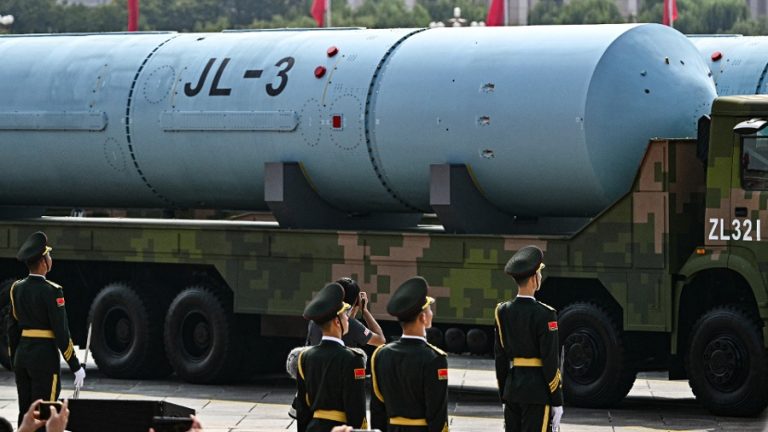
Beijing has not disclosed the missile’s identity, leaving analysts and military commentators to speculate. The state-run Global Times cited military commentator Song Zhongping, who said the weapon was likely the Julang-3 (JL-3), a submarine-launched ballistic missile that was publicly unveiled during China’s September 2025 military parade in Beijing. Song said the missile had already undergone testing on both high- and low-angle trajectories and that a near full-range launch was necessary to evaluate the overall performance and reliability of the weapons system.
Another military expert, Zhang Junshe, described the JL-3 as China’s independently developed third-generation submarine-launched intercontinental ballistic missile, with an estimated range exceeding 10,000 kilometers—capable of reaching across the Pacific from waters near the South Pacific toward the eastern Pacific.
A source using the pseudonym “Huang Anyang” offered a different account to the overseas Chinese-language outlet Epoch Times, saying the missile was an upgraded Julang-2 rather than the standard Julang-2 or the Julang-3 that outside observers had assumed. “They want the United States to believe that the Chinese navy can already strike beyond the second island chain,” Huang said, referring to the outer of two notional lines that Chinese strategists use to gauge how far the navy can project force, a line running from Japan out past the U.S. territory of Guam.
“In reality, it has not reached that level.” The upgraded Julang-2 had gone from completion to naval deployment in only about ten years, Huang said, and with critics now talking down the Chinese navy, Beijing wanted to prove that its submarine-launched nuclear force could break past that line. The aim, Huang argued, was to signal to neighboring countries, and to hint to Washington, that the navy’s long-range strike could now reach beyond the second island chain.
China will not publicly confirm the missile’s type, Huang added, and it is not yet ready to test the Julang-3 in the open, because Beijing fears that revealing its newest submarine missile too soon would provoke an even stronger response from the United States and its allies.
The Julang-2 is China’s second-generation submarine-launched ballistic missile, with a baseline range above 7,000 kilometers, and it is usually paired with the Type 094, China’s main class of ballistic-missile submarine. A military enthusiast named Zhao Yi, also speaking to Epoch Times, said the baseline Julang-2 has limited reach. A Type 094 submarine sitting in China’s coastal waters or the South China Sea would struggle to reach deep into the American mainland, he said, though it could still threaten Guam, parts of Hawaii, and sections of Alaska.
“To hit the US East Coast, or to reach deep into the American interior, the Type 094 cannot simply sit in China’s near seas,” Zhao said. It would have to break through the first and second island chains, the inner line running along Japan, Taiwan, and the Philippines and the outer line stretching past Guam, and push out toward the central Pacific. An upgraded Julang-2 with a range of 8,000 to 9,000 kilometers, he added, could threaten the U.S. West Coast from beyond the second island chain, while reaching the East Coast from waters farther back would require the Julang-3 and a range of at least 10,000 kilometers.
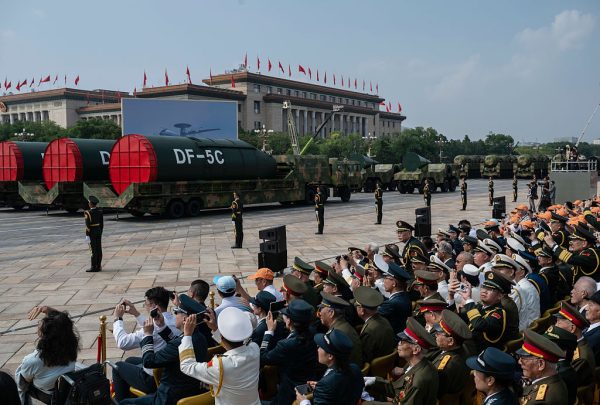
China fired the missile into a South Pacific zone it once vowed to keep nuclear-free
The missile came down inside the South Pacific Nuclear Free Zone, the region that Pacific states set aside as off-limits to nuclear weapons under the 1986 Treaty of Rarotonga. New Zealand said the test breached the intent of that treaty.
A columnist for SecretChina, Chen Jing, seized on the point. Only a few years ago, she wrote, Beijing was loudly promising to uphold the zone’s denuclearization and its peace and stability. It has now sent a nuclear-capable ballistic missile straight through that same area, laying its double-talk and strategic hypocrisy bare.
The high-profile show of force, Chen argued, looks on its face like a display of nuclear strength. Its deeper purpose, she wrote, is political theater and strategic gambling by a leadership in Zhongnanhai, the walled compound in Beijing that houses China’s top rulers, as it confronts a slowing economy, sharpening social tensions, and internal struggles over power.
A 2024 Pentagon report to the US Congress found that China already fields six nuclear-powered ballistic missile submarines, each able to carry twelve missiles.