By Fu Longshan
From the outside, the question sounds crude but persistent. If internal power struggles within the Chinese Communist Party have reached a life-or-death stage, and the military controls real weapons, why has no one attempted a coup, a mutiny, or a direct armed strike against the top leader?
The answer lies not in individual courage or hesitation, but in a system engineered to make such action structurally impossible. The CCP’s control apparatus is not merely harsh. It is calculated, layered, and deliberately designed to prevent any single actor from holding both intent and capability at the same time.
Separated guns, separated authority
Inside the CCP’s military system, those who hold guns do not control ammunition, and those who control ammunition do not command troop movements. At the most basic level, firearms and bullets are stored separately. Access to armories requires two independent locking systems, typically controlled by different officers. Both must be present, and both are accountable.
According to accounts from internal Party meetings, even senior officers, including vice chairmen of the Central Military Commission, must surrender their sidearms before entering Zhongnanhai to meet the top leader. Mobile phones and briefcases are also taken and kept by designated staff. The rule is absolute. No weapon, no meeting.
Success
You are now signed up for our newsletter
Success
Check your email to complete sign up
Beyond personal security, troop movement itself is tightly sealed. Any deployment at or above battalion level requires approval from the CMC chairman. Without a formal authorization token, any movement constitutes treason. Modern deployments require electronic authentication and are monitored through real-time GPS tracking. Units that deviate from approved routes are treated not as confused, but as hostile. Rear-positioned missile or air units are tasked with neutralizing them if necessary.
At the core of this system is the PLA’s rigid dual-command structure. Every military commander is paired with a political commissar. Each exists to restrain the other. Any sign of deviation, hesitation, or abnormal behavior must be reported. The design ensures constant internal friction rather than unified initiative.
From the company level upward, commanders focus on combat and training, while political commissars oversee Party affairs, personnel, and ideology. Commissars usually serve as Party committee secretaries, while commanders act as deputies. In matters involving appointments, discipline, or financial authority, the commissar typically holds the upper hand.
In wartime, this imbalance deepens. Combat orders issued by commanders are not legally valid without the commissar’s co-signature. If a commander attempts to move troops toward Beijing without authorization, the commissar can halt the order immediately and may even deploy security personnel to detain the commander on the spot. Commanders and commissars are often drawn from different factions, regions, or promotion tracks. Mutual distrust is not a flaw. It is the point.
In CCP political culture, reporting on colleagues is not considered betrayal. It is often a survival strategy. This makes collusion exceptionally difficult. The dual-command system functions as the Party’s first firewall against any form of military coup, ensuring that no unit ever possesses a single, decisive center of authority.

Zhongnanhai’s layered security reality
Many outside observers imagine that eliminating the top leader would end everything. In practice, the security structure surrounding senior CCP figures far exceeds common assumptions.
The closest figures to top officials are not relatives or confidants, but so-called “life secretaries.” Drivers, assistants, nannies, and guards are not personally selected. They are assigned by the Central Guard Bureau or relevant General Staff departments. These aides are trained not only to serve, but to observe. They regularly report on household visitors, conversational tone, emotional shifts, and unusual routines. Private life, at this level, does not exist.
In ordinary times, these aides function as staff. In sensitive moments, they become wardens. Internal accounts describe how, once a decision is made to act against an official, unfamiliar guards are dispatched under the pretext of “strengthening security.” Existing personnel are replaced. From that moment on, even sleeping or using the restroom occurs under observation. Vehicles may be rendered inoperable. Drivers may suddenly report “mechanical issues.” Without written approval from the General Office, no vehicle leaves the compound.
Security forces around Zhongnanhai are divided into two concentric rings. The inner ring is the Central Guard Bureau, also known as Unit 8341. It controls individual points, provides close protection, and reports directly to the Party’s central leadership. The outer ring is the Beijing Garrison, responsible for broader territorial control, bridges, and strategic access routes.
The Guard Bureau answers only to the top core leadership. Its personnel are few, but their family backgrounds and social networks undergo multi-generational political screening. Loyalty is treated as a matter of political survival. If instability appears within the inner ring, the Beijing Garrison can rapidly seal off Zhongnanhai and suppress it. If the garrison shows abnormal movement, the Guard Bureau can evacuate leadership immediately and coordinate nationwide military suppression through its special communications channels.
To prevent coordination between these two forces, the leadership deliberately assigns commanders from different regions and factions. Personnel are cross-posted in a practice often described as “sand-mixing,” ensuring that each unit contains informants loyal to the other. Rank asymmetry compounds this barrier. The Guard Bureau chief often holds political rank at or above deputy theater level, while the Beijing Garrison remains a corps-level unit. Informal coordination becomes structurally risky.

The red phone system
The so-called “red phones” form the electronic nervous system of this control network. These are classified communication lines installed in the offices and residences of senior military and political leaders.
Accounts describe a dedicated internal department tasked with monitoring these communications. Red phones operate on military-exclusive protocols and reportedly include voice-recognition monitoring. Certain keywords, including unauthorized troop movements or sensitive political names, can trigger automatic alerts or call termination. Personal mobile phones may exist, but during sensitive meetings or in restricted areas they are locked inside signal-shielded safes.
Red phones are tiered. The highest level, reserved for national and vice-national leaders, lacks dialing pads entirely. Calls are routed through dedicated operators under the Central Office’s communications bureau. Lower-tier red phones used by ministerial-level officials and senior officers include encrypted dialing systems.
For those who use them, the red phone is both a status marker and a constraint. All calls are archived. Conversations are formal, rigid, and stripped of personal language. Private discussion is avoided not by rule, but by habit.
These lines can also serve as tools of soft detention. Targeted officials may find that calls from Beijing still come through, while outbound calls fail. Operators cite maintenance or claim recipients are unavailable. In extreme cases, such as during the 1971 Lin Biao incident, wired communications to entire compounds were cut.
In contemporary settings, mobile electronic jamming vehicles may be deployed around Zhongnanhai or senior residences, blocking civilian signals entirely and preventing emergency communication through social media.
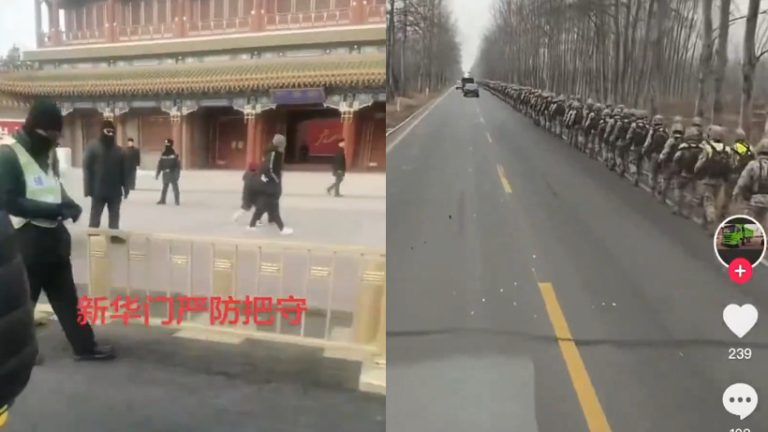
Security procedures extend to the city itself. Passcodes at Beijing checkpoints change hourly. Vehicles lacking correct authentication, even those carrying senior officials, can be detained. Control of military aircraft at Nanyuan or Xijiao airports rests solely with the CMC chairman. Without written authorization, no military aircraft enters Beijing airspace.
The leadership’s anxiety about overlapping command responses dates back decades. The 1994 Jianguomen shooting incident, carried out by a Beijing Garrison lieutenant, deeply alarmed the top leadership. In its aftermath, rules were tightened further. Armed units were barred from entering the city. Units that did enter carried no live ammunition. Military vehicles seen on Beijing streets today typically carry empty weapons.

Fear and vested interests pressure
Monitoring of senior officers has reached near-total coverage. Communications are encrypted and monitored simultaneously. Private gatherings can trigger alarms. Ahead of major purges, personal aides often function as informants planted by security organs.
The CCP operates on a logic of collective punishment. Failed resistance does not end with the individual. Families and entire networks are implicated. Many senior officers are beneficiaries of the system, enjoying privileges and extensive family interests. Unless pushed into absolute desperation, few are willing to risk total eradication.
Within this framework, loyalty is not ideological. It is transactional. Any hint of conspiracy invites immediate “organizational talks.” Mutual corruption files ensure that trust is dangerous. In this equilibrium of fear, the first person to suggest armed action is often reported by others seeking self-preservation.

Does war change the equation?
War appears, on the surface, to loosen controls. Weapons are loaded. Orders are urgent. Yet the CCP’s system adapts.
Ammunition and missile authorization are digitally managed. Leaked meeting records suggest wartime logistics are controlled directly by the CMC’s Joint Logistics Support Force. Missile launches may require real-time digital keys issued from Beijing.
Modern weapons depend on satellite navigation systems such as Beidou. A frontline unit attempting to reverse course toward Beijing can have navigation and encrypted communications cut instantly, leaving it blind and isolated.
Dual-command authority intensifies during war. Discipline inspection teams embed down to division level. Political commissars gain expanded veto power, including authority to strip commanders of command or impose discipline immediately.
Families of senior officers become hostages in all but name. During wartime, they are relocated to designated “protected zones.” Communication is limited to monitored family lines. Every decision is weighed against personal consequence.
Rotation policies fragment units to prevent long-term loyalty. Propaganda credits victories to the Party center rather than individuals. Commanders who gain prominence are often recalled or reassigned.
The Party’s fear of wartime coups is shaped by history. The Lin Biao incident and the 1979 Sino-Vietnamese War both left deep impressions on Beijing, where powerful field commanders unsettled the center.
Even in war, the system holds. Guns may carry bullets, but they cannot be aimed at Zhongnanhai. Anyone important enough to meet the top leader cannot even touch a weapon. In this structure, rebellion is not a question of resolve. It is structurally foreclosed.