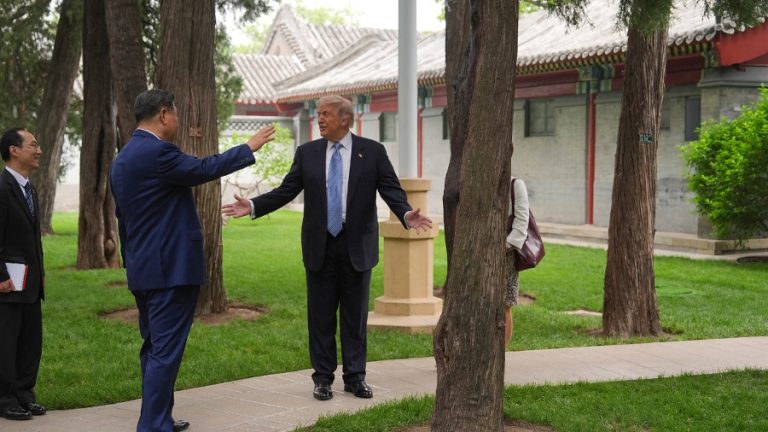
According to China’s official Xinhua News Agency, on the afternoon of Feb. 6, 2026, the Central Military Commission (CMC) hosted a New Year cultural performance at the China National Theatre to honor retired military cadres stationed in Beijing. Xi Jinping—General Secretary of the Chinese Communist Party (CCP), state president, and chairman of the CMC—attended the event and greeted retired officers of the People’s Liberation Army (PLA).
On the surface, the ceremony followed familiar choreography. Politically, however, the moment was anything but routine.
Just days earlier, on Jan. 24, CMC Vice Chairman Zhang Youxia and CMC member Liu Zhenli were officially announced to have fallen from power. Their removal sent shockwaves through both Party and military circles, sharply heightening political sensitivity within the armed forces. Against this backdrop, Xi’s appearance—and who stood beside him—became the focus of intense scrutiny.
Xinhua dutifully reported that the retired officers present vowed to “resolutely implement the system of responsibility under the CMC chairman,” a standard loyalty pledge emphasizing Xi Jinping’s personal command over the military.
Yet the most revealing detail lay elsewhere. According to CCTV News, “Xi Jinping watched the performance, accompanied by CMC Vice Chairman Zhang Shengmin.”
Success
You are now signed up for our newsletter
Success
Check your email to complete sign up
One companion. No more.

From collective leadership to a single enforcer
The contrast with previous years is stark.
At the same New Year event in 2024, Xi was accompanied by senior CMC figures Zhang Youxia, He Weidong, Liu Zhenli, Miao Hua, and Zhang Shengmin. At the time, then–Defense Minister Li Shangfu had already been purged.
In 2025, the lineup narrowed but still included Zhang Youxia, He Weidong, Liu Zhenli, and Zhang Shengmin. By then, Miao Hua had been placed under investigation.
By 2026, the procession had collapsed entirely. Only Zhang Shengmin—widely viewed as the key official overseeing the military’s disciplinary machinery and internal purges—remained standing beside Xi Jinping. All other top CMC figures had been removed.
U.S.-based independent Chinese commentator Cai Shenkun noted that if this trend continues, next year’s New Year event for retired military cadres may feature Xi Jinping alone. Footage from the ceremony already shows that the retired officers in attendance were largely unfamiliar faces. According to Cai, this suggests that many once-prominent military elders have either been purged outright or pushed to the margins.
Since assuming the chairmanship of the CMC, Xi Jinping has promoted large numbers of generals—only to later investigate, discipline, or remove them. What remains, Cai argues, is a shrinking circle of aging cadres whose primary political function is not command but public displays of loyalty.
The sense of awkwardness surrounding the New Year performance was unmistakable. But the real institutional damage became even more visible days later.

No full generals at Beijing’s premier military–political conference
On Feb. 5, 2026, Beijing hosted its annual Capital Military–Political Conference, a flagship event meant to showcase coordination between the CCP, the municipal leadership, and the PLA units stationed in the capital.
According to the Beijing Daily, the meeting was attended by CCP Politburo member and Beijing Party Secretary Yin Li, Minister of Veterans Affairs Pei Jinjia, and Beijing Mayor Yin Yong, all of whom delivered remarks.
Yet footage aired by CCTV’s National Defense and Military Channel revealed a startling anomaly. Seven officers wearing lieutenant general insignia and thirteen wearing major general insignia were present—but not a single full general (shangjiang), the PLA’s highest active rank, appeared at the conference.
This unprecedented absence was not accidental.

A pattern of disappearances, not an isolated incident
The contrast with previous years underscores the depth of the crisis.
At the Jan. 22, 2025 Capital Military–Political Conference, one full general attended: He Hongjun, then executive deputy director of the CMC Political Work Department. Notably, neither CCTV nor Beijing-based Party media mentioned his name in their reports. In October 2025, He Hongjun was officially announced to have been purged and expelled from both the CCP and the PLA—confirming that his political downfall had already been sealed.
At the Feb. 2, 2024 conference, the sole full general in attendance was Miao Hua, then director of the CMC Political Work Department. He was officially brought down later that year, in November.
Since the CCP’s 20th Party Congress, at least fifteen active-duty full generals have been publicly investigated. An additional twenty full generals have effectively vanished from public view, their status unacknowledged but unmistakably ominous.

Lieutenant generals rotate as the purge moves downward
Seven lieutenant generals attended the 2026 conference: Chen Demin, Liang Ping, Zheng Yanpo, Dong Wenhui, Ji Duo, Hu Yuhai, and Ding Xingnong.
Publicly available information shows that Chen Demin serves as deputy director of the CMC Political Work Department; Liang Ping is deputy political commissar of the Central Theater Command; Hu Yuhai is deputy political commissar of the PLA Navy and director of its Political Work Department; Ji Duo is deputy political commissar of the PLA Air Force; and Ding Xingnong is deputy political commissar of the Rocket Force. These are not marginal figures—they occupy key political-control roles across the CMC, theater commands, and service branches.
The remaining two names raise further questions. Zheng Yanpo was promoted to lieutenant general in March 2024 when he became deputy political commissar of the Western Theater Command and political commissar of its ground forces. Because Beijing falls under the Central Theater Command, his appearance at the capital conference strongly suggests a reassignment—possibly to a senior political role within the PLA Ground Force.
Dong Wenhui previously served in the Political Department of the People’s Armed Police (PAP), a paramilitary force under CCP and CMC control. He likely attended the conference in his current capacity as PAP deputy political commissar.

Survivors, skipped promotions, and political ominousness
The instability becomes clearer when viewed year by year.
Only four lieutenant generals attended the 2025 Capital Military–Political Conference: Zhu Guobiao (then PAP deputy political commissar), Ding Xingnong, Ji Duo, and Zhou Junqiang (then director of the PLA Ground Force Political Work Department). By 2026, Zhou Junqiang and Zhu Guobiao had disappeared from the conference entirely.
Even among those who remain visible, political fortunes are fragile. Ding Xingnong, despite ranking second among alternate members of the CCP’s 20th Central Committee, was conspicuously skipped when vacancies were filled at both the Third Plenum in July 2024 and the Fourth Plenum in 2025. Although he attended the 2025 and 2026 capital conferences, he was absent from both central committee plenums—an unmistakable political warning sign.
Looking further back, the February 2, 2024 conference featured seven lieutenant generals, including Leng Shaojie, Zhang Fengzhong, Liu Bencheng, Ji Duo, Gao Wei, Yang Xiaoxiang, and Zhu Wenxiang. Of these seven, only Ji Duo appeared again in both 2025 and 2026. The other six vanished from subsequent conferences, with several later investigated or showing clear signs of impending political trouble.
Ji Duo is effectively the lone survivor.

A military gripped by fear
Across three consecutive years of Capital Military–Political Conferences, the roster of attending lieutenant generals has changed dramatically. Nearly every year brings a new set of faces—and the quiet disappearance of the previous ones.
This is not routine rotation. It is the visible imprint of a sweeping purge that has spread from full generals to lieutenant generals, from the Central Military Commission to theater commands, service branches, and paramilitary forces. Senior officers are removed, sidelined, or erased with little warning, creating constant upheaval within the PLA’s command structure.
The consequences are profound. Personnel instability has become chronic. Career trajectories are unpredictable. Loyalty tests now outweigh professional competence. Within the ranks, anxiety deepens as officers watch colleagues vanish from public view.
What was once meant to symbolize unity between Party, capital, and military now exposes a force under relentless internal assault. The disappearance of generals from Beijing’s most important military–political stages is no longer an anomaly—it is the new normal of a PLA increasingly defined by fear, silence, and decay at the top.