By Zhi Xiaomin
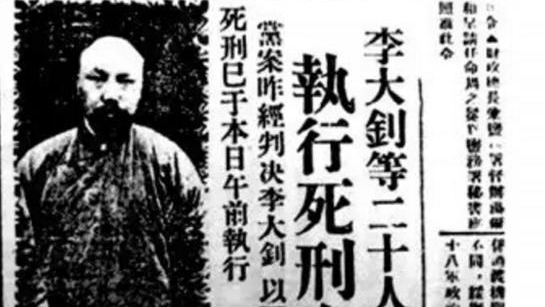
Li Dazhao was executed by hanging in Beijing by the Beiyang government. For decades, the Chinese Communist Party has depicted his death as the “reactionary warlords’ persecution of a revolutionary martyr.” Yet the spring of 1927 coincided with a nationwide wave of large-scale anti-Communist suppression. In the south, party purges and mass killings unfolded; in the north, arrests and manhunts escalated rapidly. Within this climate, the Fengtian clique led by Zhang Zuolin was eager to demonstrate its capacity to “maintain order and resist Bolshevism.”
Under these circumstances, Li Dazhao—one of the most symbolically significant leaders of the CCP’s northern organization—naturally became a target that “had to be dealt with, and dealt with severely.” In the CCP’s commemorative narrative, Li is often deliberately recast as a “Peking University professor, an intellectual pioneer, and a scholar who sacrificed himself for his ideals.” In the political reality of 1927, however, he was no longer an academic figure. He was an operational leader of an underground revolutionary organization.
At the time of his arrest, Li Dazhao embodied at least three overlapping roles.
First, he was the core organizer of the CCP’s northern apparatus, responsible for building party organizations in Beijing and across North China, and for directing labor and student movements. He was a hands-on commander of revolutionary operations, not a passive observer.
Success
You are now signed up for our newsletter
Success
Check your email to complete sign up
Second, he was a key node in the Comintern’s revolutionary network in China. In the 1920s, the Chinese Communist Party was not an independent political party but a branch of the Communist International.
Third, he was an active participant in ongoing subversive activities. Li maintained contact with Soviet advisers and embassy channels, receiving guidance and material support for revolutionary operations.
Together, these three factors formed the decisive reasons the Beiyang government concluded that Li Dazhao was a figure who “had to be handled, and had to be harshly punished.”
The core reason for Li Dazhao’s execution was not his “ideas” or “speech,” but his direct involvement in subversive activities with concrete links to the Soviet Union and the Communist International. In other words, the true reason for his execution was that he was regarded as an agent of a foreign revolutionary power—a Soviet agent operating inside China.
During the May Fourth New Culture Movement, Li Dazhao, with his thick beard, appeared older than he actually was. In reality, he was only around thirty. When Zhang Zuolin ordered his execution, Li was just thirty-eight. Why did a young life end so abruptly at the height of its prime? To answer that question, one must trace his personal trajectory and political career.
Li Dazhao: early life and intellectual formation
Li Dazhao (courtesy name Shouchang, 1889–1927) was born in Laoting, Hebei Province. Orphaned at a young age, he was raised by his grandfather. Following local custom, he married Zhao Renlan—seven or eight years his senior—at the age of eleven. The following year, he left home to pursue his studies. His young wife not only cared for his elderly grandfather but also helped raise funds to support his education.
In 1905, Li took part in the imperial examinations, only to encounter the Qing government’s abrupt abolition of the civil service system. He subsequently enrolled at Yongping Prefecture (present-day Lulong County, Hebei) Middle School, where he was exposed to new ideas and began reading the works of Kang Youwei and Liang Qichao, gaining an initial understanding of Western society.
In 1907, Li’s grandfather died. Deeply shaken by China’s declining national power, Li turned his attention to politics. That summer, he traveled to Tianjin to sit for the entrance examination to the Beiyang Law and Political School. In 1910, one of his classmates, Jiang Weiping, enlisted in the military and was killed by Russian forces in Northeast China. Li wrote a poem mourning his death and venting his anger toward Russia:
“The land is full of national grief, tears flow without end…
For a thousand years, the spirits must harbor resentment,
Not allowing the barbarian horse to cross the river.”
After the Xinhai Revolution of 1911, Li moved to Beijing and joined the Chinese Social Party founded by Jiang Kanghu. The party promoted freedom in love, equality in education, public inheritance, the principle of “to each according to ability, to each according to need,” personal autonomy, and a vision of universal harmony—a politically idealistic organization. Years later, after the outbreak of the Second Sino-Japanese War, Jiang Kanghu collaborated with Wang Jingwei and became a core member of the Japanese-backed puppet regime.
In the winter of 1913, Li Dazhao went to Japan. In the spring of 1914, he enrolled at Waseda University, majoring in political science. By that time, the Japanese scholar Kawakami Hajime had already translated Marx’s Capital into Japanese. Li absorbed Marxist theory indirectly through this translation.
By early 1918, on the recommendation of Zhang Shizhao, Li was appointed director of the Peking University Library by Cai Yuanpei. Around the same time, the Russian October Revolution was capturing global attention. Although Li could not witness the events firsthand, he published articles praising the Soviet regime, arguing that the Western world was in decline and that only the Russian Revolution represented a new progressive force for humanity. On this basis, he declared:
“Look to the future of the world; it will surely be one under the red flag.”
Li’s prioritization of ideological analysis over concrete problem-solving sparked a fierce debate with Hu Shi over “issues versus ideology,” reflecting the intense intellectual ferment of the era.
After the May Fourth Movement, China entered an age of fractured warlord rule. Although Li Dazhao held a professorship at Peking University, he remained deeply embedded in practical political struggle. With backing from the Soviet Communist Party, he not only helped establish the Chinese Communist Party but also worked to court powerful figures such as Sun Yat-sen and Wu Peifu.
According to Hu Shi’s diary, around 1922 Li frequently traveled to Baoding or Luoyang to visit his former classmate Bai Jianwu, who at the time served as Wu Peifu’s administrative director—a relationship that made Li’s political intentions unmistakably clear.
In 1924, during the Kuomintang’s First National Congress, Li reportedly publicly acknowledged his membership in the Soviet Communist Party. He played a leading role in organizing the May 30th Movement of 1925 and the March 18th Movement of 1926. According to the diplomat Gu Weijun, Li even argued in a petition that:
“Even if Outer Mongolia were placed under Soviet control, its people could live better there.”
Because of these actions, the Beiyang government issued a warrant for Li Dazhao, accusing him of “using Communist teachings to incite the masses and repeatedly instigating disturbances.” Forced into a corner, Li sought refuge in the Soviet embassy on Dongjiaomin Lane.
In April 1927, Zhang Zuolin abruptly dispatched military and police forces to search the embassy. Li Dazhao was arrested, and authorities announced the seizure of large quantities of weapons and documents allegedly detailing plans to overthrow the government. Zhang later selected key materials and compiled them into a volume titled Compilation of Soviet Conspiracy Evidence. In recent years, copies of this collection have reportedly fetched high prices at the old book market in Taiyuan’s Workers’ Cultural Palace.
On April 28, 1927, Li Dazhao was executed by hanging for “colluding with foreign powers” at the age of thirty-eight. A decade later, in 1937, Bai Jianwu met a similar fate—executed by Feng Yuxiang’s forces for collaborating with the Japanese.