By Li Deyan
A string of unexplained absences at the top of the Chinese People’s Political Consultative Conference, the CCP’s top political advisory body, is raising questions about factional power shifts and possible corruption investigations inside the Party. The most prominent absentee is Shi Taifeng, the newly installed head of the CCP’s Organization Department, the body that controls every senior appointment in the Chinese Communist Party.
Shi, who is also the CPPCC’s highest-ranking vice chairman, has skipped multiple leadership meetings since early 2026. Three other vice chairpersons were also missing from a Feb. 6 session, with at least two linked to ongoing corruption speculation. Analysts say Shi’s accumulation of two powerful roles violates long-standing CCP conventions and reflects the disorder produced by intensifying elite power struggles under Xi Jinping, China’s paramount leader.

The CCP’s new personnel chief has missed consecutive meetings of the political advisory body he nominally leads
Shi Taifeng, the newly appointed head of the Organization Department, the CCP body that controls all senior personnel appointments, has been absent from multiple high-level CPPCC meetings in recent weeks. Shi also holds the title of first vice chairman of the CPPCC, making him the advisory body’s second-ranking figure after its chairman. Observers say his pattern of nonattendance suggests the CPPCC role has become secondary to his new portfolio and that he may formally relinquish the vice chairmanship during the upcoming Two Sessions, China’s annual legislative meetings scheduled for March 2026.
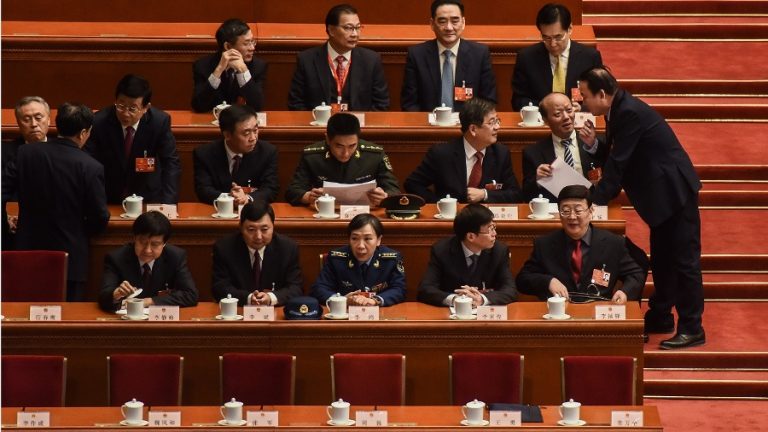
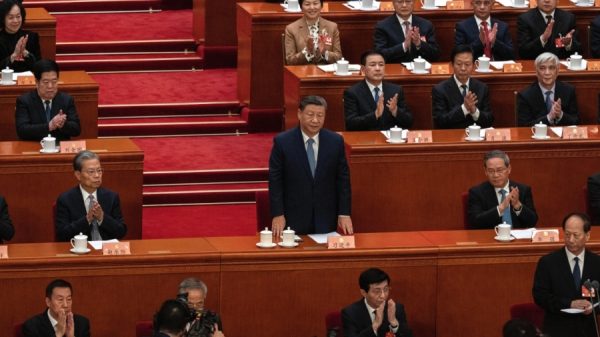
On Feb. 6, 2026, the 46th Chairperson’s Council Meeting of the 14th CPPCC National Committee convened in Beijing. Wang Huning, a member of the Politburo Standing Committee, the CCP’s supreme decision-making body, and the CPPCC’s chairman, presided and delivered remarks. Vice Chairpersons Hu Chunhua, Shen Yueyue, Ho Hau Wah, and Su Hui also spoke.
Success
You are now signed up for our newsletter
Success
Check your email to complete sign up
Of the CPPCC’s 23 vice chairpersons, 19 attended. Four were absent: Shi Taifeng; Phagpalha Geleg Namgyai, an 86-year-old Tibetan religious leader; Qin Boyong, a vice chairperson linked to corruption rumors; and Chen Wu, a former Guangxi regional leader whose subordinate was purged last year.
State media attributed Shi’s absence to a scheduling conflict. On the same day, Cai Qi, the Politburo Standing Committee member who runs the Party’s day-to-day operations as head of the Secretariat, visited prominent figures from the cultural, scientific, and technological sectors. Shi accompanied Cai in his capacity as Organization Department head, alongside Li Shulei, the Party’s chief propaganda official.
The Feb. 6 absence was the second time in less than half a month that Shi, the CPPCC’s top-ranked vice chairman, had missed a major CPPCC gathering.
On Jan. 21, 2026, the CPPCC held its annual symposium on macroeconomic conditions. Vice Chairman Wang Yong presided, and Wang Huning delivered remarks. Shi did not attend. In both January 2024 and January 2025, Shi himself had chaired the same symposium. The sudden change in 2026 has drawn scrutiny from political watchers.
Days before two military leaders fell from power, multiple senior figures were absent from a Party seminar
On Jan. 20, 2026, the CCP convened the opening session of a study seminar for provincial- and ministerial-level officials focused on the upcoming Fourth Plenum of the 20th Central Committee.
He Lifeng, one of China’s vice premiers and a close economic adviser to Xi Jinping, was absent because he was attending the World Economic Forum’s annual meeting in Davos. Several other senior figures were also missing: Zhang Youxia, vice chairman of the Central Military Commission and one of the most powerful figures in China’s military hierarchy; Ma Xingrui, a former Party secretary of the restive Xinjiang region; Shi Taifeng; and Liu Zhenli, chief of the Joint Staff Department, the PLA’s top operational command body.
The simultaneous absence of Zhang, China’s second-ranking military leader, and Liu triggered widespread speculation that both had encountered serious political trouble. Shi’s absence also drew attention, while Ma’s nonappearance attracted less concern given his previous record of missing meetings.
On Jan. 23, Shi reappeared publicly, presiding in person over the seminar’s closing ceremony. Zhang and Liu did not resurface. The following day, authorities officially announced that both had fallen from power, confirming what the absences had signaled.

A 2025 reshuffle moved a rival faction’s ally into control of CCP appointments, raising questions about Xi Jinping’s authority
In April 2025, the CCP carried out a rare high-level personnel reshuffle. Shi Taifeng was transferred from the United Front Work Department, the Party organ responsible for managing relations with non-Communist groups, to head the Organization Department. Li Ganjie, who had been running the Organization Department and is widely regarded as a close Xi Jinping ally, moved in the opposite direction to the United Front Work Department. Shi retained his roles as CPPCC vice chairman and deputy secretary of the CPPCC party leadership group.
Both men are Politburo members and Secretariat secretaries, making the exchange of portfolios at this level unusual in CCP political practice.
U.S.-based political commentator Tang Jingyuan told overseas Chinese-language media that the reshuffle sent a clear signal that Xi Jinping’s control over personnel decisions was weakening. Authority over Party cadre appointments traditionally rests with the Organization Department. While Li Ganjie is widely regarded as a close Xi ally, Shi occupies a different political position. Shi was a classmate of former premier Li Keqiang, who died in 2023 and was long associated with a rival power center, at Peking University’s law department. Shi is seen as having strong ties to the Communist Youth League faction, a network of officials who rose through the Party’s youth wing and have historically served as a counterweight to Xi’s personal loyalists.
According to Tang, Shi’s transfer to the Organization Department significantly expanded his real power, while Li’s move to the United Front Work Department diluted his influence. The net effect, Tang argued, was a shift in personnel authority away from Xi’s camp and toward officials associated with the Youth League.
Holding both the Organization Department and the CPPCC vice chairmanship breaks established CCP rules
Political commentator Yue Shan said Shi’s repeated absence from CPPCC leadership meetings since early 2026 confirms that CPPCC affairs have become secondary since he assumed control of the Organization Department. Yue said Shi may step down from the vice chairmanship during the Two Sessions.
When Shi previously served as head of the United Front Work Department, holding the CPPCC’s first vice chairmanship aligned with Party norms. The CPPCC functions as a united front institution, so the overlap made organizational sense. Continuing to hold the CPPCC post while leading the Organization Department violates that established convention, Yue said.
Such irregularities, Yue added, reflect the effects of intense internal power struggles under Xi Jinping, with long-standing rules increasingly cast aside.
Three other CPPCC vice chairpersons were absent from the Feb. 6 meeting, and at least two face corruption speculation
At the Feb. 6 CPPCC chairperson’s council meeting, three other vice chairpersons were also absent: Phagpalha Geleg Namgyai, Qin Boyong, and Chen Wu.
Since late September 2025, Hao Mingjin, vice chairperson of the National People’s Congress Standing Committee and chairman of the China National Democratic Construction Association, one of eight nominally independent parties that exist under CCP oversight, and Qin Boyong, a CPPCC vice chairperson and executive vice chairman of the same association, have repeatedly missed NPC, CPPCC, and association meetings.
On Oct. 30, 2025, Australia-based anti-CCP blogger Jiang Wangzheng wrote on X that Hao and Qin were under investigation and that a third association leader, Vice Chairman Shen Jinqiang, was cooperating with authorities, describing the situation as a “collective investigation.”
Qin appeared at the association’s 80th anniversary celebration on Dec. 17, 2025. Hao did not. Qin was absent from both the 44th CPPCC chairperson’s council meeting on Nov. 20, 2025, and the 46th meeting on Feb. 6, 2026.
A former Guangxi leader’s absences coincided with the purge of his protégé
Chen Wu, a CPPCC vice chairperson and former top official in the Guangxi Zhuang Autonomous Region in southern China, missed the Feb. 6 meeting. According to the CPPCC’s official website, he was also absent from the 35th chairperson’s council meeting on April 29, 2025, and the 36th meeting on May 28, 2025. Those absences coincided with the period during which his former subordinate, then-Guangxi regional government chairman Lan Tianli, fell from power. Lan’s removal was officially announced on May 16, 2025.

An 86-year-old Tibetan religious leader has been absent from all CPPCC meetings since March 2025
Phagpalha Geleg Namgyai, an 86-year-old Tibetan Buddhist leader who has served as a CPPCC vice chairman since 2003, attended the Two Sessions in March 2025 but has missed all subsequent CPPCC chairperson’s council and standing committee meetings.
On Feb. 2, 2026, Phagpalha again did not attend a meeting. State media reported that, under his authorization, a meeting of the Tibet Autonomous Region CPPCC Standing Committee was presided over by Vice Chairman and party deputy secretary Slang Nyima.
Phagpalha may have been absent for health reasons. Within CCP political practice, however, repeated absence from meetings is often viewed as a warning sign, frequently preceding formal investigations.
Editor’s Note: This article is based on Chinese state media reports, publicly available meeting records, and commentary from overseas Chinese-language analysts. Information concerning internal Communist Party deliberations and personnel arrangements cannot be independently verified and is presented as analysis or speculation attributed to the cited sources.