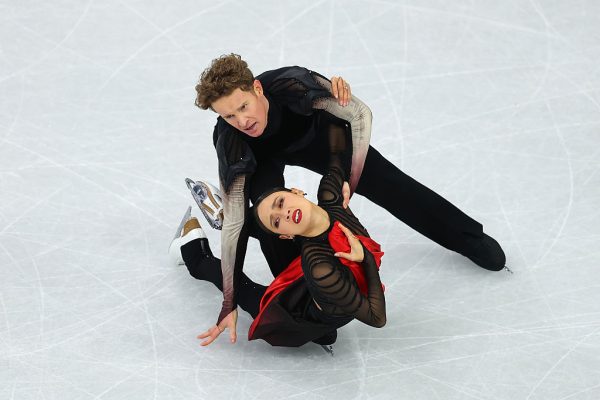
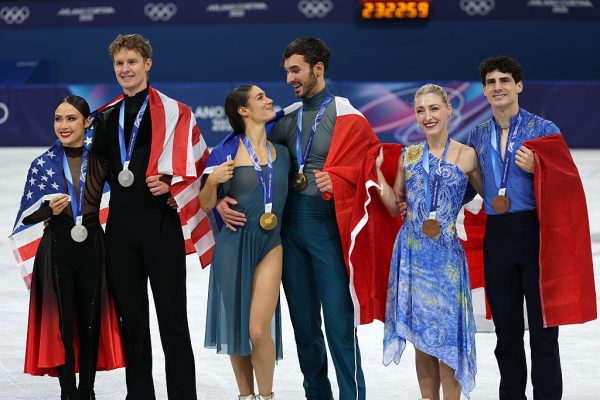
According to the New York Post, the figure skating world has recently been stirred by controversy over the scoring by French judge Jézabel Dabois. U.S. ice dance duo Madison Chock and Evan Bates finished second with a total score of 224.39, just 1.43 points behind French duo Laurence Fournier Beaudry and Guillaume Cizeron, who took gold with 225.82 points.
Within 24 hours after the competition, Dabois’s scoring quickly became the focus of public debate. Data shows that the score differences she gave between the French and U.S. teams deviated significantly from the trend of other judges and even conflicted with her own scoring logic for the same teams in other segments.

Abnormal point differences in individual segments raise questions
In the free dance segment, Dabois awarded the French duo 137.45 points, the second-highest among all judges. She gave Chock and Bates only 129.74 points, making her the only judge not to give the U.S. duo over 130 points. The point difference between the two teams was 7.71, the largest gap among the nine judges.
A similar situation occurred in the rhythm dance earlier. Dabois gave the French duo 93.34 points, while the U.S. team scored only 87.6 points, a difference of nearly six points. Multiple media outlets and data analysis agencies pointed out that this deviation from the overall average was not an isolated incident. Sports website SB Nation cited SkatingScores.com data showing that Dabois has previously been questioned for allegedly favoring French skaters.
In response to the controversy, an International Olympic Committee (IOC) spokesperson did not immediately respond to the New York Post’s request for comment.
Success
You are now signed up for our newsletter
Success
Check your email to complete sign up
Faced with the dispute, Chock told NBC that the team had experienced a “24-hour emotional rollercoaster” but remained proud of completing four high-level Olympic programs, considering it a highly valuable achievement.
Past controversies of the champion duo resurface
The current controversy also brought renewed attention to the background of the French champions. Fournier Beaudry had previously been in the spotlight due to her former partner and boyfriend, Nikolaj Sørensen. Sørensen was accused of sexually assaulting a U.S. skating coach and former athlete in 2012 and was banned in 2024. Although the ban was later lifted due to procedural issues, the case is still under review.
In the Netflix documentary Glitter & Gold, Fournier Beaudry publicly defended Sørensen and expressed regret over how the suspension affected his career.
At the same time, Cizeron has faced personal image controversies. His former ice dance partner and Beijing Winter Olympics champion Gabriella Papadakis described his training style in her memoir as “controlling, demanding, and overly critical.” Cizeron denied these claims, calling them a “smear campaign,” and said he was considering legal action to protect his reputation.
Neither athlete directly addressed these controversies during the Olympics, but Cizeron told Agence France-Presse (AFP) that these challenges strengthened their resolve, noting that the duo went from zero collaboration to Olympic champions in just 10 months—a feat widely regarded as “impossible.”
Safety and values debate continues
According to a commentary in USA TODAY, the gold medal outcome has also sparked broad social discussion. The article argued that awarding gold to a duo closely linked to someone involved in sexual assault controversy could send the wrong message to victims and parents.
The report noted that Sørensen was present in the audience during the competition and interacted with the French duo during the medal ceremony, further fueling public debate.
The commentary also highlighted that Chock and Bates, as a married couple, four-time Olympians, and seven-time U.S. champions, have long been core figures in U.S. ice dance. During the Beijing Winter Olympics, they served as captains of the U.S. figure skating team and helped stabilize the team amid the Kamila Valieva doping controversy involving Russian athletes.
In this Olympic cycle, the duo completed four high-intensity programs in six days and helped the U.S. team win the team gold. While they already hold a team gold medal, an individual Olympic gold remains a long-term goal.
The article concluded that the result not only disappointed the U.S. duo but also exacerbated long-standing issues in figure skating regarding scoring transparency and ethical standards.