By Jianyi
Leaked post claims China’s police chief will ‘step down’
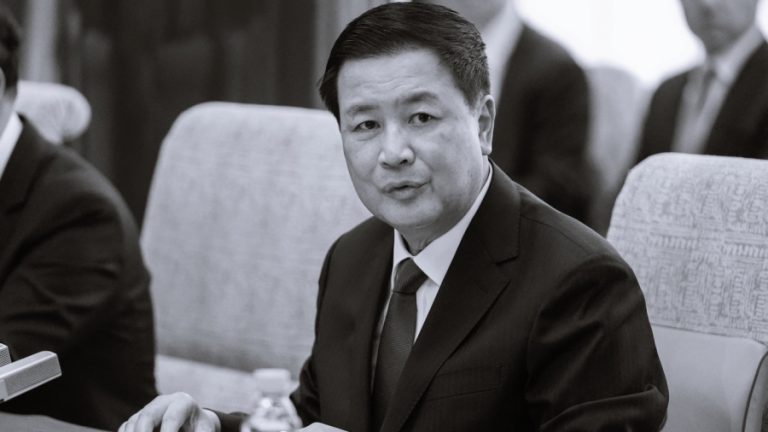
On Feb.12, two contradictory pieces of information appeared simultaneously on the internet. The first surfaced on X (formerly Twitter): “Public Security Minister Wang Xiaohong → out.” The second came from Xinhua, the Chinese Communist Party’s official news agency, reporting that Wang Xiaohong had attended a national police disciplinary conference and delivered a combative speech.
The leak came from Zhong Xinxi, a self-described “emerging Chinese writer and historical researcher,” and consisted of just eight Chinese characters. Those eight characters drew more than 400,000 views within 18 hours. Commenters called it a “bombshell.”
In follow-up replies, Zhong added that Wang Zhonglin, the current CCP Secretary of Hubei Province and a figure associated with Shandong-faction political networks, was the leading candidate to replace Wang Xiaohong as minister.

Cancer rumors and political calculations swirl around Wang Xiaohong’s exit
When asked why Wang Xiaohong would leave before the next CCP congress, Zhong answered simply: “His health is extremely bad.”
Success
You are now signed up for our newsletter
Success
Check your email to complete sign up
Speculation about the nature of his illness immediately flooded the comment sections. One commenter asked bluntly: “Did he get hit?” Others typed a single word: “Cancer.”
One user offered a timeline: “As early as January 2023, there were reports that Wang Xiaohong had late-stage liver cancer. The average survival for late-stage liver cancer is three to six months. Even with surgical resection or embolization, patients often cannot survive long due to cirrhosis. Fewer than 40 percent of liver cancer patients survive beyond three years. Fewer than 20 percent survive beyond five.”
Other commenters dismissed the health explanation as a cover story. “His power is too great, he has held it too long, and he has built his own mountain fortress,” one wrote, referencing the CCP term for an entrenched factional power base. “If they don’t find a reason to push him out now, he’ll end up like Zhang Youxia and Miao Hua and He Weidong,” referring to senior military leaders who were recently purged in Xi Jinping’s sweeping crackdown on the People’s Liberation Army.
“After Zhao Kezhi, this will be the second consecutive Public Security Minister who failed to complete a full term,” another noted, invoking Wang’s predecessor, who also departed the post early.
One commenter offered a four-character classical Chinese idiom that translates roughly as: “When the birds are gone, the bow is put away; when the hare is dead, the hound is cooked.” The meaning: once a loyal enforcer has served his purpose, the ruler discards him.
“Once Wang leaves the Public Security Ministry, he’s a dead man walking,” another wrote. “His reputation there is beyond toxic.”
Others believed the ouster had nothing to do with illness at all. “This is about throwing the Party’s biggest power-hungry insider to the wolves,” one wrote, “to cool down internal fury over the Zhang-Liu case,” referring to the purge of Zhang Youxia, the former Vice Chairman of the Central Military Commission, and Liu Zhenli, the former Chief of the Joint Staff Department of the CMC, both of whom were detained in 2025 in what many analysts view as Xi Jinping’s most dangerous intra-elite confrontation to date.
Beijing’s instant denial backfired
Within hours of the leak, Xinhua published a report showing Wang Xiaohong presiding over a national public security conference on Feb. 12. The speed of the response was striking.
Even more striking was the tone of Wang’s speech. He loudly reaffirmed the “Two Establishes” and “Two Safeguards,” the CCP’s core loyalty slogans pledging allegiance to Xi Jinping’s paramount authority, and stressed the need to uphold “the Party’s absolute leadership over public security work.”
Given the context, this performance was bizarre. Wang Xiaohong is widely understood to have played a direct role in the detention of Zhang Youxia and Liu Zhenli. A man in his position, at this moment, would have little reason to broadcast such ostentatious loyalty, unless he was desperately trying to shore up his standing. The display reeked of what Chinese internet users call “survival instinct.”
Cai Shenkun, an independent political commentator, wrote on X: “The internet says Wang Xiaohong has throat cancer and is about to hand over the knife. The denial came out immediately. Wang Xiaohong already serves beyond the normal age limit for the Public Security Minister post. Throat cancer rumors have circulated for years. People who know the real situation say the actual diagnosis is bladder cancer. He turns 70 next year and cannot possibly continue as minister.”

Who replaces China’s police chief? Four names are circulating
Cai Shenkun outlined four possible successors, each of whom reveals something about the factional balance Xi Jinping is trying to maintain:
Wang Zhonglin, the CCP Secretary of Hubei Province, is the most recently leaked name. He is five years younger than Wang Xiaohong and a prominent figure in Shandong-faction networks. If Wang Zhonglin gets the post, Cai argued, it would suggest that Peng Liyuan, Xi Jinping’s wife and a native of Shandong, exercises real influence over major personnel decisions. The Ministry of Public Security is a vice-state-level position, making a move from provincial party secretary a promotion into one of the most powerful posts in the State Council.
Shen Xiaoming, the CCP Secretary of Hunan Province, has been rumored as a candidate for longer. Shen has deeper credentials than Wang Zhonglin, having served as the top leader of two provinces. He entered Xi Jinping’s orbit during his time in Shanghai and is said to be close to Ding Xuexiang, the current Executive Vice Premier and one of Xi’s most trusted aides. Cai described him as having “the qualifications and the ability.”
Yin Hong, the CCP Secretary of Jiangxi Province, is the same age as Shen and also rose through the Shanghai system. During the 2025 National Day holiday, Shi Taifeng, the head of the CCP’s Organization Department, which controls all senior personnel appointments, made a special visit to Jiangxi to evaluate Yin. At the time, two versions circulated: Yin was being considered either to replace Cai Qi as Director of the General Office of the CCP Central Committee, or to replace Wang Xiaohong as Public Security Minister.
Shi Guanghui, a younger cadre born in the 1970s, is a less obvious candidate. Cai noted that Shi moved from Shanghai’s vice-mayorship to the post of Political and Legal Affairs Commission Secretary in Guizhou in 2018, and then transferred to the same post in Inner Mongolia in 2024. Many observers interpreted these moves as a sidelining. Cai argued the opposite: Shi had been serving as “Xi’s eyes and ears” in the provinces and had now completed his mission. His expected next step, according to Cai, is the governorship of Jiangxi, with the current governor moving up to replace Yin Hong as party secretary.
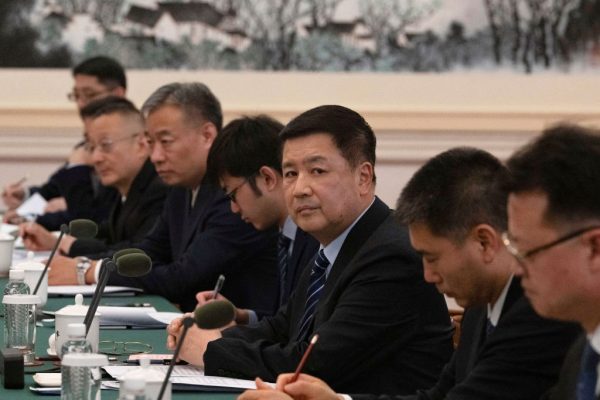
Did the military hand over evidence against Wang Xiaohong?
One commenter offered a sharp analysis: “Could it be that Wang Xiaohong’s dirt was handed directly to the disciplinary commission by the military? It’s the same pattern as Bo Xilai using Wang Lijun,” a reference to the 2012 political scandal in which Bo Xilai, the former CCP Secretary of Chongqing, was brought down partly through evidence provided by his own police chief, Wang Lijun, who fled to a U.S. consulate. “Wang Xiaohong has been involved in far more dirty business than that. When the Public Security Ministry recently pushed through all those internet regulations, I said at the time: they’re prescribing medicine for others while sick themselves. The ministry itself may end up getting purged.”
The Public Security Ministry faces a storm
In a thread titled “A Storm Is Coming to the Public Security Ministry,” commenters debated whether Wang Xiaohong faced personal danger or merely a career transition.
“Wang is stepping down for health reasons only. No storm,” one insisted.
The original poster shot back: “You’re getting a new boss. How is that not a storm?”
Another commenter raised a point many considered significant: “Wang Xiaohong should be safe, right? He’s the man who looked after Xi Mingze when they were both in Fujian.” Xi Mingze is the daughter of Xi Jinping, and Wang Xiaohong served in Fujian’s public security apparatus during the years Xi Jinping governed the province.
This argument drew fierce pushback. “That’s absurdly naive,” one replied. “Zhang Youxia’s family and Xi’s go back generations, and look what happened to him. Wang Xiaohong is just a lackey.” Another invoked a historical parallel: “Neil Heywood once looked after Bo Guagua in London, too,” referring to the British businessman whose murder by Gu Kailai, the wife of Bo Xilai, triggered the 2012 political crisis. “It’s precisely because he knows too much,” a third commenter wrote.
If Wang Xiaohong falls, the military purge victims may yet have the last laugh
If the leak proves to be another in a long line of “predictions that arrived ahead of schedule,” the final outcome of the power struggle between Wang Xiaohong and the purged military leaders remains deeply uncertain.
Viewed through the lens of Cultural Revolution history, Zhang Youxia, Liu Zhenli, and the military networks that support or sympathize with them still retain the potential to reverse their fortunes.
The day they do would be the day Xi Jinping falls.