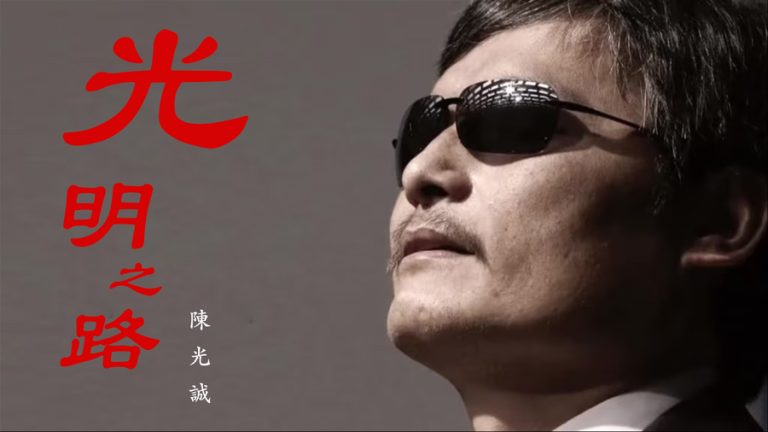
How a blind boy in rural Shandong became China’s most famous self-taught lawyer
Chen Guangcheng was born on Nov. 12, 1971, in Dongshigu village, Linyi, Shandong province. A single photograph survives from his infancy, taken when he was a few months old and his eyesight was still intact. At roughly five months, a severe fever destroyed his vision. His father was away and his mother was working in the village’s production brigade; by the time the family noticed, the damage was irreversible.
Chen retained only the faintest perception of light. Objects held directly before his eyes registered as blurred shapes and rough colors. Trees were indistinct green masses. People were shadows.
He was the fifth of five brothers. The villagers called him “Blind Five,” and few expected him to leave Dongshigu. He would eventually travel farther than anyone in the Chen family, and his name would be known around the world.

Radio signals from Taiwan taught a blind teenager to question CCP censorship
In 1989, at age eighteen, Chen enrolled at a school for the blind in Linyi, where he began learning to read and write for the first time. He was a late starter, but he quickly displayed an appetite for independent thinking and a deep curiosity about the world beyond his village.
The origins of that curiosity were older than his formal education. His father had read novels aloud to him as a child, and from the mid-1970s he had listened to radio broadcasts on the family’s single medium-wave receiver. The set could pick up Taiwanese stations. Chen still remembers the opening words: “Voice of Light, the Voice of Free China. Here is the news.”
Success
You are now signed up for our newsletter
Success
Check your email to complete sign up
One episode from the mid-1970s left a lasting mark. When he tuned to a Taiwanese frequency, an older brother immediately switched the radio off and warned him never to listen again. Chen asked why. The only answer he received was: “They’ll arrest you.” The exchange planted a seed. If the information was forbidden, there had to be a reason, and that reason was worth understanding.
In 1994, Chen transferred to a school for the blind in Qingdao. In 1998, he enrolled at Nanjing University of Chinese Medicine, where he studied acupuncture and massage therapy. A roommate in Nanjing owned a shortwave radio and tuned in to foreign broadcasts at night. Chen listened alongside him, and the programs sharpened his understanding of the social and political issues that Chinese state media either distorted or ignored.
Why Chen Guangcheng gave up medicine to fight the CCP’s abuse of disabled citizens
Growing up blind in rural China gave Chen early, firsthand experience of how the system treated people with disabilities. He taught himself Chinese law, and before long, he was using that knowledge to defend himself and his fellow villagers in disputes with local officials.
In the summer of 2000, he took an internship at a massage hospital in Luoyang, Henan province. Most of the patients, he recalled, were government officials and business executives. After graduating in 2001, he was assigned a post at a county-level traditional Chinese medicine hospital in Yinan. He never reported for duty.
The problems that mattered most, Chen concluded, were systemic. The country’s ailments were institutional, not physical. He abandoned medicine and devoted himself full-time to legal advocacy on behalf of the rural poor. Word spread. Villagers from across the region began seeking his help, and the Chinese and international press took notice. In 2002, the American magazine Newsweek put him on its cover. He became widely known as China’s “barefoot lawyer,” a self-trained advocate with no formal legal credentials who nonetheless took on the state.
During this period, radio remained his primary link to the outside world. Through shortwave broadcasts, he met Yuan Weijing, a foreign-language teacher who would become his wife. They married in 2003 over the objections of both families and had a son the same year. A daughter followed in 2005.
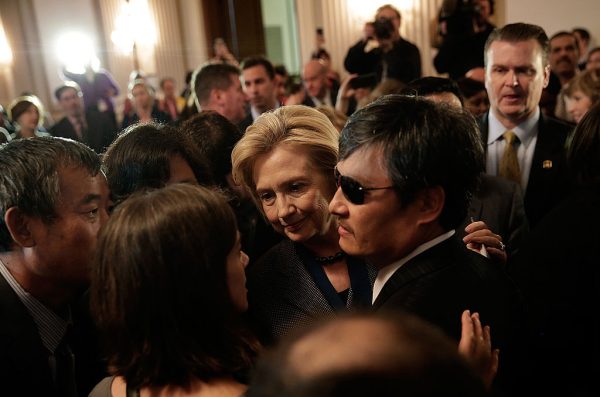
Chen Guangcheng documented 130,000 forced abortions and sterilizations in Shandong Province
In 2005, Chen and a group of associates began investigating violent enforcement of the one-child policy in Linyi, a prefecture-level city in Shandong. What they found was systematic brutality.
Local CCP authorities, led by the municipal Party secretary, had organized a multi-agency campaign involving the family planning commission and other government bodies. Teams operated around the clock, detaining women suspected of violating birth quotas.
By Chen’s count, roughly 600,000 people in Linyi were unlawfully detained, subjected to forced abortions, or coerced into sterilization that year. Of those, more than 130,000 underwent forced abortions or sterilization procedures. Chen demanded that prosecutors investigate the officials responsible and published his findings online.
The reaction from local CCP authorities was immediate and severe.
How the CCP turned a Shandong village into a surveillance fortress to silence one man
Beginning on Aug. 11, 2005, a large contingent of security personnel descended on Dongshigu village and placed Chen under extralegal house arrest. Guards were stationed around his home and at every intersection in the village. Work teams went door to door, pressuring villagers to withdraw their support for Chen and spreading claims that he was “collaborating with hostile foreign radio stations.”
His family was targeted as well. Chen’s older brother, Chen Guangfu, received threatening phone calls warning that if the family planning campaign encountered “problems,” both families would face consequences.
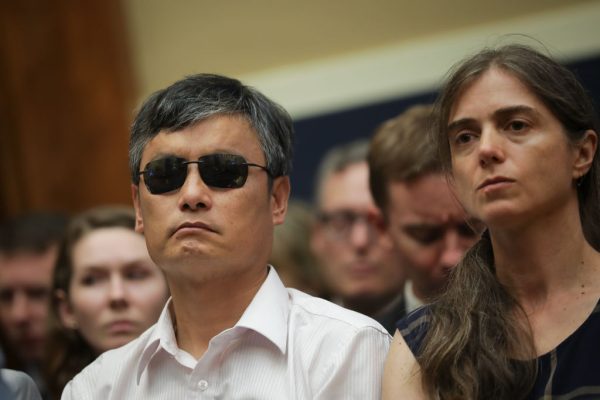
The CCP imprisoned Chen Guangcheng on fabricated charges after he exposed forced abortions
From March to June 2006, public security officers in Yinan county detained Chen for three months without producing valid legal documentation. He was then transferred to the Yinan county detention center.
Later that year, after two trials, a court convicted him of “intentional destruction of property” and “gathering a crowd to disrupt traffic order.” He was sentenced to four years and three months in prison.
Inside Linyi Prison, Chen obtained a shortwave radio through an intermediary, smuggling it past regular cell inspections. Prison authorities conducted periodic sweeps they called “clearing the cells,” during which inmates were lined up, searched, and their quarters ransacked. To hide the radio, Chen opened a boxed milk carton from the bottom, drank the contents, placed the radio inside, and resealed the package so it appeared untouched. He stored it among a case of identical cartons brought by visiting family members. Even during thorough searches, the radio went undetected.
Behind locked steel doors, the radio waves kept him connected to the world outside.
Chen Guangcheng left prison only to find his entire village had become a bigger cage
On Sept. 9, 2010, Chen completed his sentence and returned to Dongshigu. Within days, he realized he had merely exchanged one form of confinement for another. The prison had walls; the village had something more elaborate.
More than a week before his release, authorities had dispatched dozens of personnel to Dongshigu to prepare a comprehensive surveillance network. The Chen family home served as the center point, with guard positions radiating outward in every direction.
Sentries were posted at each corner of the house, then at every alley and intersection beyond. At four-way crossroads, guards stood at each corner, positioned so that every sentry remained within sight of at least two others. The southwest corner guard could see the southeast and northwest posts; the arrangement was fully reciprocal, creating a web of mutual surveillance designed to ensure that no guard could slack off or look away unnoticed.
The entire village became a locked perimeter around one family.

The CCP beat Chen Guangcheng’s wife until her bones broke after a smuggled video went viral
In February 2011, Chen and his wife Yuan Weijing secretly recorded a video documenting their conditions under illegal house arrest. The footage circulated online and gave the outside world its first direct look at what was happening in Dongshigu.
The authorities’ response was swift and brutal.
A group of men, including public security officers and local CCP officials, forced their way into the home. They knocked Yuan Weijing to the ground, threw a quilt over her body, dragged her to the courtyard, and pinned her down with one foot on the quilt while kicking her repeatedly. The beating lasted hours. She suffered fractures to her brow bone, upper eye socket, and ribs.
Over the following month, similar raids occurred three more times. The intruders produced no warrants, wore no uniforms, and carried no identification. They entered the home, beat the occupants, seized belongings, and left.
After the raids, a ring of high-definition surveillance cameras was installed around the residence, escalating the security cordon further. The Chen family was sealed off from the outside world. No one, including relatives, was permitted to approach.