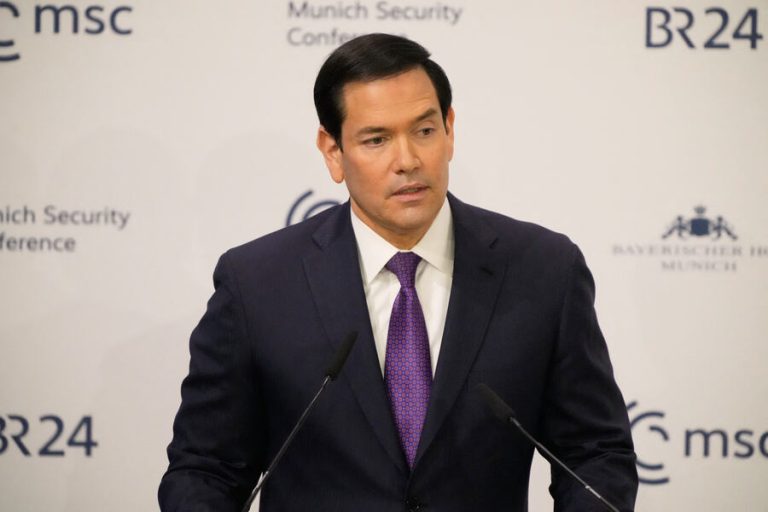
According to the Associated Press, U.S. Secretary of State Marco Rubio signaled reassurance to European allies at the Munich Security Conference on Saturday, Feb. 14. His tone was softer than in the past, but he firmly indicated that despite the strong rhetoric during President Trump’s administration, the U.S. still intends to reshape the transatlantic alliance and advance American priorities.
Rubio reminded the audience that the U.S. and Europe share centuries of deep connections. Even while promoting reforms in these relationships and institutions, the U.S. will remain closely linked with Europe, as these institutions have been the cornerstone of the post-World War II world order.
In his remarks, he recalled last year Vice President J.D. Vance’s sharp criticisms of European values and the subsequent Trump administration actions toward allies, including last month’s brief threat to impose tariffs on multiple countries to push for U.S. control over Greenland, a semi-autonomous territory of NATO ally Denmark.

US policy remains firm, warning of ‘migration crisis’ and ‘climate worship’
Despite the softer tone, Rubio made it clear that Trump administration policies have not changed. He criticized so-called “climate worship” and an “unprecedented wave of mass migration,” claiming they threaten the cohesion of Western societies.
Rubio noted that the West’s post-Cold War “euphoria” created a dangerous illusion of a “historical end,” assuming that every country would become a liberal democracy, trade and business ties would replace national bonds, the world would have no borders, and everyone would become a global citizen.
Success
You are now signed up for our newsletter
Success
Check your email to complete sign up
“We have collectively made these mistakes, and now we must collectively face the facts and rebuild the future,” Rubio said, emphasizing that the U.S. can sometimes appear direct and urgent because President Trump expects allies to take matters seriously and reciprocate.
He also reaffirmed that the U.S. does not seek the end of the transatlantic era: “Our home is in the Western Hemisphere, but we will always be Europe’s children.” The audience responded strongly, giving a standing ovation. Rubio also reviewed the history of U.S. forces fighting alongside allies from the Battle of Caen to Kandahar.

European allies stay cautious, seek greater autonomy
Europeans found Rubio’s speech reassuring but did not let their guard down entirely. European Commission President Ursula von der Leyen called the speech “very reassuring” but noted that “some voices in government are tougher.” She stressed that Europe must strengthen its independence, including defense capabilities, and uphold “digital sovereignty,” particularly in regulating hate speech on social media.
UK Prime Minister Keir Starmer said Europe should not become complacent and must rebuild close ties with the continent, promoting a shift from “over-dependence” to “mutual interdependence.” Estonia’s Defense Minister Hanno Pevkur called the U.S. claim of being “Europe’s children” a “rather bold statement” and emphasized that Europe still has work to do.
Regarding Greenland, Rubio made no mention. Last month, following Trump’s Arctic ambitions, the U.S., Denmark, and Greenland began technical security talks. Danish Prime Minister Mette Frederiksen described the meetings as constructive but maintained caution, emphasizing respect for sovereign nations and self-determination; Greenlanders clearly do not want to become part of the U.S.

Reaffirming alliance commitments, policy continuity in new form
Foreign Policy reported that Rubio’s Valentine’s Day speech could be seen as a “reconciliation” with Europe, contrasting sharply with Vance’s criticisms last year. Rubio highlighted the shared history, culture, and Christian heritage of the U.S. and Europe and expressed a desire to jointly “revive one of the greatest civilizations in human history.”
He urged Europe not to dwell only on the crisis in transatlantic relations but to seize the opportunity for a “radical update,” reshaping security and autonomous cooperation mechanisms. Belgian Defense Minister Theo Francken said the core content from both officials was similar, but Rubio’s speech carried more diplomatic nuance and emotional resonance.
At the same time, Rubio’s remarks continued Trump administration positions, including warnings on the “migration crisis” and “climate policy” and a cautious approach to multilateralism. U.S. Deputy Secretary of Defense Elbridge Colby said America will still honor commitments to allies through military means but is placing policies on a more sustainable foundation.