Reported exchange during Chinese New Year monitoring
“We are the millstone; we listen to the donkey.” “Who does the donkey listen to?” “Listen to the pig.”
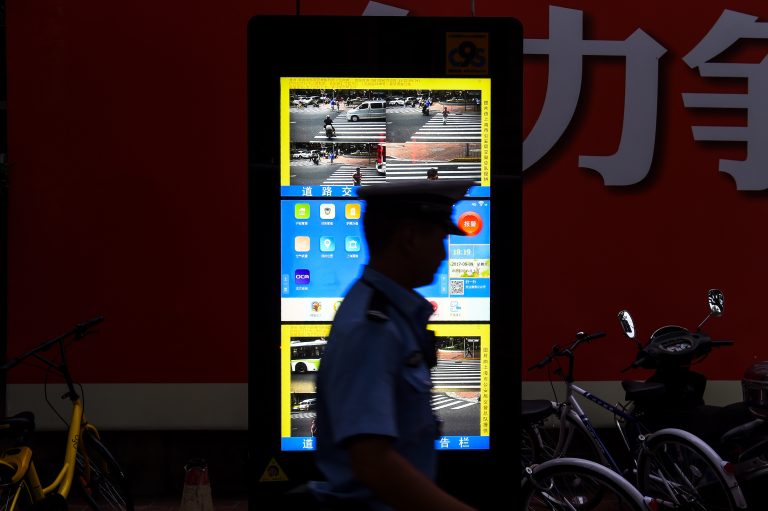
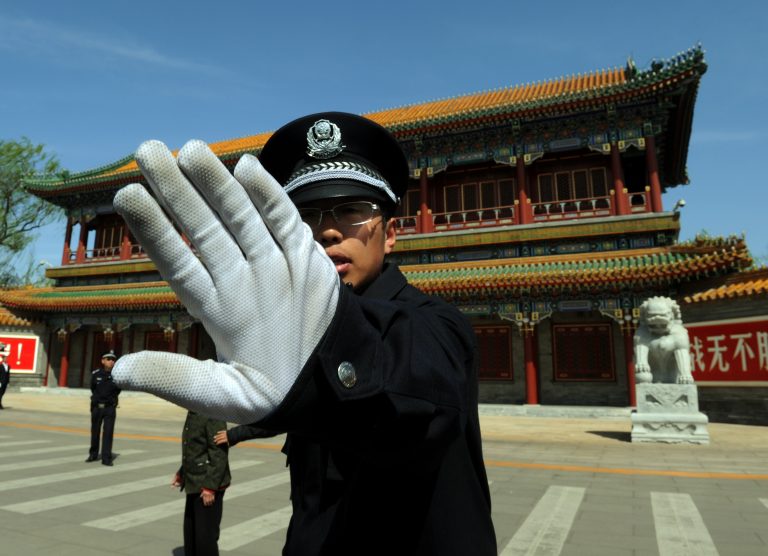
This brief exchange allegedly took place on the evening of Feb. 7 between Beijing police officers and individuals they were assigned to monitor.
The fifteen-character dialogue has been widely shared on Chinese social media. According to those circulating it, the remark suggests that even frontline “stability maintenance” officers tasked with enforcing political controls privately express cynicism toward the country’s top leadership. In the retelling, the “pig” is understood to refer to Xi Jinping.
Commentators presenting the exchange argue that it reflects underlying discontent within parts of the Chinese Communist Party (CCP) system and highlights the limits of official propaganda.

Elderly salon participants placed under guard
The reported incident occurred as Beijing entered what authorities describe as a “sensitive period” ahead of the Chinese New Year, a holiday traditionally marked by family visits and social gatherings. Instead, according to accounts posted online, several elderly residents were placed under surveillance.
Success
You are now signed up for our newsletter
Success
Check your email to complete sign up
Independent mainland journalist Gao Yu described her experience in a Feb. 13 post on X: “As the Year of the Red Horse approaches day by day, unexpectedly Beijing has entered another ‘sensitive period,’” she wrote. “When friends gather, as long as a little information leaks out, the authorities deploy from all sides; I was blocked at home once.”
Gao recounted that on Feb. 6, an 84- or 85-year-old Beijing woman died. Nine years earlier, the woman had participated in an “Enlightenment Salon” organized by Tao Shilong and Du Guang. The salon has since been banned by authorities.
According to Gao, the woman was cremated on the morning of Feb. 8, and no ashes were retained. On the evening of Feb. 7 at 8 p.m., Gao wrote, several people in Beijing who had attended the salon nine years earlier were placed under guard.
She described the exchange that followed. “Those in Haidian District who were inexplicably placed under guard questioned the police and received the answer: ‘The sub-bureau may not know either; it was directly arranged by the municipal bureau.’”
One resident reportedly told officers, “We don’t even know the name of who died; are you worthy of this police uniform by being so jittery?”
The reply, according to Gao: “We are the millstone; we listen to the donkey.”
When asked, “Who does the donkey listen to?” the officer responded: “Listen to the pig.”
Gao added that police visited her home on Feb. 9. When she asked their purpose, she said they replied, “Just coming to sit for a while.” Those placed under guard that day were reportedly not withdrawn until 8 p.m.
“In the days before and during the New Year, it is only human nature for relatives and friends to visit one another,” Gao wrote. Lawyer Pu Zhiqiang, she noted, could only say, “Someday, when passing by, I’ll come to see you.” “So we follow Lawyer Pu’s direction and route, passing by like this…”
The post prompted messages of support. One commenter wrote, “Mr. Gao has experienced the vicissitudes of life, yet his bearing has become more composed and his spirit clearer. At eighty-two, he has not lost half a bit of his vigor, but added a bit more grandeur.”
Another wrote, “Sister Yu looks even better; appearance comes from the heart.”

Commentary on Xinhua’s language
Separate commentary has focused on recent reporting by Xinhua News Agency, China’s official state news outlet. Some observers argue that dissatisfaction or irony can be detected in the way certain stories are framed.
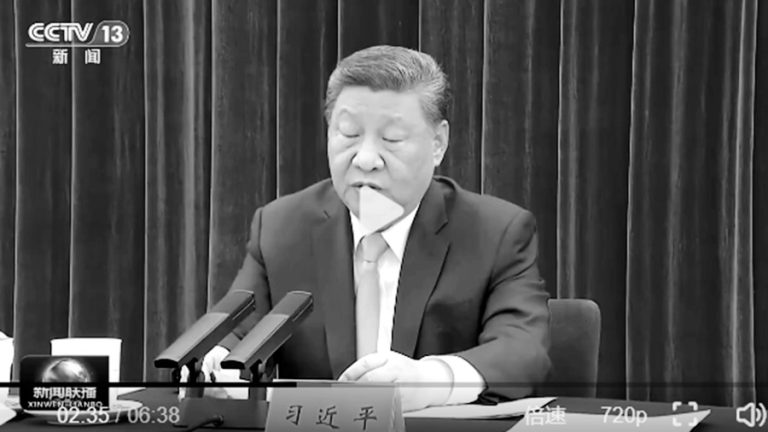
On Feb. 13, Xinhua published an article highlighting a proverb cited by Xi Jinping: “Red flowers still need green leaves to support them; a fence needs three stakes; a good man needs three helpers.”
At what critics describe as a politically sensitive moment, with Xi having largely consolidated control over the Central Military Commission, the article’s emphasis on the need for support was interpreted by some as indirectly undercutting the image of centralized authority.
In another report, Xinhua noted that Xi Jinping, “after learning that someone in a household was seriously ill, instructed local cadres to conduct in-depth research on the issue of poverty caused by illness.”
Some commentators questioned the phrasing. Rather than focusing on immediate medical or financial assistance, the article described Xi as directing officials to study the broader issue of illness-induced poverty.
Those analyzing the language argue that by recounting such details, Xinhua allows readers to form their own judgments. They describe this method as more indirect than the blunt language attributed to police officers, but potentially more deliberate.
Despite differences in tone, critics say both the reported police exchange and the wording in state media point to similar undercurrents within the system.
By Jian Yi