Police arrested Kwan on sedition charges for handing out flyers
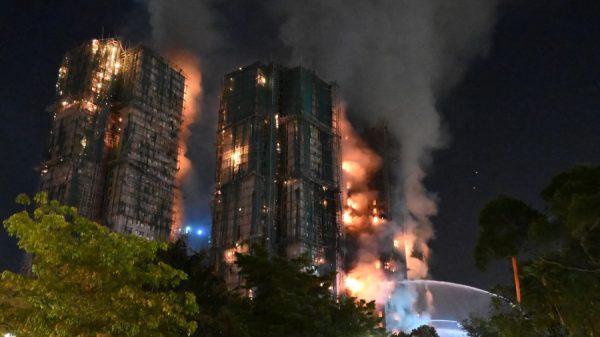
The Wang Fuk Court fire broke out on Nov. 26, 2025, reaching a five-alarm level in the Tai Po district. In the days that followed, Kwan created a social media page called the “Tai Po Wang Fuk Court Fire Concern Group” and began distributing flyers near Tai Po Market Station on November 28, urging the Hong Kong government to establish an independent commission of inquiry.
His petition outlined four demands: ongoing support for displaced residents with guaranteed adequate rehousing; an independent investigation into possible corruption and conflicts of interest in the building’s construction; a review of engineering oversight systems to prevent rubber-stamp inspections; and full accountability for government officials whose negligence contributed to the disaster.
On November 29, officers from Hong Kong police’s national security unit, the force responsible for enforcing Beijing’s sweeping national security law, arrested Kwan on suspicion of sedition. They detained him for two nights before releasing him on bail. Overnight, the petition’s social media accounts and webpages vanished.
CUHK launched disciplinary proceedings the day Kwan made bail
The university wasted no time aligning itself with the authorities. On the same day Kwan was released on bail, CUHK initiated a disciplinary process and referred the case to its Student Disciplinary Committee. The committee summoned Kwan to a hearing on charges of potential misconduct, but according to Kwan, it never specified which of his actions constituted a violation.
Kwan told Yahoo News that during the January hearing, panelists criticized his tone of voice and email language but failed to formally notify him of two new misconduct charges being considered. “They said I was disrespectful to the people at the hearing. I had no idea that could be grounds for punishment, and I was never given a chance to defend myself against those charges,” he said. He argued that if the committee intended to add new allegations, it should have convened a separate hearing and given him the right to respond.
Success
You are now signed up for our newsletter
Success
Check your email to complete sign up
Throughout the proceedings, Kwan said he was never told the specific substance of the charges against him. When he asked panel members for clarification, they told him it was the panel’s turn to ask questions, not his.

The university punished Kwan for calling the process a ‘kangaroo court’
In email exchanges with the disciplinary panel, Kwan described the hearing as a “kangaroo panel” and a “circus,” and called the disciplinary committee a “disgrace.” When questioned about these remarks during the hearing, he explained his reasoning: the university was using its institutional power to interrogate someone who had not been convicted of any crime, without even specifying the charges. That, he said, made the entire exercise a farce.
The committee acknowledged it lacked sufficient grounds to punish Kwan for the arrest itself. Instead, it seized on his language, his attitude during the hearing, and the claim that his actions could damage the university’s reputation. Combined with a prior disciplinary record that included a politically motivated criminal damage charge in 2022 for posting stickers commemorating the June 4 Tiananmen Square massacre, the committee tallied three major infractions and expelled him.
According to a letter from CUHK and reporting by Agence France-Presse, the committee’s Feb. 12 decision cited “multiple acts of misconduct,” including Kwan’s public criticism of the disciplinary process and his accumulated record.
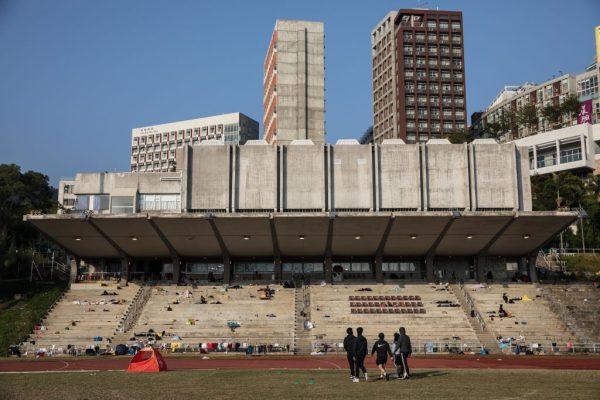
Kwan had completed all coursework and was weeks from graduating
Kwan enrolled at CUHK in September 2020, majoring in Government and Public Administration. He had been suspended twice during his studies and attended classes intermittently, but by the end of 2025 he had completed every required credit. He was scheduled to graduate in March 2026.
The expulsion erased more than five years of academic work. In an interview with The Collective, Kwan said the result did not surprise him. He attributed it partly to the government’s will and partly to individuals within the system who, given a small amount of power, relish the opportunity to punish people the regime wants silenced. “CUHK is using a diploma as a tool to suppress a former student. That is the university’s shame,” he said. “They can take my degree, but they cannot take my dignity. I refuse to provide cover for petty people who enjoy carrying out repression.”
On the committee’s claim that he violated confidentiality rules and damaged CUHK’s reputation, Kwan pushed back: if the university’s own sham proceedings damage its reputation, that is the university’s problem to solve.
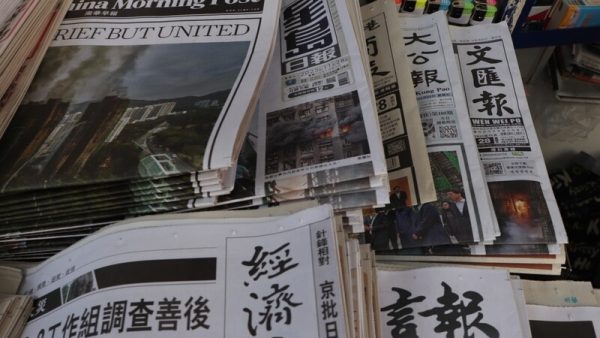
The petition drew over 10,000 signatures before authorities shut it down
Before police intervened, the petition Kwan organized in coordination with several CUHK student unions attracted more than 10,000 signatures. The scale of public support reflected widespread anger over the Wang Fuk Court fire and the government’s failure to hold anyone accountable.
The crackdown that followed extended well beyond Kwan himself. Within two months of the petition, five of CUHK’s nine college student unions, including those at Shaw, Wu Yee Sun, New Asia, United, and Lee Woo Sing colleges, were pressured into suspending operations or forced to disband. Chung Chi College’s student union announced its own immediate suspension on January 17. Combined with King’s College student union, which had already been shut down the previous year, only two registered student unions, at S.H. Ho College and Morningside College, remained active.

Hong Kong’s shrinking space for campus activism
Kwan told reporters the case illustrates the accelerating destruction of free expression on Hong Kong campuses and across the city. The pattern is now routine: civic action triggers a national security response, compliant institutions pile on with internal discipline, and the individual loses years of work while the underlying grievance goes unaddressed. No government official has been held accountable for the Wang Fuk Court fire.
The news of Kwan’s expulsion provoked strong reactions online. Commenters expressed dismay that caring about public safety could cost a student his degree, criticized CUHK’s faculty for bringing shame on the university, and urged Kwan to leave Hong Kong and build a life abroad. One widely shared comment captured the mood: “The most effective way to deal with a problem is to get rid of the person who raised it.”