
Amid ongoing tensions between the U.S. and Iran, and with both sides set to hold critical talks in Switzerland, a BBC fact-checking team has confirmed via satellite imagery that the United States is conducting an unprecedented military buildup in waters surrounding Iran. This deployment not only includes the nuclear-powered aircraft carrier USS Abraham Lincoln leading a strike group, but will also see the addition of the world’s largest warship, the USS Gerald R. Ford, creating a rare dual-carrier deterrent posture. Military experts note that the U.S. military’s current preparations in the Middle East are “deeper and more sustained,” clearly exceeding the scale of recent operations against Venezuela or Iranian nuclear facilities.
Satellite tracking reveals carrier movements
BBC reported on Feb. 17 that fact-checking journalists Richard Owen-Brown and Alex Murray successfully located the exact position of the USS Abraham Lincoln using publicly available imagery from Europe’s Sentinel-2 satellite. The Nimitz-class nuclear-powered aircraft carrier is currently in the Arabian Sea, approximately 150 miles (240 km) off the coast of Oman, and about 700 km from offshore Oman.
Since being reportedly deployed to the Persian Gulf region at the end of January, the carrier had not appeared in satellite imagery, mainly due to its passage through relatively sparse coverage in international waters. In contrast, land-based military assets are easier to monitor continuously via satellite. The Abraham Lincoln carries around 90 aircraft of various types, including advanced F-35 fighters, and approximately 5,680 crew members, giving it formidable sea and air combat capabilities.
Notably, the U.S. Navy’s newest and most advanced aircraft carrier, the USS Gerald R. Ford, is en route to the Middle East and is expected to arrive within the next three weeks. At that point, the U.S. will establish a dual-carrier strike group near Iran—a scale of force assembly rarely seen in recent Middle East operations.
Twelve warships form a strategic network
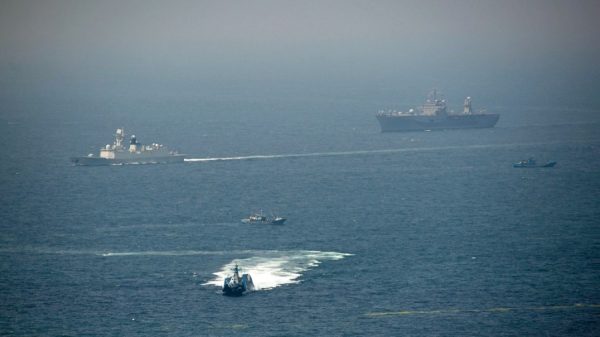
Satellite imagery confirms that up to 12 U.S. warships are currently deployed in the Middle East, forming a complex and powerful maritime operational network.
Success
You are now signed up for our newsletter
Success
Check your email to complete sign up
Centered on the Abraham Lincoln, the carrier strike group includes three Arleigh Burke-class guided-missile destroyers, providing air superiority, sea control, and long-range strike capabilities.
Two additional destroyers with long-range missile capabilities are deployed in separate waters, offering flexible fire support.
Three vessels specialized for nearshore operations are currently docked at Bahrain’s naval base in the Persian Gulf, a key hub of the U.S. Fifth Fleet.
Two destroyers are near the U.S. base at Souda Bay in the eastern Mediterranean, and another is operating in the Red Sea, creating a strategic chain from the Mediterranean to the Indian Ocean.
This distribution indicates that the U.S. is constructing a “multi-layered ring presence” from the eastern Mediterranean, Red Sea, and Arabian Sea to the Persian Gulf, ensuring rapid deployment of sea and air forces under any potential conflict scenario.
Iran responds firmly with Strait of Hormuz exercises
In response to the U.S. military display, Iran acted swiftly. After the U.S. Central Command released photos of the Abraham Lincoln in the Arabian Sea on Feb. 6, the Islamic Revolutionary Guard Corps conducted large-scale naval exercises in the Strait of Hormuz.
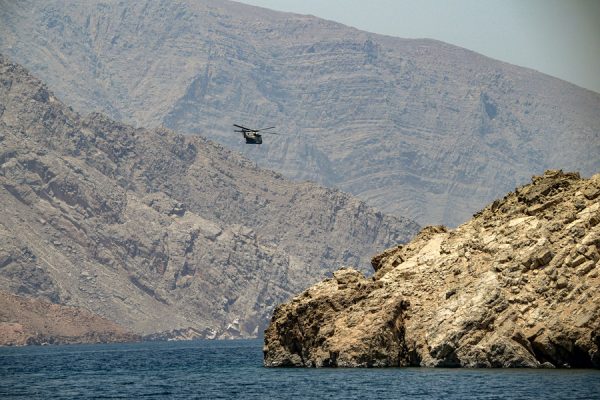
The strategic importance of the Strait of Hormuz cannot be overstated. This narrow waterway between Oman and Iran is one of the world’s most critical energy transit routes. About one-fifth of global oil and gas passes through here, including significant crude exports from Iran’s primary terminal on Kharg Island. Any military conflict in the region could have catastrophic effects on global energy markets.
Revolutionary Guard commander Major General Mohammad Pakpour personally oversaw the exercises and flew over Kharg Island in a helicopter. According to Tasnim News Agency, closely affiliated with the Guard, missiles were fired during the drills, demonstrating Iran’s ability to blockade the strait and strike maritime targets. This sends a clear signal to the U.S.: Iran has both the capability and the willingness to cut off this vital energy route if necessary.

Experts: deterrence surpasses past operations
Justin Kramp, CEO of risk intelligence firm Sibylin and military intelligence expert, told BBC that current U.S. preparations in the Middle East are “deeper and more sustained,” exceeding the January military operation against former Venezuelan President Nicolás Maduro and last June’s “Midnight Hammer” airstrike on Iranian nuclear facilities.
In the Venezuela operation, the Gerald R. Ford was deployed to the Caribbean, with eight U.S. warships in the region, but relatively few aircraft were used since air support could be provided from the U.S. mainland or Puerto Rico. Venezuela’s military was generally considered weaker, unlikely to mount effective retaliation.
In contrast, last year’s “Midnight Hammer” operation faced a militarily stronger Iran. At that time, the U.S. deployed two carrier strike groups in the Middle East, five destroyers in the Mediterranean and Red Sea, and three combat vessels in the Persian Gulf. Fighter squadrons and aerial refueling tankers were sent from the U.S. to Europe, but B-2 stealth bombers carrying out strikes on Fordo, Isfahan, and Natanz nuclear sites took off directly from bases in Missouri.
Kramp emphasized that the current number of ships, aircraft, and eight regional air bases enables the U.S. military to conduct “relatively intense and sustained strikes,” with approximately 800 sorties per day. “What we’re seeing is not just strike readiness, but broader deterrence deployment that can expand or contract as needed. This configuration has greater depth and continuity than last year’s Venezuela or ‘Midnight Hammer’ operations. The aim is to maintain combat readiness and counter any potential Iranian responses to U.S. assets—including Israel.”
Timing of the US military buildup is extremely sensitive
This large-scale military buildup comes at a highly sensitive time. U.S. and Iranian officials are scheduled to hold the second round of critical talks in Switzerland on Tuesday, Feb. 17. Iran stated that discussions will focus on its nuclear program and potential U.S. sanctions relief, while Washington aims to address broader issues.
The current military standoff is not isolated but represents an escalation of longstanding U.S.–Iran tensions. Iran’s ongoing nuclear program has long drawn international concern, and its recent crackdown on domestic protesters has drawn condemnation. U.S. reinforcement at this moment is seen as both a “negotiation leverage” and an “insurance policy” outside the talks.
Military experts generally agree that the U.S. deployment is not a simple preemptive strike posture, but a strategy to ensure it can suppress potential Iranian reactions under any scenario. This deployment serves as both strategic deterrence against Iran and preparation for possible military action while reassuring regional allies, particularly Israel.
Energy security and global impact
The strategic position of the Strait of Hormuz means that any military conflict could trigger global economic ripple effects. Iran has repeatedly hinted it could block or disrupt shipping there if seriously threatened, aiming to drive up global oil prices and create energy market volatility.
However, the U.S. current air and naval deployment in the Red Sea, Gulf of Oman, and Arabian Sea aims to “minimize” the effectiveness of such Iranian actions. Enhanced maritime patrols, mine-clearing, air defense, and missile interception systems are intended to prevent Iran from gaining a strategic advantage, even if tensions escalate.
With the Abraham Lincoln now in Iranian waters and the Gerald R. Ford en route, combined with existing destroyers, combat ships, and regional air base support, the heightened military tension in the Middle East is unlikely to ease in the short term.
The future trajectory will largely depend on key factors: the outcome of the U.S.–Iran Swiss talks, internal developments in Iran, regional conflicts and proxy actions, and the reaction of global energy markets.