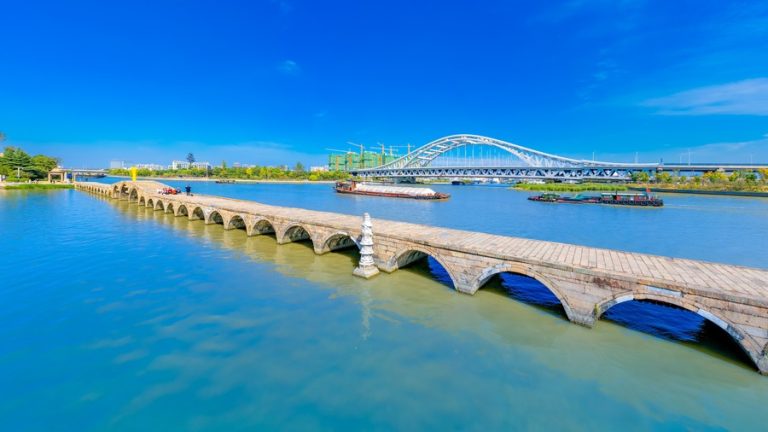
In southwestern Suzhou, Jiangsu Province, a long ribbon of stone stretches across the waters of the Beijing–Hangzhou Grand Canal.
Baodai Bridge has stood here for more than a thousand years.
It is one of China’s oldest surviving large-scale stone arch bridges. First built during the Tang Dynasty, the bridge carries both architectural distinction and legend. According to historical accounts, Wang Zhongshu, then prefect of Suzhou, donated his treasured jade belt to fund the construction. In remembrance of this act, the bridge was named “Baodai,” meaning “Precious Belt.”
Suzhou’s terrain is interwoven with rivers and lakes. Bridges define its landscape and have shaped its identity as a water city. Among them, Baodai Bridge is regarded as the most magnificent.
The bridge lies about 3.5 kilometers southeast of Fengmen Gate, outside Suzhou, within what was historically Wu County. It spans the Dadai River, positioned between the Grand Canal and Dantai Lake. For centuries, it functioned as a key passageway for ships traveling through Wusongkou and along the canal system.
Success
You are now signed up for our newsletter
Success
Check your email to complete sign up
It also once served as part of the overland route linking Suzhou with Hangzhou, Jiaxing, Huzhou, and other cities in the Jiangnan region.
Baodai Bridge extends roughly 317 meters and is composed of 53 connected stone arches — the highest number of arches among existing ancient bridges in China. Its profile is slender and low. From afar, it resembles a jade belt laid gently across the water.
The design is practical as well as visually restrained. Dozens of arches are joined in sequence, distributing water pressure while allowing vessels to pass beneath. Over time, the bridge underwent repeated repairs during the Song, Yuan, Ming, and Qing dynasties, yet it remains well preserved today.
The original construction dates to the 14th year of the Yuanhe era of the Tang Dynasty, around 816–819 AD. Historical tradition holds that Wang Zhongshu’s donation financed the project, and the bridge’s name commemorates that gesture.
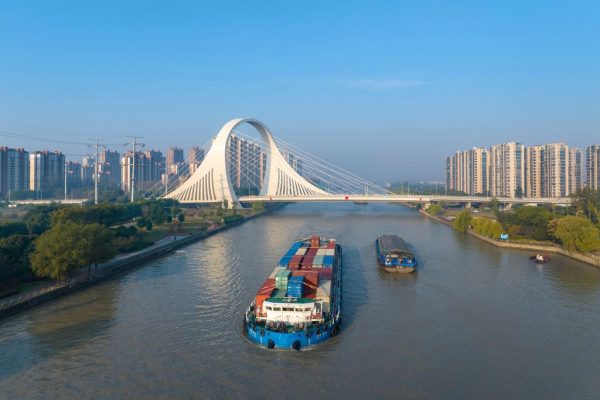
Suzhou’s bridge with the most arches
The bridge stands beside the Grand Canal, framed by gently rolling hills. Distant mountains and nearby waters form a natural backdrop. The structure itself resembles a long rainbow resting on waves. Seen from afar, it appears like a jade belt floating above green fields.
This imagery is sometimes cited as another explanation for its name. The form is vivid and expressive, contributing to its reputation as Suzhou’s foremost bridge.
Across successive dynasties, the bridge was rebuilt or repaired six times. The structure visible today largely dates to a reconstruction completed in 1872, during the eleventh year of the Tongzhi reign of the Qing Dynasty.
Of its 53 arches, most have an average span of about 4.6 meters, except for the 14th, 15th, and 16th arches. These three gradually widen and rise. As their spans increase, the bridge deck ascends correspondingly. From the 13th to the 17th arches, the surface curves upward, reaching approximately 7.5 meters at its highest point at the 15th arch.
The bridge openings vary in shape. There are round arches, semicircular arches, small semicircular arches, and large ox-round arches. Some form complete circles. Others appear half above the water and half below. The full circular arch design enhances structural strength while lending the bridge a graceful overall curve.
The structure reflects a balance between function and economy. All arches are navigable. Three larger arches in the central section were designed with higher clearance to accommodate larger vessels, while the remaining arches are smaller. The connected-arch system reduces the overall height of the bridge, lowers construction demands, lightens its weight, and facilitates both boat towing and flood discharge.
The concept demonstrates careful planning and technical foresight.
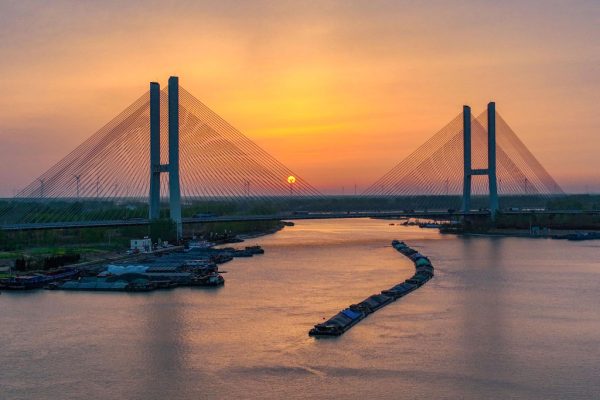
Distinctive construction of the piers
The engineering of the bridge piers is equally notable.
To prevent chain collapse among multiple arches, builders adopted two structural forms: “flexible piers” and “rigid piers.” The arch masonry does not follow the “single arch combination” method used in the Zhaozhou Bridge, nor the “strip stone arc masonry” method seen in the Lugou Bridge. Instead, it employs a “multi-hinged arch” technique that integrates advantages from both systems.
Such a method is rare in ancient bridge construction history. It extends the structure’s durability while preserving a sense of lightness in its form.
Because the foundation soil at the site is soft, wooden piles were used. Each pier rests on 60 round wooden piles, each measuring between 15 and 20 centimeters in diameter. Stones were inserted between the piles and their heads, reinforcing stability without obstructing floodwaters.
The bridge was built using hard, plain Jinshan stone. Originally, pairs of bluestone lions stood at both the northern and southern ends. Today, the pair at the north end remains, while the southern pair has sunk into the riverbed.
At the north end stand a four-eaved stele pavilion and a stone pagoda.
The pagoda rises about four meters high and was carved from a single block of bluestone into a five-tiered, eight-sided structure. Its square base is decorated with carved sea waves and cloud-dragon motifs. The tower finial is assembled from arranged stone blocks. Each of the five levels has eight sides, and each side contains a niche with a Buddha statue.
These carved details add further distinction to the bridge.
In the history of Chinese bridge architecture, Baodai Bridge is recognized as a “multi-arch thin-pier connected stone bridge” distinguished by complexity, variation, and structural refinement.
When the moon rises high during the Mid-Autumn Festival, each arch casts its reflection upon the water. The mirrored arcs shimmer like a string of pearls moving with the waves.
A traditional verse describes the scene:
“A phoenix hairpin lost from the jade terrace,
A jade belt lying on the water reflecting green moss;
When the Mid-Autumn moonlit night arrives,
Fifty-three arches cast their reflections.”
In moonlight, stone, water, and sky align in quiet symmetry. The bridge stands in harmony with Suzhou’s ancient waterways, uniting practical function with enduring artistry.
Baodai Bridge remains not only a feat of engineering, but also a lasting presence within the cultural landscape of China’s Grand Canal.
By Yi Wen