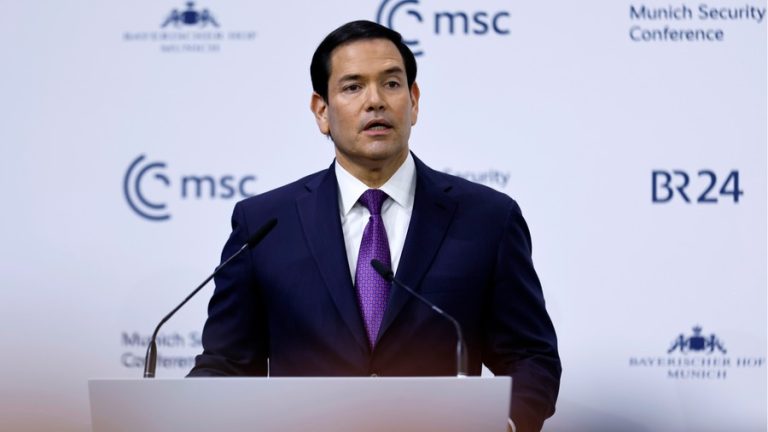
Amid a year marked by tension and uncertainty between Washington and European capitals, U.S. Secretary of State, Marco Rubio, addressed the 2026 Munich Security Conference with the goal of easing strains.
At the previous conference, held in early 2025 shortly after President Donald Trump assumed office for his second term, Vice President J.D. Vance had stunned European leaders with sharp criticism, setting off months of friction. European governments then faced tariff threats that ended in compromise, uncertainty over NATO commitments that prompted renewed defense spending pledges, and White House efforts to pursue control of Greenland, which triggered urgent talks and new European attention to Arctic security.
Many in the audience expected confrontation. Instead, Rubio’s tone signaled recalibration.
The broader conference theme was the weakening of the postwar order. German Chancellor Friedrich Merz declared that the rules-based system “no longer exists,” pointing to widening divisions between Europe and the United States. Similar warnings surfaced at January’s World Economic Forum in Davos, where Canadian Prime Minister Mark Carney described a “fracturing” global framework. The “Munich Security Report 2026” argues that the U.S.-led order built over eight decades is under strain and repeatedly references President Donald Trump as a central actor in that disruption.
Rubio rejected the idea that recent American policy alone caused the breakdown.

Success
You are now signed up for our newsletter
Success
Check your email to complete sign up
From the ‘end of history’ to strategic miscalculation
In Munich, Rubio traced the problem to the post–Cold War embrace of globalization. Western leaders, he argued, assumed that history had reached a liberal democratic endpoint, that economic integration would dissolve geopolitical rivalry, and that a “rules-based global order” would supersede national interests.
That premise proved flawed. While the United States and Europe opened markets, other states shielded domestic industries, heavily subsidized national champions, and used Western access to strengthen their own strategic positions. Factories closed, supply chains shifted abroad, and segments of the middle class saw jobs disappear.
Although he did not explicitly name China in this portion of his remarks, the references were clear: state-directed subsidies, managed trade practices, and strategic control of critical supply chains.
For years, critics in Washington have argued that China leveraged its accession to the World Trade Organization to accumulate power without political liberalization. Testifying before the U.S. Senate in 2023, Rubio described China’s WTO entry as a turning point. The belief that capitalism would transform China politically, he argued, proved mistaken. Instead, China grew wealthier while tightening internal control and promoting its governance model abroad.
In that model, centralized authority presents itself as more efficient than democracy, capable of long-term planning unconstrained by electoral politics. The result, in Rubio’s framing, is a stronger Chinese Communist Party at home and a more assertive posture overseas.
That assessment appears in the 2025 U.S. National Security Strategy. The document contends that decades of globalization hollowed out America’s industrial base while empowering a strategic competitor. It cites state-led industrial subsidies, unfair trade practices, intellectual property theft, supply-chain coercion, and influence operations. It also links Chinese exports of fentanyl precursors to the U.S. opioid crisis.
The conclusion embedded in both Rubio’s remarks and the strategy document is that the economic architecture underpinning the postwar order no longer functions as intended.
Europe reached similar findings earlier. In December 2017, the European Union’s first “Market Distortion Report” concluded that China’s economy was shaped by extensive state intervention and industrial overcapacity. Yet despite those concerns, Europe has continued deep economic engagement with Beijing, reflecting both dependency and internal divisions.
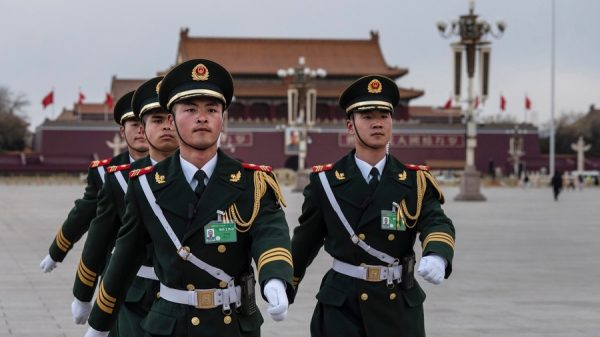
A parallel warning on military expansion
Rubio’s argument extended to security. Western governments, in his telling, expanded welfare systems and delegated authority to international institutions while neglecting defense capabilities. At the same time, rival powers accelerated military modernization and used energy resources as instruments of leverage.
The implication again pointed to Beijing.
China’s GDP ranks second globally, yet household consumption remains comparatively low. In 2019, it stood at 38.8 percent of GDP, below levels common in many developing economies. Critics argue that a substantial share of national wealth has been directed toward state priorities, including sustained military buildup.
The 2025 China military power report issued by the U.S. Department of War states that the People’s Liberation Army has mobilized financial resources, technology, and political will to build what Beijing calls a “world-class military.” The report describes expanding nuclear forces, naval capabilities, long-range strike systems, cyber operations, and space assets. It cites 2024 cyber espionage activities, including operations known as “Volt Typhoon,” as evidence of Beijing’s capacity to infiltrate critical U.S. infrastructure.
The Pentagon’s 2026 National Defense Strategy reflects a calibrated stance. The unclassified 34-page document no longer labels China a “strategic competitor,” and it states that the United States does not seek confrontation. At the same time, it emphasizes deterrence in the Indo-Pacific and insists that no power should dominate the region. Taiwan does not appear in the public version.
The strategy describes China as the most powerful country relative to the United States since the 19th century. It calls for deterrence “through strength rather than confrontation,” signaling vigilance without open escalation.
The article contends that several Trump administration actions beginning in 2026, including moves related to Venezuela, Greenland, and Iran, are connected to countering China’s expanding global footprint.
Reform, not retreat
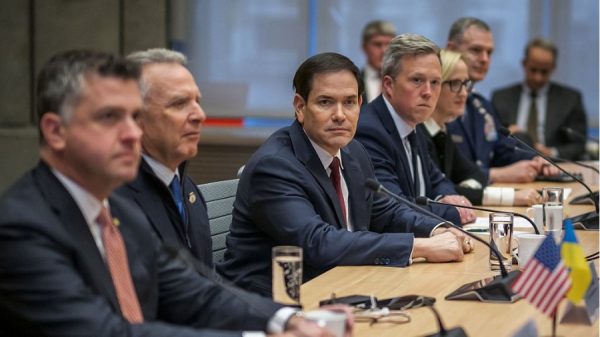
Rubio framed his appeal as institutional reform rather than abandonment. The United States, he argued, will no longer subordinate national interests to what he called a “so-called global order.” Yet he did not advocate dismantling postwar institutions. Instead, those systems must be rebuilt.
He invited Europe to take part in that reconstruction. The United States, under President Trump, is prepared to move forward alone if necessary. But partnership with European allies remains the preferred course.
Whether that partnership deepens remains uncertain. Disputes over climate policy, trade, multilateralism, and immigration have strained trust. In the near term, full alignment on trade rules and geopolitical strategy appears unlikely.
Recent European diplomacy underscores that tension. Chancellor Merz warned in Munich that China systematically exploits economic dependencies. Nevertheless, he plans to visit Beijing with a large business delegation. Canada reduced tariffs on Chinese electric vehicles while imposing quotas to limit volumes. The United Kingdom approved construction of a major new Chinese embassy even as tensions rose following the sentencing of Hong Kong media tycoon Jimmy Lai to 20 years in prison. London responded by easing visa procedures for thousands of Hong Kong residents, prompting criticism from Beijing.
French President Emmanuel Macron, after returning from China, warned that the European Union could impose tariffs if Beijing fails to address its trade surplus. A French strategic planning body recommended a 30 percent tariff on Chinese imports. Macron has called for protecting European industry, noting that both China and the United States shield domestic sectors. His shifting rhetoric illustrates Europe’s balancing act.
Rubio closed with a reaffirmation of transatlantic ties. “We will always be Europe’s children,” he told the audience, drawing a standing ovation. European Commission President Ursula von der Leyen later described the speech as reassuring.
The United States, Rubio made clear, does not intend to manage what he characterized as an orderly Western decline. Instead, the objective is renewal: a revitalized alliance and a restructured international order capable of withstanding strategic rivalry.
By Zhu Zhongguo
(The article represents only the author’s personal views.)