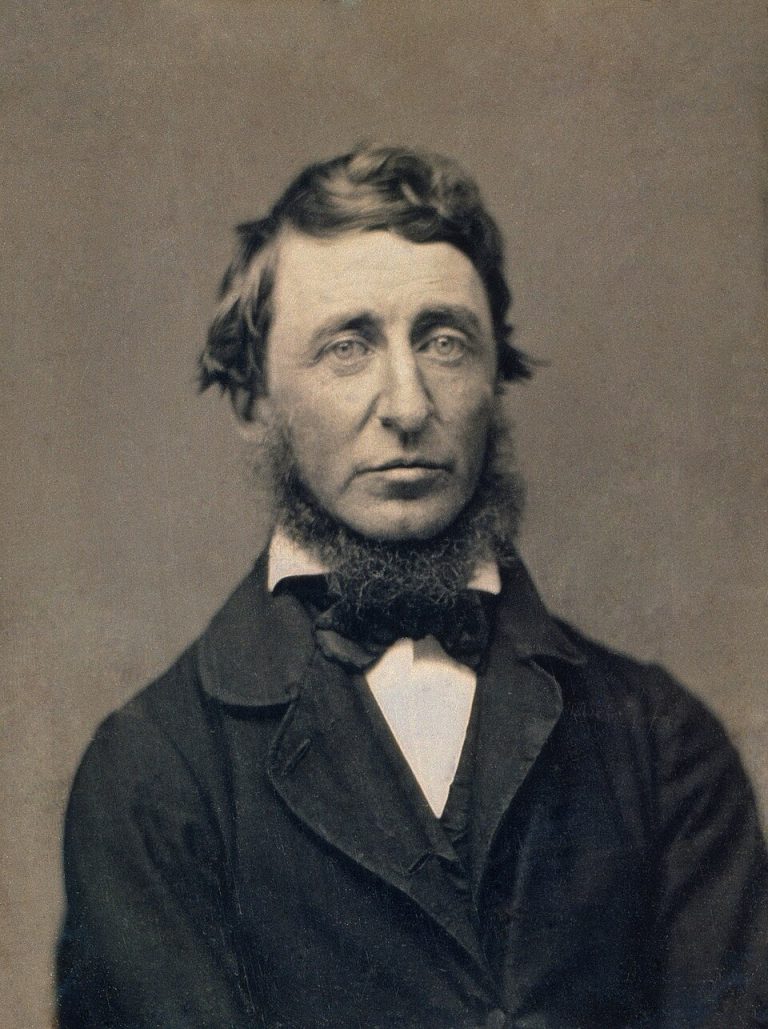
Walden was the first work of American literature I encountered. I had just finished elementary school and my entrance exams when my father took me to a bookstore and allowed me to choose a book beyond my required readings. Among the shelves, I chose this one. From the age of twelve into adulthood, it remained with me.
After coming to the United States, I realized that Henry David Thoreau was not a “typical” American. In some ways, he resembled the Confucian and Daoist figures of traditional Chinese thought—independent, restrained, committed to a disciplined simplicity. He reminds me somewhat of Wang Yangming (王陽明), who sought truth through moral inquiry and the investigation of things. Thoreau withdrew to Walden Pond not as an escape, but as a form of practice. Together with Ralph Waldo Emerson, he represented an America that valued spiritual life, individual conscience, intellectual independence, and a measured distance from material excess.
The subsequent development of American society, however, seems to have followed a different course. Perhaps they represented not the dominant current, but an ideal.
Recently, a friend suggested that Thoreau’s opposition to the Fugitive Slave Act parallels contemporary resistance to ICE. The comparison, however, requires caution. Thoreau publicly defended John Brown after Brown’s 1859 raid on the federal arsenal at Harpers Ferry—an attempt to initiate an armed uprising against slavery. Brown was captured and executed.
The Fugitive Slave Act was a law that institutionalized injustice. It would take a civil war and Abraham Lincoln’s Emancipation Proclamation to dismantle the system it protected. Thoreau, guided by conscience, challenged the prevailing condemnation of Brown and argued that when a law is unjust, citizens bear responsibility to resist it—peacefully and nonviolently.
Success
You are now signed up for our newsletter
Success
Check your email to complete sign up
ICE, by contrast, is a federal agency tasked with enforcing immigration law, including the removal of individuals who entered the country unlawfully, particularly those with criminal records. The historical and legal contexts differ substantially. To equate them risks collapsing distinct moral and political questions into a simplified analogy.
Thoreau did not endorse violence. Instead, he insisted on moral clarity and freedom of speech. He stood between law enforcement and dissent, holding open the space for principled disagreement. From later traditions of nonviolent resistance—seen in figures such as Mahatma Gandhi and Martin Luther King Jr.—one may reasonably trace an intellectual lineage back to him.
In contrast, the recent “campus killing involving a political activist “ reflects a different development. Whatever one’s view of his positions, he entered universities to debate those who disagreed with him on represents not argument, but the termination of argument. In a country founded on liberty, equality, and democratic process, such violence undermines the very structure that makes disagreement possible. culture, faith, and politics. His death at the hands of a fellow citizen.
When I first arrived in Berkeley in the early 1980s, the campus plaza was an open forum. Along Telegraph Avenue, people performed, distributed pamphlets, debated, and listened. Disagreement was visible, sometimes loud, but rarely physical. Joan Baez had already moved on to larger stages, but people said she first gained recognition singing there. It was an environment where multiple voices coexisted without the presumption that difference required elimination.
For someone raised under authoritarian conditions, that atmosphere was not romantic—it was structural. It was the lived experience of pluralism.
Looking back, one cannot help but ask what has changed.
These reflections are not written in condemnation, but in recognition: this country once sustained a tradition in which conscience, dissent, and restraint could exist together without mutual destruction.
By Wei J Chir