It was Feb. 15, 1961. In the official language of the Chinese Communist Party, it was described as a year of “overcoming natural disasters and uniting to forge ahead.” In the research of Yang Jisheng and in internal Party archives later made available to scholars, it stands as one of the bleakest New Year’s Eves in modern Chinese history.
A New Year’s Eve without fire
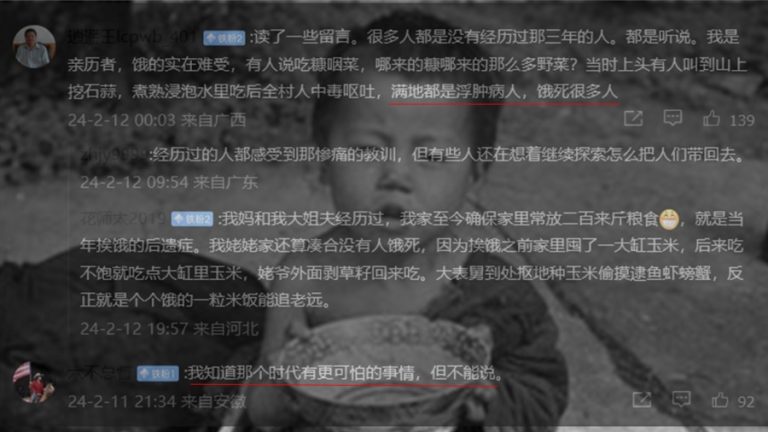
In Tombstone, Yang Jisheng records that during the Spring Festival of 1961, rural China fell into silence. There were no firecrackers. Gunpowder was treated as a military supply. There was no cooking smoke. Many households had long since run out of grain.
In some places, the New Year’s Eve meal became an act of survival.
The Xinyang Incident
In Xinyang, Henan, one of the regions hardest hit during the Great Famine, internal investigations documented extreme cases of starvation. On New Year’s Eve that year, in some villages not a single household could light a fire.
To survive, some peasants dug up the bodies of relatives who had already starved to death and consumed them. A grassroots cadre later stated that he witnessed a family cooking, during their New Year’s Eve meal, the body of a child who had died young. The episode appears in internal handling materials related to what became known as the “Xinyang Incident.”
Success
You are now signed up for our newsletter
Success
Check your email to complete sign up
Sichuan, the ‘heavenly granary’
Sichuan, long described as the “heavenly granary,” also experienced widespread starvation.
Li Jingquan, then Secretary of the Sichuan Provincial Party Committee, continued to requisition and ship grain out of the province while large numbers of people faced acute hunger. During the Spring Festival of 1961, farmers in Daxian reportedly knelt at the entrance of the commune canteen asking for grain.
According to accounts, they were told not to “smear socialism.” That night, dozens died at the gate of the canteen. Reports described their stomachs as filled with grass roots and cotton wadding.
The leadership response
Party historical materials state that in 1961 Mao Zedong “shared hardship with the people and did not eat meat.” Memoirs by Mao’s staff and cooks indicate that although Mao refrained from pork for a period, fish dishes remained on his menu. An April 1961 menu included steamed fish and baked fish.
During the Spring Festival of 1961, Zhou Enlai hosted foreign guests at the Great Hall of the People. Official banquets continued.
After returning to his hometown for inspection in 1961, Liu Shaoqi told Mao: “People are eating each other; this must be reported.” According to internally circulated meeting minutes, Mao treated the issue within the framework of “class struggle,” and cadres who reported severe conditions were later criticized as “right opportunists.”
A system of fear
After Peng Dehuai was purged at the Lushan Conference in 1959, officials across the country faced intense political pressure. To demonstrate support for the Great Leap Forward, inflated grain production figures were widely reported even as shortages deepened.
By the Spring Festival of 1961, the consequences of those distortions were fully visible.
Cheng Xiaonong, a U.S.-based scholar associated with research connected to former reform-era officials, has pointed to data indicating that 1960 and 1961 were peak years for China’s grain exports. Grain continued to be shipped abroad to meet foreign policy and debt obligations while domestic shortages persisted.
Yu Maochun, a Washington-based policy scholar, has stated that the Party leadership viewed peasants primarily through the lens of political objectives rather than as individual citizens. He has argued that ideological goals often took precedence over human cost during this period.
The Spring Festival of 1961 remains associated with deep collective trauma. People did not dare to cry. Crying requires calories.
At the end of Tombstone, Yang Jisheng wrote: “I collected every stone for this tombstone so that future generations will know that there once was such a dark era here.”
Fu Longshan