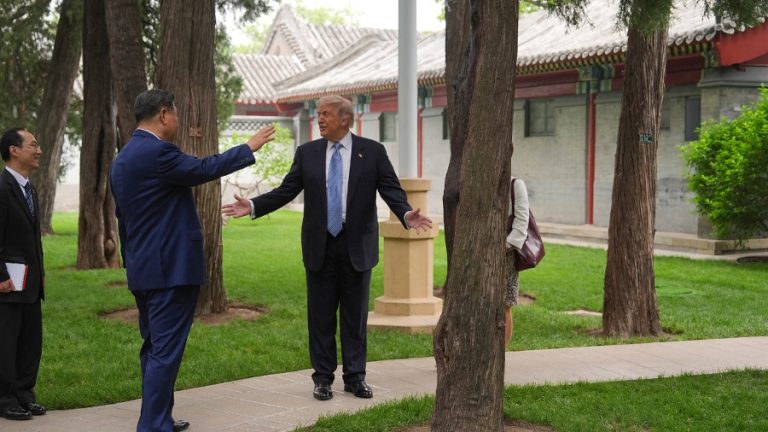
On Dec. 4, 2025, Xi Jinping, the CCP’s general secretary and China’s top leader, hosted French President Emmanuel Macron and his wife Brigitte in Beijing. Shortly afterward, a video barely over one minute long appeared on X and was viewed millions of times. It showed Xi and his wife Peng Liyuan standing and waiting for the Macrons to approach. As they waited, a staffer hurried to Xi’s side and crouched at his feet.
Xi showed no reaction, no surprise, no awkwardness, no gesture of thanks. The act of a grown man kneeling at his feet had clearly become routine. Commenters noted the staffer appeared to be middle-aged or older, visible from behind with a balding head. The sight of an older man performing what viewers described as a servant’s gesture for a leader who showed no discomfort drew a wave of mockery before censors moved to suppress it.
A resurfaced photo proves the pattern goes back at least a decade
The CCP’s image problem got worse in February, when a photograph surfaced showing the same ritual from eleven years earlier.
On Feb. 19, 2026, an X user named Zhu Yunhe posted an image from Sept. 18, 2014. It showed Xi Jinping standing outside the Raj Ghat memorial in New Delhi, the site honoring Indian independence leader Mahatma Gandhi. A man in a suit was crouched at Xi’s feet, tying his shoelaces, while Peng Liyuan stood beside them.
Sharp-eyed commenters spotted the detail that turned an odd photo into a viral one: the kneeling man’s suit jacket had fallen open, revealing a holstered firearm. This was no ordinary aide. He was one of Xi Jinping’s armed personal security agents.
Success
You are now signed up for our newsletter
Success
Check your email to complete sign up
Xi was 61 at the time. Just a year earlier, during a June 2013 trip to the United States, he had boasted publicly about his fitness: “I swim and take walks. I swim a thousand meters every day.” By his own account, he was a physically active man with no difficulty bending down. The image of an armed agent kneeling at his feet to perform a task any healthy adult handles without thinking was something else entirely: a window into how power is exercised and received inside Xi’s inner circle.
“Great, this is what ‘serving the people’ looks like,” one commenter wrote, turning the CCP’s most famous slogan against its leader.

At the APEC summit, Xi’s security agent revealed a different kind of fear
The Macron video and the India photo showed imperial vanity. A separate incident from the November 2025 APEC summit in South Korea revealed something darker: paranoia.
Cameras captured a middle-aged man appearing at Xi’s right side immediately after he sat down. The man’s demeanor and constant proximity to Xi across multiple public appearances, including meetings with foreign heads of state and domestic travel, marked him as something more than ordinary staff. Observers who tracked his repeated appearances concluded he was a senior personal security official with a high degree of Xi’s trust.
The man half-knelt beside Xi’s chair and pulled three items from his own suit pockets: a cup, an eyeglass case, and tissues. All three were personal items that Xi apparently refused to let anyone else carry or handle, even at a multilateral summit surrounded by other world leaders and their security teams.
Xi does not trust the cups, utensils, or supplies provided at international venues. His personal belongings travel on the body of his most trusted agent. The arrangement suggests a level of fear about poisoning or health information leaking that goes well beyond standard protocol for a head of state. Where the shoe-tying scenes showed a man comfortable being served like a king, the APEC scene showed a man who is also afraid.

From the Soviet Politburo to Xi Jinping’s entourage: how communist elites live
The scenes around Xi are extreme, but they fit a pattern that runs through the history of communist regimes.
Boris Yeltsin, the former Russian president who had served as a candidate member of the Soviet Politburo before turning against the system, once described what life looked like at the top of the Communist Party. When he reached candidate Politburo rank, he recalled, “Central Committee secretaries and Politburo members all flew on dedicated aircraft, Il-62s or Tu-134s. Each one surrounded by bodyguards and attendants.” Even at his relatively junior rank, Yeltsin said, he was assigned three personal chefs, three attendants, a cleaning woman, and a gardener.
“Flattery and obedience are rewarded with access to every privilege,” Yeltsin observed. “The higher you climb the ladder of position, the more you receive. If you reach the very top of the Party’s power pyramid, you can have everything. You have entered communism.”
There is a corollary Yeltsin left unstated: at that point, everyone around you has become your servant.
Yeltsin also offered a warning that resonates beyond the Soviet context: “You can build a throne out of bayonets, but you cannot sit on it for long.”
For the CCP and for the countless ordinary Chinese citizens crushed under its weight, that sentence carries very different meanings.
By Jianyi