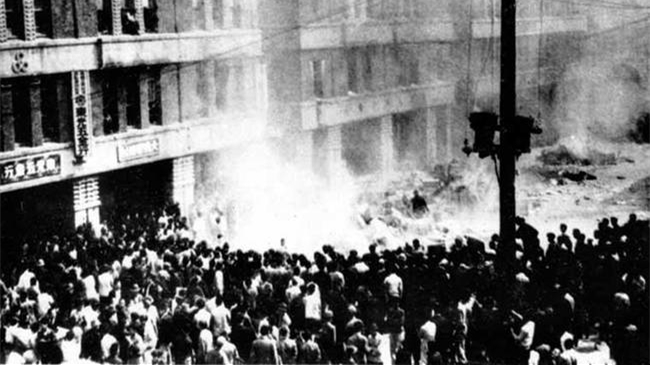
A confrontation between tobacco enforcement officers and a street vendor in Taipei on Feb. 27, 1947, escalated into island-wide unrest the following day. The February 28 Incident has long been attributed to economic collapse, administrative corruption, and excessive force by Nationalist authorities.
However, research based on CCP internal documents, archival materials, and later scholarly analysis indicates that Chinese Communist Party underground networks were active during the unrest and viewed the turmoil within the broader framework of the Chinese Civil War.
Economic breakdown and political escalation
Postwar Taiwan faced hyperinflation, commodity shortages, and administrative dysfunction under Governor Chen Yi. Friction between mainland officials and local elites intensified. After protesters gathered at the Governor-General’s Office on Feb. 28 and were fired upon by guards, unrest spread across multiple cities.
Local elites formed “228 Incident Settlement Committees” to negotiate political reforms. According to Hoover Institution research scholar Lin Hsiao-ting, comparisons of Chiang Kai-shek’s diaries and archival telegrams show that Chen Yi adopted a conciliatory tone in Taipei negotiations while simultaneously reporting to Nanjing that the situation constituted rebellion.
In early March, Chen Yi requested reinforcements. When the reorganized 21st Division arrived at Keelung, military suppression followed. Chiang Kai-shek later sent a mid-March telegram instructing that reprisals be strictly prohibited and violators punished, according to archival records.
Success
You are now signed up for our newsletter
Success
Check your email to complete sign up
The death toll remains disputed. Early Kuomintang figures in 1947 estimated 500 to 1,000 fatalities. A 1992 Executive Yuan research report, using demographic analysis, estimated 18,000 to 28,000 victims, including deaths and disappearances. Compensation records from the 228 Foundation document more than 2,300 recognized cases. U.S.-based scholar Cheng Xiaonong has argued that claims of 100,000 deaths are inconsistent with Taiwan’s population of roughly six million at the time. Cheng estimated total victims, including imprisonment, at around 20,000.
CCP underground networks and strategic assessment
According to CCP internal materials cited in later research, the Taiwan Provincial Working Committee, which operated underground and reported to the CCP East China Bureau, became active following the outbreak. Documents from the East China Bureau described the unrest as an opportunity within the mainland war context.
In Taichung, Hsieh Hsueh-hung organized what was known as the “27th Brigade.” Archival accounts describe core members as trained underground cadres. Telegrams attributed to the CCP Central Committee instructed Taiwan-based operatives to mobilize public sentiment, weaken Nationalist military morale, and coordinate with mainland battlefront operations.
Tsai Hsiao-chien, identified in CCP records as secretary-general of the Taiwan Provincial Working Committee, reportedly instructed cadres to shift from clandestine activity to open mobilization. Chang Chih-chung directed armed actions in Chiayi, including efforts to disrupt air supply routes. Regional organizers in Tainan and other areas expanded militia recruitment.
Scholars including Ming Chu-cheng have argued that early protests were spontaneous but that CCP-affiliated organizers subsequently influenced the direction of demands. According to this interpretation, political conditions advanced by certain activists — including military disarmament and high-level autonomy — reduced the likelihood of negotiated settlement.
Civil war context and military consequences
U.S.-based scholar Cheng Xiaonong has argued that the 228 Incident should be analyzed within the broader civil war environment of 1947. At the time, Nationalist forces were engaged in major operations in Shandong and northern Shaanxi. The redeployment of the 21st Division to Taiwan altered troop distribution during a critical period.
Lin Hsiao-ting’s archival research indicates that Chiang Kai-shek’s early understanding of events relied heavily on Chen Yi’s telegrams. Chen characterized the unrest as rebellion influenced by Communist elements, a description that contributed to the decision to dispatch reinforcements.
Miles Yu, former China adviser to the U.S. Secretary of State’s Policy Planning Staff, has stated that the incident later became a significant propaganda issue. He argues that the CCP portrayed the event internationally as evidence of Nationalist brutality, influencing foreign perceptions during the late stages of the Chinese Civil War.
Aftermath for CCP participants
After 1949, Hsieh Hsueh-hung was appointed to a position within the new regime. Archival and memoir sources record that she later faced criticism during the Anti-Rightist Movement and endured struggle sessions during the Cultural Revolution. Other Taiwanese Communist participants who relocated to the mainland were, according to historical accounts, investigated or labeled during successive political campaigns.
The 228 Incident remains one of Taiwan’s most contested historical events. Archival materials from multiple sides indicate that administrative failure, military decision-making, and underground political mobilization intersected during a pivotal phase of the Chinese Civil War.
By Fu Longshan