The CIA’s latest outreach to China’s military ranks arrived in the form of a polished 95-second video, and it struck a nerve. Meanwhile, China’s official military newspaper revealed plans to use artificial intelligence and big data to monitor soldiers at the grassroots level, confirming what many already suspected: the Chinese Communist Party fears its own army more than any foreign adversary. The dynamic echoes the Cold War, when a Soviet general’s disgust with communist corruption led him to hand the United States 25 years of intelligence that helped end the standoff.
On Feb. 12, the Central Intelligence Agency (CIA) released a short recruitment video titled “Why Stand Up: To Save the Future.” The video was aimed squarely at Chinese military personnel, and it demonstrated an intimate understanding of CCP internal politics.
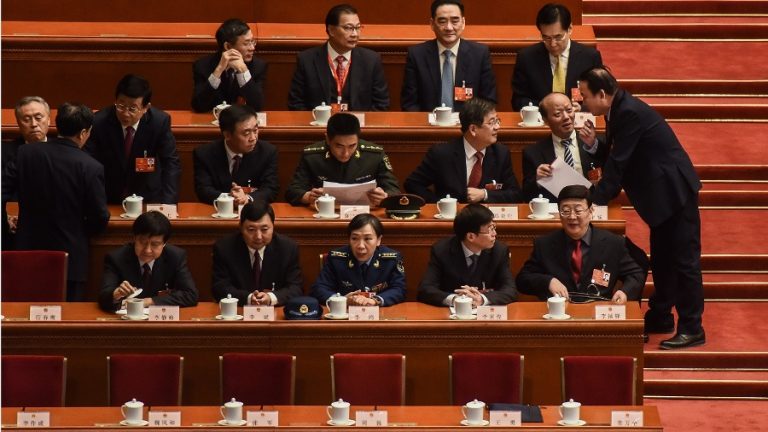
The footage zeroed in on the anxieties of officers serving under Xi Jinping, China’s top leader. “The leaders are really only protecting their own private interests,” one line declared. “Anyone with real leadership ability will eventually be feared and ruthlessly destroyed.” If Zhang Youxia, the vice chairman of China’s top military command body, or Liu Zhenli, the military’s joint staff chief, were to watch those lines, they would recognize the message instantly. Both were considered among the few genuinely competent military professionals remaining in the senior ranks.
The video avoided slogans. Instead, it appealed to something more personal: parenthood. “I can’t let these madmen shape the world my daughter will grow up in,” one voice said. “Choosing this path is how I fight for my family and my country.” The screen then showed a computer displaying a “Contact the CIA” interface. A figure sat in a parked car in heavy rain, typing: “For the peaceful future of both our countries, I want to give you some important information.” A license plate bearing the character for Anhui province flickered on screen, an apparent allusion to the late prime minister Li Keqiang, whose sudden death in 2023 remains surrounded by suspicion.
The details showed more than production quality. They showed that the CIA understands CCP factional politics at a granular level. A similar video released roughly a year earlier drew over 15 million views and, according to U.S. officials, generated new intelligence sources.
Success
You are now signed up for our newsletter
Success
Check your email to complete sign up
The more precise and emotionally resonant these videos become, the more anxiety they create inside the Party apparatus. CCP leaders know how many people within their own system feel trapped and persecuted by the very regime they serve. Many are looking for a way out.

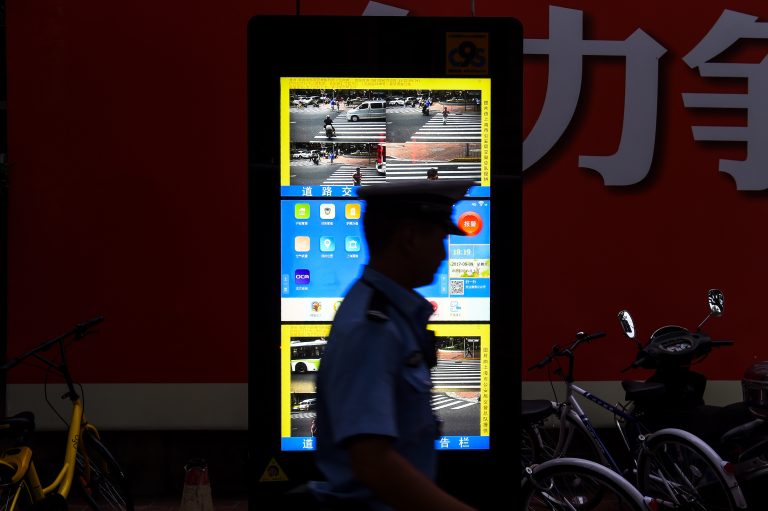
Beijing’s response: AI-powered surveillance of its own soldiers
The Party’s answer came through the pages of the People’s Liberation Army Daily, the CCP military’s official mouthpiece. On Feb. 25, the paper published an article in its “ideological front” column under the headline “Using Technology to Advance the Modernization of Grassroots Military Governance.” The article argued that “modernizing grassroots military governance” was essential to “solidifying the foundations of strengthening the military.”
To most readers, “strengthening the military” suggests improving combat readiness. Inside the CCP’s coded vocabulary, it means something different. A recent PLA Daily editorial stated openly that “political strength is the most fundamental kind of strength.” In Party-speak, a “strong military” is one that obeys the Party unconditionally, defends CCP rule above all else, and, when the moment demands it, is willing to turn its weapons on the Chinese people, as it did during the Tiananmen Square massacre of June 4, 1989.
Strip away the bureaucratic language and the article’s message is blunt: use high-tech surveillance to detect any sign of disloyalty within the ranks. Other passages confirmed this reading: “Building the military must start from the political perspective” and “all technology applications must serve the Party’s absolute leadership over the military.”
The CCP’s obsession with controlling its own forces has deep roots. When the Soviet Communist Party collapsed, the Soviet military’s refusal to intervene on behalf of the regime played a decisive role. Beijing is determined to prevent the same scenario in China.
There is a Chinese proverb: “Chase the fish and they flee to the abyss; chase the birds and they fly to the deep forest.” The harder you squeeze, the faster your quarry escapes.
No surveillance system, however “intelligent,” can extinguish the desire for freedom. The Party’s drive to turn every barracks into a digital panopticon will accelerate exactly the behavior it seeks to prevent. Officers and officials with a conscience, people who do not want their children to grow up inside a high-tech prison state, will face a clarifying choice. History shows that some of them will choose to act.

The Cold War precedent: General Polyakov and the power of conscience
During the Cold War, a Soviet military intelligence general named Dmitri Polyakov made exactly that choice. A two-star general in the GRU, Soviet military intelligence, Polyakov worked as a CIA source for 25 years. He provided the names of nearly 150 Soviet spies, 1,500 KGB and GRU operatives and staff, 25 crates of classified documents, Soviet cipher systems, spy recruitment methods, and intelligence transmission routes. The damage to Soviet intelligence was without parallel.
Former CIA Director James Woolsey called Polyakov the most valuable spy of the entire Cold War. “General Polyakov didn’t just help us win the Cold War,” Woolsey said. “He also prevented the Cold War from turning hot. His role was immeasurable.”
A CIA officer who worked on Polyakov’s case for 15 years recalled: “He made it clear he had to help us. Otherwise, the Soviet Union would win the Cold War, and that was something he could not bear.”
Former CIA official Sandy Grimes described Polyakov as “a man of enormous courage… In the end, we won. The Cold War ended. The Soviet Union dissolved.”
Polyakov was not motivated by money. He described himself as a Russian patriot, driven by revulsion at the corruption of the Communist Party elite. The CCP’s current trajectory, a regime that surveils its own soldiers, purges its own generals, and builds digital cages around its own people, is producing the same conditions that turned Polyakov against the Soviet system. The question is not whether a Chinese Polyakov exists. It is how many there are, and when they will act.
By Jianyi