By Tian Jingxin, Vision Times
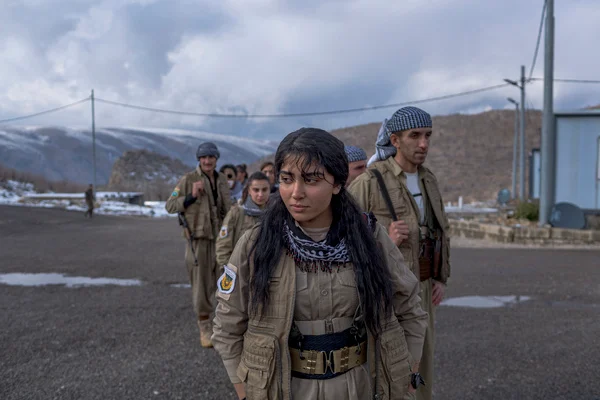
As instability inside Iran deepens and tensions with the U.S. escalate by the minute, major Iranian Kurdish opposition groups have set aside decades of rivalries to form a historic military and political alliance aimed at challenging Tehran’s clerical regime. According to Western intelligence assessments and multiple media reports, the newly unified force could become one of the most serious internal threats facing Iran’s government.
Reports from the “New York Post” and other outlets indicate that six major Iranian Kurdish political factions have joined a newly formed coalition known as the Coalition of Political Forces of Iranian Kurdistan (CPFIK). Leaders of the participating groups announced the alliance earlier this week, describing it as an effort to coordinate both political strategy and armed operations.
The coalition’s stated objective is to organize Kurdish forces in western Iran and establish an autonomous Kurdish region while exploiting what they see as a moment of vulnerability for Tehran as the regime faces mounting external and internal pressure.
The formation of the coalition represents a significant breakthrough. Several of the participating factions have historically been divided by ideological differences, ranging from Kurdish nationalism to leftist movements, or by leadership disputes.
Groups behind the Kurdish coalition
Success
You are now signed up for our newsletter
Success
Check your email to complete sign up
The alliance brings together six major Kurdish political and armed organizations:
Democratic Party of Iranian Kurdistan (PDKI)
One of the oldest and most influential Kurdish opposition parties in Iran, the PDKI commands one of the largest Kurdish armed forces, commonly known as Peshmerga fighters. The group advocates Kurdish autonomy within a federal Iranian system and is expected to play a leading political role in the coalition.
Kurdistan Freedom Party (PAK)
Known for its combat experience, PAK fighters previously worked alongside U.S. forces in operations against ISIS and received American training and equipment. Within the new coalition, the group is expected to serve as a primary ground combat force.
Kurdistan Free Life Party (PJAK)
A militant organization closely linked to the Kurdistan Workers’ Party (PKK) in Turkey, PJAK specializes in guerrilla warfare and operates mainly in mountainous regions along the Iran–Iraq border. Its inclusion in the coalition reportedly required difficult negotiations but significantly strengthens the alliance’s military capabilities.
Komala – Toilers of Kurdistan
Led by Reza Kaabi, this left-wing Kurdish faction emerged from earlier splits within the Komala movement. It contributes both political and armed support to the alliance.
Khabat Organization of Iranian Kurdistan
A long-standing Kurdish opposition group with nationalist and religious influences. Historically, it has cooperated with the Iranian opposition organization Mujahedin-e Khalq (MEK) and maintains a strong anti-regime stance.
Komala Party of Iranian Kurdistan
Led by veteran Kurdish politician Abdullah Mohtadi, this party serves as the coalition’s diplomatic and political bridge to Western governments and international actors. Mohtadi gained international visibility during the 2022–2023 Mahsa Amini protests, when he attempted to coordinate broader Iranian opposition efforts, including outreach to supporters of Iran’s former royal family.
Analysts view the Komala Party’s formal entry into the alliance earlier this month as a crucial step that significantly broadened the coalition’s political legitimacy.
Revving the engines
The coalition appears to be dividing responsibilities among its member groups. According to analysts, the PDKI will focus on political coordination, PAK will spearhead conventional ground operations, and PJAK will conduct guerrilla operations in mountainous border regions. This hybrid structure, combining organized military units with guerrilla tactics, could allow Kurdish forces to exert sustained pressure on Iranian security forces.
The “Jerusalem Post” reported that Kurdish fighters have already begun operating along the Iran–Iraq border, where several Kurdish militias maintain bases. Their objective is to stretch Iranian security forces and potentially open a new internal front against the regime. If successful, such operations could divert Tehran’s military resources and encourage broader unrest inside the country.
The Kurdish population in the Middle East exceeds 35 million people, making them one of the largest stateless ethnic groups in the world. Kurdish communities are primarily located in Turkey, Iraq, Syria, and Iran, with more than 8 million Kurds living in Iran, roughly 10 percent of the country’s population.
A long-standing Kurdish struggle
Kurdish activists say Tehran has suppressed Kurdish political movements and cultural identity for decades. Despite repeated crackdowns, Kurdish opposition groups remain among the most organized and militarily capable forces challenging the Iranian government.
Kurdish fighters have also built a reputation for battlefield effectiveness. Kurdish militias fought alongside U.S. forces against Saddam Hussein’s regime in Iraq, and later played a key role in the fight against ISIS in both Iraq and Syria.
Though the full size of Kurdish militias remains unclear, major factions claim to command thousands of fighters. “Iranian Kurdish groups see what is happening now as an opportunity to unite around the goal of self-determination,” Hewa Khalid, a Kurdish studies expert at Indiana University, told the New York Post.
“Iran’s future depends on who leads the country and how they respond to Kurdish demands. We could see a Kurdish region operating within Iran, or we could see the next Yugoslavia.”
Regional escalation
The Kurdish alliance is emerging amid intensifying regional tensions. According to “The Wall Street Journal,” Israeli airstrikes targeting Iranian military installations in Kurdish-majority areas helped create conditions for the current uprising.
Reports from CNN and Reuters also suggest that the U.S. Central Intelligence Agency (CIA) has begun contacting Kurdish opposition leaders and may provide weapons and support to help open a “second front” against Iran’s Islamic Revolutionary Guard Corps (IRGC).
U.S. President Donald Trump reportedly held phone conversations earlier this week with leaders in Iraqi Kurdistan and Iranian Kurdish opposition groups to discuss possible cooperation. A senior Kurdish official told reporters: “We believe this is a once-in-a-generation opportunity. Iran’s military morale is low, and thousands of experienced fighters are gathered along the border, ready to cross if necessary.”
Tehran has responded forcefully. Over the past 48 hours, Iran’s Islamic Revolutionary Guard Corps reportedly launched dozens of ballistic missiles and suicide drones at Kurdish opposition bases in northern Iraq. Iranian state media warned that any country supporting what it called “separatist terrorists” would face severe retaliation.
Despite the threats, analysts say the unprecedented coordination among Kurdish factions, combined with ongoing protests inside Iran driven by economic hardship, could mark a turning point in the struggle against the country’s ruling clerical establishment.
Editorial note: Views expressed in this article are the opinions of the author and do not necessarily reflect the views of Vision Times.