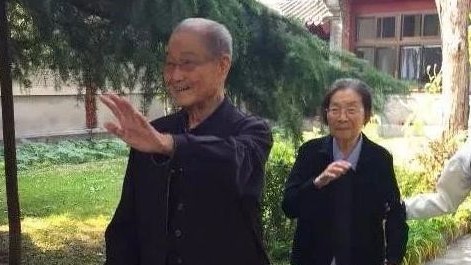
Song Ping, the Chinese Communist Party elder who shaped the careers of two generations of CCP leaders and served as the Party’s most powerful personnel chief, died in Beijing on March 4, 2026, at the age of 109. Born two years before the founding of the CCP itself, Song was the last surviving figure from the era when retired Party elders could still constrain the general secretary’s power. His death removes the final link to that system.
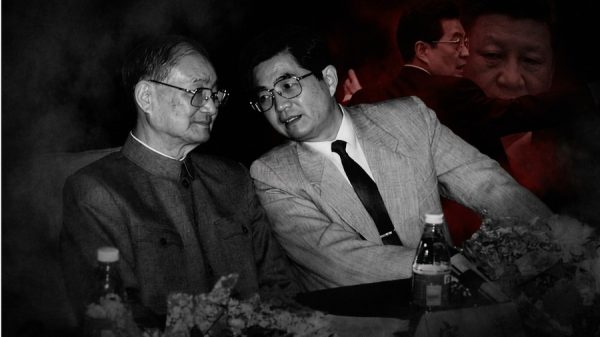
The Party’s official narrative framed Song as a benevolent mentor who nurtured younger talent. The reality was far more consequential. Song was the CCP’s original “organization tsar,” a master of factional warfare who spent decades locked in a shadow struggle with Zeng Qinghong, the chief political fixer for former CCP general secretary Jiang Zemin. Song’s greatest legacy was his role in elevating Hu Jintao, the former CCP general secretary, from an obscure provincial official in Gansu to the leadership of the world’s largest authoritarian party. At 105, sitting in a wheelchair on the stage of the Great Hall of the People, Song watched as Xi Jinping, the CCP’s current general secretary, had Hu Jintao physically removed from the closing ceremony of the 20th Party Congress in October 2022, a public humiliation that doubled as a demolition of everything Song had spent his life constructing.
Zhou Enlai’s secretary learned the art of political survival in 1940s Chongqing
Song Ping was born in 1917 in rural Shandong province. He won a scholarship to Tsinghua University, a rare achievement for someone from a poor farming family in that era. His political education, however, came from his years as personal secretary to Zhou Enlai in Chongqing during the 1940s, when the city served as the Nationalist wartime capital and the CCP ran its operations under constant surveillance.
Zhou was the operational commander of the CCP’s intelligence apparatus during that period. As his closest aide, Song spent his days managing underground courier networks behind Nationalist lines, vetting suspected “traitors” within Party ranks, and navigating the lethal overlap between the Nationalist government’s two rival intelligence agencies. This apprenticeship gave the young Song a mastery of factional maneuvering and a talent for reading people that would define his entire career. He learned to observe everyone around him without revealing anything, mentally cataloging loyalties and vulnerabilities.
After the Japanese surrender in 1945, Song followed Lin Biao’s forces into Manchuria and was tasked with founding the Harbin Daily. The newspaper position was a cover for a far more sensitive assignment: conducting political background checks on the flood of intellectuals, former Nationalist officials, and young recruits pouring into the CCP’s first major urban base. Song’s assessments determined who entered the inner circle and who was purged. The Harbin Daily functioned as an intelligence screening network for Lin Biao’s command, and Song ran it with the cold precision he had learned at Zhou Enlai’s side.

Song Ping survived the Cultural Revolution by mastering strategic ambiguity
Success
You are now signed up for our newsletter
Success
Check your email to complete sign up
Song proved to be a worthy student of Zhou Enlai’s survival instincts. During the decade of the Cultural Revolution, as Liu Shaoqi, Deng Xiaoping, and even Song’s old comrade Xi Zhongxun (the father of Xi Jinping) were purged, imprisoned, or exiled, Song emerged untouched.
In 1971, after the death of Lin Biao, Zhou Enlai arranged for Song to become the de facto top leader of Gansu province. The appointment came at one of the most dangerous moments in CCP history, when the ultra-left faction around Jiang Qing (Mao’s wife and leader of the “Gang of Four”) was locked in a death struggle with Zhou’s pragmatist camp. Song publicly shouted ultra-left slogans louder than the Red Guards while quietly using his technical background from the State Planning Commission to seize control of Gansu’s military-industrial production and administrative machinery.
Song’s decade governing Gansu served a dual purpose. The remote northwestern province became a kind of political safe harbor for the CCP’s conservative elder faction. While senior leaders like Chen Yun and Deng Xiaoping were scattered or under house arrest and political contact between them had been severed, Song used his position to secretly maintain channels of communication with these sidelined elders. When nearly everyone else was cutting ties and piling on, Song provided a protective umbrella for purged leaders and their families through special administrative channels.
This “political credit” accumulated during the chaos converted instantly into power after the fall of the Gang of Four in 1976. Chen Yun and the old guard, restored to authority, brought Song back to the center of power in Beijing as their chief executor for personnel reshuffles, political purges of remaining Maoist loyalists, and the selection of the next generation of leaders.
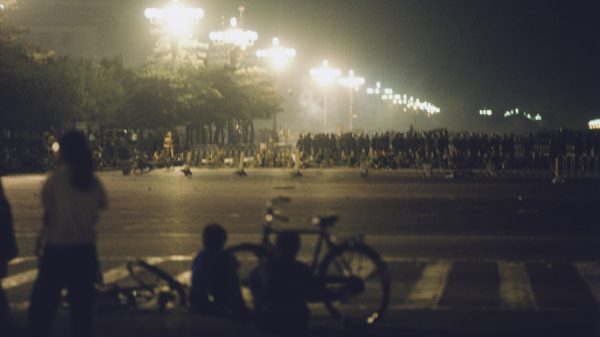
Song Ping cast the decisive vote in the 1989 crackdown
The Tiananmen crisis of 1989 was Song Ping’s defining moment. As a Politburo member and head of the CCP’s Organization Department, which controls all senior personnel appointments, Song aligned decisively with the hardliners around Chen Yun and Deng Xiaoping against CCP general secretary Zhao Ziyang, who had shown sympathy for the student demonstrators.
After the crackdown, Song directed a sweeping internal purge of officials who had supported the democracy movement. His reliability during the crisis earned him promotion to the Politburo Standing Committee, the CCP’s supreme decision-making body, at the Fourth Plenum of the 13th Central Committee in late June 1989. From that position, Song formally took control of the personnel system that determined the career trajectory of every senior official in the Party.
For much of the 1990s, Song Ping waged an undeclared war against Zeng Qinghong, the chief strategist and personnel manager for Jiang Zemin’s “Shanghai faction.” Zeng sought to pack the central government and provincial leaderships with Jiang loyalists through aggressive, relationship-driven promotions. Song, operating from semi-retirement but still wielding enormous influence over the organization system, fought back with procedural weapons.
Song imposed stringent vetting standards for rising officials, ostensibly based on Deng Xiaoping’s “Four Modernizations” criteria for cadre selection: younger age, better education, professional competence, and revolutionary commitment. In practice, these standards functioned as a filter designed to block the Shanghai faction’s patronage appointments. When Zeng tried to advance allies through personal connections, Song demanded proof of grassroots experience and technical credentials, requirements that few Shanghai faction candidates could meet.
Song used these gatekeeping powers to fast-track a different cohort: low-profile, technically trained officials who had served in the hardship provinces of China’s northwest. Hu Jintao and Wen Jiabao were the flagship products of this strategy. Every appointment Song placed in a key position became an obstacle that Zeng could not dislodge. Through this “cold war” of procedural obstruction, Song protected Hu Jintao’s status as the designated successor throughout the period of maximum Shanghai faction influence, preserving a rival power base within the Party.

Song Ping forced Jiang Zemin to surrender the military chairmanship
The power struggle reached its climax after the 16th Party Congress in 2002, when Jiang Zemin stepped down as CCP general secretary but retained the chairmanship of the Central Military Commission, the Party’s top military command body, in an attempt to rule from behind the scenes, imitating Deng Xiaoping’s model.
This infuriated Song and the elder faction. In the summer of 2003, Song dropped his usual behind-the-scenes posture and led an open campaign against Jiang. He rallied fellow retired elders, including Wan Li and Qiao Shi, and organized a series of coordinated political confrontations at restricted meetings in the Jingxi Hotel and during informal consultations at the Beidaihe summer retreat.
Song confronted Jiang directly and, in his capacity as representative of the elder faction, submitted an open letter to the Politburo. The letter avoided personal grievances and instead framed the attack on institutional grounds, arguing that Jiang’s refusal to relinquish the military chairmanship was an act of personal power-hoarding that “shook the Party’s foundations and destroyed its rules.”
The siege lasted more than a year. In the autumn of 2004, under relentless pressure from Song and his coalition of elders, Jiang was forced to surrender the military chairmanship. The victory cemented Song’s status as the ultimate arbiter of succession politics in the post-Deng era and cleared the path for Hu Jintao to govern without a shadow emperor behind him.
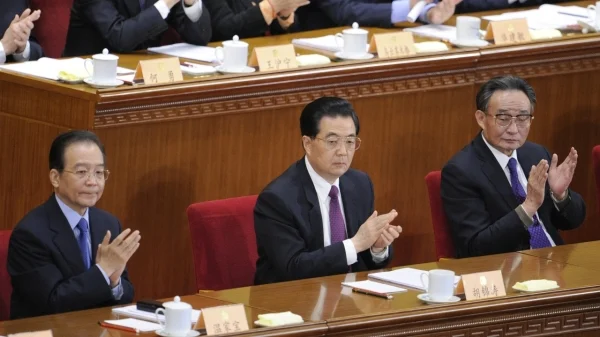
The 2022 humiliation: Song Ping watched his life’s work destroyed on live television
On Oct. 22, 2022, one of the most surreal scenes in modern CCP history unfolded in the Great Hall of the People. Song Ping, 105 years old and confined to a wheelchair, had been placed in the front row of the stage. Seated just meters away was Hu Jintao, the man Song had discovered, protected, and steered to the top of the CCP over three decades.
Cameras broadcasting live to the world captured every detail. Hu Jintao attempted to examine a red document folder on his desk. Aides, apparently on a signal from Xi Jinping, physically restrained him, then lifted him from his seat. Hu struggled, turning back toward the stage. He reached out to tap the shoulder of prime minister Li Keqiang, who sat rigid and refused to make eye contact. Xi Jinping wore an expression of cold satisfaction. Wang Huning, the Party’s chief ideologist, watched with an unreadable look.
For Hu Jintao, the episode was a profound personal humiliation. For Song Ping, sitting in his wheelchair just steps away, it was something worse: a real-time liquidation of his entire political legacy. The man he had spent his career protecting was being dragged out of the room by the protege of his old ally’s son. The rules Song had fought to establish were being shredded in front of a global audience.
The chain of succession told the whole story. Song had placed Hu Jintao on the succession track at the 14th Party Congress. Hu had shepherded Xi Jinping’s own rise to power at the 18th Party Congress. Xi, with Song watching from the front row, ordered Hu removed from the stage. Song was both Xi Zhongxun’s old comrade and Hu Jintao’s patron. He witnessed it all personally. The scene announced to the world that in the new era of absolute personal rule, the system of elder oversight was finished.

Song Ping’s connection to the Xi family made the betrayal personal
Song Ping’s relationship with Xi Jinping’s family ran deep. In the early 1950s, Xi Zhongxun served as vice premier and secretary-general of the State Council while Song was a deputy director of the State Planning Commission. They were close colleagues who worked side by side within the Zhongnanhai leadership compound, with heavily intertwined political interests. This half-century of “old family” connections once led outsiders to assume that Xi Jinping would, at minimum, show deference to this elder of his father’s generation and leave Song’s proteges in the Communist Youth League faction some room to operate.
That assumption was obliterated. Xi Zhongxun, in his later years, had been one of the CCP’s rare internal liberals, known for opposing personality cults, sympathizing with ethnic minorities, and maintaining a lifelong friendship with the 10th Panchen Lama. Xi Jinping inherited his father’s iron will but chose a political path that amounted to a generational reversal. He dismantled the tolerant atmosphere his father had championed and concentrated power to a degree not seen since the Mao era.
After taking power, Xi Jinping conducted a systematic annihilation of the Communist Youth League faction that Song had spent three decades assembling. Prime minister Li Keqiang was sidelined. Li Yuanchao, once a rising star, vanished from public life. The Communist Youth League’s central apparatus was marginalized. Every cut landed on a node of the power network Song had painstakingly constructed.
Song had maintained the bond with the Xi family during their darkest years of political persecution. He had cast an implicit vote of approval for Xi Jinping’s ascent. In return, he received the wholesale destruction of his political bloodline. The pattern was straightforward: Xi used Song’s acquiescence to consolidate power, then dismantled every institution and faction Song had built. In Xi Jinping’s calculus, Song represented an obsolete relic of an earlier system, an obstacle to absolute personal control. The ruthlessness of the break forced Song, at an age when most people are far beyond caring about politics, to confront the coldest possible reality: the dynasty he had helped the Xi family protect became the graveyard of everything he had built.

With Song Ping gone, the last constraint on absolute power is dead
Song Ping’s death closes the book on the CCP’s “collective leadership” experiment. The system of elder oversight that once placed limits on the general secretary’s authority, a system Song personally enforced for decades, has no remaining defenders with the standing or the institutional position to challenge Xi Jinping.
Song Ping’s career spanned the full history of CCP power politics: from Zhou Enlai’s wartime intelligence operations, through decades of personnel control, to the wheelchair on that stage in 2022. He participated in ending the chaos of the Mao era and dedicated himself to building a system of factional balance and orderly succession. At 109, he took the wreckage of that project to his grave. What remains is a Party with no internal checks on the general secretary and no one left with the standing to impose them.