The Chinese economy has taken another major hit. China’s construction industry lost more than 8 million workers in 2025, and the contraction is accelerating. In February 2026, a large Jiangsu-based construction group with registered capital exceeding 600 million yuan and a 25-year history ordered all headquarters staff onto “temporary leave status” through the end of April. The notice encouraged employees to seek other work or start businesses on their own. A nearly identical scheme appeared at a Beijing construction firm in January.
The Jiangsu firm’s notice, which circulated widely online, stated that due to a sluggish market and operational difficulties, all employees at group headquarters would enter “temporary leave status” beginning February 24, tentatively lasting until April 30. During the leave period, the company would only “try its best” to continue paying its share of social security and housing fund contributions, a mandatory employer-funded savings program that Chinese workers rely on for housing costs. Employees would still be responsible for covering their own portion.
One clause stood out: “Employees are encouraged to independently seek other employment or start their own businesses.”
Many people in the construction industry said it was the first time they had encountered the term “leave status,” and for good reason. Under China’s Labor Contract Law, companies carrying out large-scale economic layoffs are required to pay “N+1” severance, meaning one month’s salary for each year of employment plus an additional month. The “leave status” arrangement sidesteps this entirely. Companies only need to cover their portion of social security and can avoid paying even the minimum wage.
The calculus is straightforward. If employees wait out the leave period, they earn nothing while still paying their share of social security, gradually draining their savings. If they resign voluntarily, the company avoids severance obligations altogether. Industry insiders say the phrase “encouraging independent job seeking” is a polite way of telling workers the company cannot afford to keep them and hopes they will leave on their own. The arrangement uses time to reduce the workforce at the lowest possible cost.
Success
You are now signed up for our newsletter
Success
Check your email to complete sign up
The Jiangsu case is not isolated. In January 2026, a Beijing construction group issued a nearly identical notice, citing downward macroeconomic pressure, a prolonged vacancy in company leadership, and the suspension of major client projects. The company announced a full halt to work and production starting Jan. 6, with all employees on standby until June 30.
Employees would receive their original salaries during the first month. From the second month onward, they would receive a living allowance equivalent to 70 percent of Beijing’s minimum wage. After deductions for social security and housing fund contributions, take-home pay would fall below 2,000 yuan per month, roughly $280.
The Chinese economy lost 8 million workers in a single year
These individual cases reflect an industry in freefall. According to figures from China’s National Bureau of Statistics, which are widely considered to understate the severity of economic problems, the business activity index for the construction sector stood at 48.2 in February 2026, down 0.6 percentage points from the previous month and firmly in contraction territory.
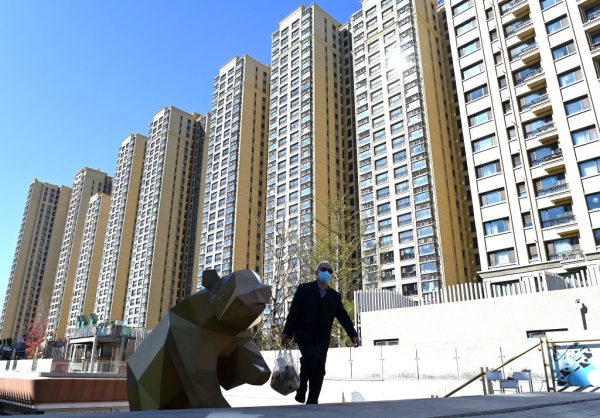
In 2025, the total output value completed by construction enterprises nationwide reached 30.38 trillion yuan, a year-on-year decline of 5.43 percent. The employment numbers are worse: the average number of people directly engaged in construction production and operations fell to 51.15 million, a year-on-year decrease of 12.97 percent. More than 8 million workers left the industry in a single year.
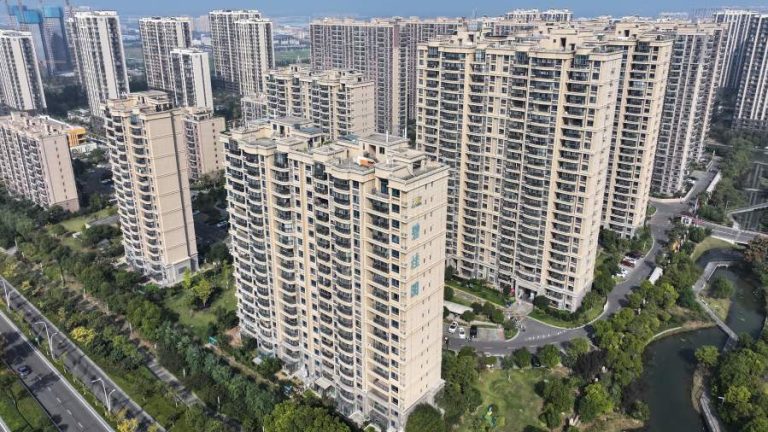
The immediate cause is a sharp drop in demand. With residential property sales in prolonged decline, new construction projects have fallen off a cliff. Local governments, drowning in debt, can no longer stimulate growth through infrastructure spending the way they once did. Approvals for large infrastructure projects have slowed considerably.
The number of projects has fallen, but the number of construction companies has not. To survive, firms are locked in destructive competition, bidding lower and offering more advance funding. Many projects barely generate profit. Some are taken at a loss simply to maintain cash flow.

134 construction companies collapsed in the first two months of 2026
At the beginning of 2026, the industry experienced a wave of bankruptcies. According to data from China’s national enterprise bankruptcy and restructuring case information network, 81 construction companies entered bankruptcy or liquidation proceedings in January 2026 alone. February added another 53. In just two months, at least 134 construction companies across China collapsed, with Jiangsu, Guangdong, and Zhejiang, traditionally the country’s strongest construction provinces, among the hardest hit.
The list of bankrupt companies includes former industry giants. Anhui Tongji Construction Group, which once recorded annual output as high as 8 billion yuan, was accepted by the court for bankruptcy restructuring on January 8. Jiangsu Zhongnan Construction Industry Group, once ranked eighth among China’s top 500 construction enterprises, has also entered restructuring proceedings.
Industry observers say the collapse reflects the end of a development model that drove more than a decade of rapid expansion in the real estate sector: high leverage, rapid turnover, and large-scale expansion. That model required constantly rising demand. When demand stopped rising, the entire structure began to buckle. The construction industry connects more than 50 upstream and downstream sectors, including steel, cement, building materials, and home furnishing, and supports tens of millions of jobs. Its contraction sends shockwaves across the broader economy.

The pain is spreading beyond construction into export manufacturing
The downturn is no longer confined to construction. Since the escalation of the U.S.-China trade conflict, factories engaged in foreign trade have seen a sharp decline in orders and have begun announcing temporary shutdowns of their own.
Photos circulating online show factories across multiple regions issuing holiday notices. Yihe Furniture in Huizhou, Guangdong province, announced a five-day suspension. In Quanzhou, Fujian province, Zuxing Company moved its molding workshop to unpaid weekend leave until May. One factory owner said plainly that if the company can continue operating it will stay open, and if it cannot, it might as well shut down.
A Jiangsu worker posted a video showing empty factory workshops where production had stopped entirely. She said employees were waiting for notice of when work might resume and that she had been forced to look for temporary jobs in the meantime.
The CCP’s economic strategy of “internal circulation,” a policy framework that emphasizes domestic consumption as a substitute for export-driven growth, is failing to compensate for the losses. If China also loses meaningful access to the U.S. market, the export side of the economy faces serious trouble as well, and the unemployment crisis now visible in construction and manufacturing will deepen further.
By Cai Siyun