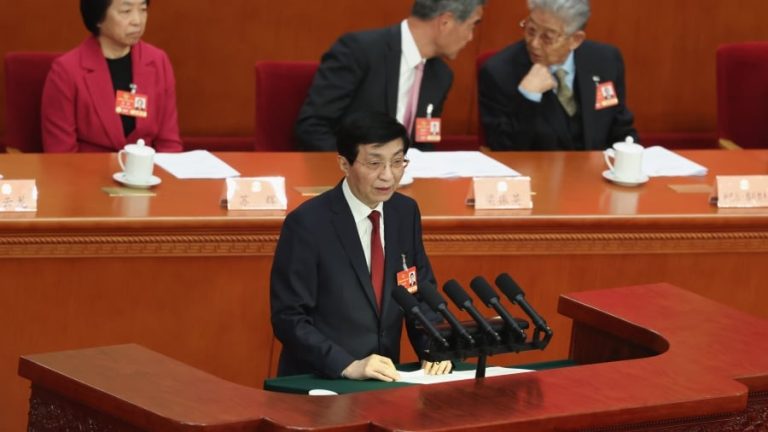
Wang Huning, the Chinese Communist Party’s chief ideologue and its fourth-ranked official, is visiting North Korea this week at the head of a party and government delegation, a trip announced on July 14 by the Party’s International Department and running from July 15 to 17. The visit comes at the invitation of North Korea’s ruling Workers’ Party and its government, and it has set off speculation among overseas Chinese commentators that Wang is gathering material for the doctrinal documents that will frame Xi Jinping’s next term. The intrigue has been sharpened by a quieter development at home: Wang’s deputy of twelve and a half years, Mu Hong, skipped a closed-door strategy meeting of the political advisory body Wang chairs and has now been out of public view for 11 days.
Wang Huning’s trip caps a burst of high-level exchanges between Beijing and Pyongyang
Wang sits on the Politburo Standing Committee, the small body at the apex of Party power, and chairs the Chinese People’s Political Consultative Conference, or CPPCC, the Party’s top advisory organ. His trip follows immediately on a North Korean visit in the other direction. From July 10 to 12, Premier Pak Thae-song led a delegation to Beijing for events marking the 65th anniversary of the China-North Korea Treaty of Friendship, Cooperation and Mutual Assistance, the 1961 pact that still binds each side to defend the other. When Pak met Xi Jinping on July 10, according to Party media, he relayed leader Kim Jong-un’s wish to build the relationship into what he called the “most powerful strategic relations.”
The choice of envoy struck observers as odd on its face, and some said the oddity was the point. North Korea has no counterpart to the CPPCC, one X user noted, so a visit by its chairman makes little protocol sense. U.S.-based commentator Cai Shenkun wrote on X that the “master strategist who has served three successive Party leaders” was heading to Pyongyang either to scout the path for the North Koreanization of China or to manufacture its theoretical justification.
Another account, “Xin Gaodi,” offered a more procedural read: Wang is preparing to draft the programmatic documents for the 21st Party Congress, the leadership conclave expected next year, and pointedly noted that Xinhua billed the group as a party and government delegation rather than a CPPCC one. Other users were harsher, jeering that Wang would study Kim Jong-un’s ideological canon in order to come home and write Xi’s, using mocking nicknames for both leaders. One invoked the old saying of the “red horse and red sheep,” a folk belief that fire-horse and fire-sheep years bring national calamity; by the traditional calendar, 2026 is a fire-horse year.
Wang’s deputy Mu Hong skipped a closed-door strategy session without explanation
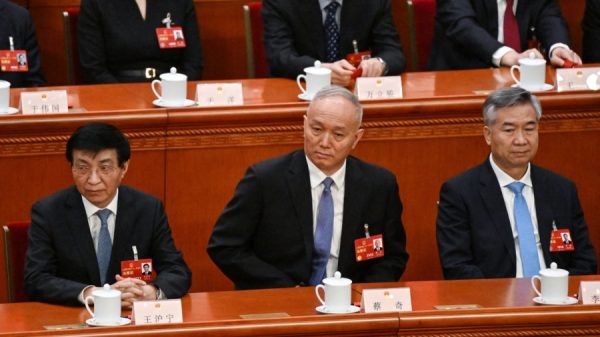
The meeting Mu Hong missed was no routine gathering. On July 7, according to Xinhua, the CPPCC convened its 2026 wuxuhui, a closed-door session in which a leadership group steps back from daily business to argue out strategy, theory, and political line. Wang presided and spoke. Xinhua’s account named 20 attendees, led by Politburo member and CPPCC vice chairman Shi Taifeng and including vice chairmen Hu Chunhua, Shen Yueyue, Wang Yong, Zhou Qiang, Leung Chun-ying, Edmund Ho, Battseren, Su Hui, Shao Hong, Chen Wu, Gao Yunlong, Xian Hui, Wang Dongfeng, Jiang Xinzhi, Jiang Zuojun, Wang Guangqian, He Baoxiang, Qin Boyong, and Zhu Yongxin.
Success
You are now signed up for our newsletter
Success
Check your email to complete sign up
Of the CPPCC’s 23 sitting vice chairmen, three were absent, and two of the absences explain themselves. Pagbalha Geleg Namgyai is 87 and has long stopped attending the body’s leadership meetings. Yang Zhen had a scheduling conflict on the record: Inner Mongolia news media reported that he spent July 7 in Hohhot chairing a standing committee session of the Chinese Peasants’ and Workers’ Democratic Party, one of the Party’s satellite “democratic parties,” alongside its chairman, He Wei. Mu Hong’s absence is the one with no stated reason.
READ MORE:
- Xi Jinping Rewrites Communist Party History to Place Himself Alongside Mao
- Xi Jinping Promotes Two Generals to Refill a Chinese Military Command Hollowed Out by His Own Purges
Mu Hong has served as Wang Huning’s deputy for more than 12 years
Mu Hong last appeared in public on July 3, at a group study session of the CPPCC’s Party leadership, and from July 4 through July 14 he logged 11 straight days without a public activity. His career ran through the state planning apparatus: bureau and department posts at the State Planning Commission and its successor, the National Development and Reform Commission, a stint as vice chairman of the Guangxi regional government, and appointment as a deputy director of the commission in December 2007.
In January 2014 he became a full-time deputy director of the office of the Central Leading Group for Comprehensively Deepening Reform, the body Xi created to drive his reform agenda, and in December 2014 he rose to executive deputy director. Wang Huning has headed that office since its founding in January 2014, which makes Mu Hong his deputy there for twelve and a half years and counting.
Vision Times columnist Jian Yi called an 11-day disappearance by an official of Mu’s rank rare and worth watching. Two explanations suggest themselves, Jian wrote: health, since Mu was born in 1956 and turns 70 this year, or political trouble, which cannot be ruled out.

Jian Yi reads the disappearance through Xi’s doctrine of cutting down the strong
Jian Yi set the episode against an article that the Study Times, the newspaper of the Central Party School, published several years ago on the Zhian Ce, a famous memorial to the throne by the Western Han dynasty statesman Jia Yi. The article turned on two of Jia Yi’s maxims: “strengthen the trunk and weaken the branches,” and “the greatest hidden danger of chaos lies with the vassal lords.” Jian argued that those two lines go a long way toward decoding Xi’s conduct in recent years.
Read through that lens, Jian wrote, even figures like Cai Qi, Wang Xiaohong, and Wang Huning himself are tools Xi is using for now, high-grade servants in the leader’s eyes, and Mu Hong ranks lower still. Xi moved against Wang Qishan, Zhang Youxia, and Chen Xi, in Jian’s telling, precisely to strengthen the trunk and weaken the branches, and once those networks are cut away, Cai Qi, Wang Xiaohong, and Wang Huning become the next targets. Jian’s conclusion pressed the argument to its limit: Xi’s intended successor is his daughter, Xi Mingze, and the pruning of every “strong branch” is meant to clear her path to power. If Xi one day takes down Cai Qi, Wang Xiaohong, and Wang Huning, Jian wrote, or if Cai Qi and Wang Xiaohong take down Xi, the outside world should not be surprised.