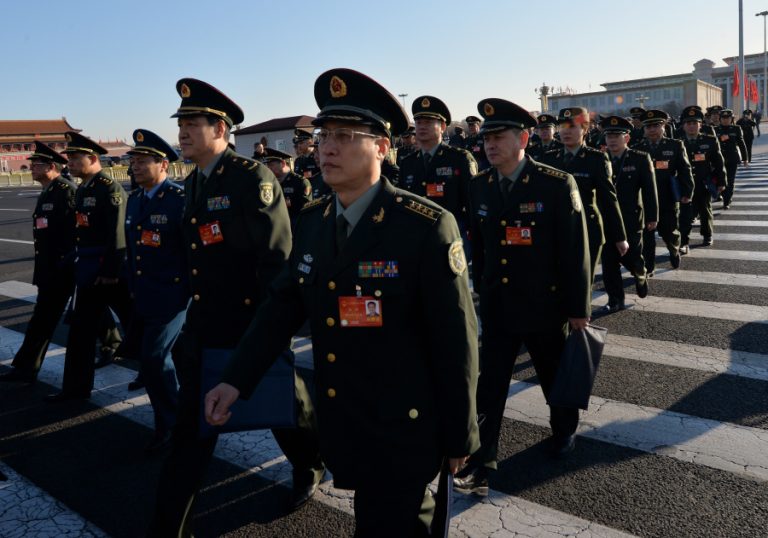
Since the 20th Party Congress in 2022, Xi Jinping, the CCP’s general secretary and chairman of the Central Military Commission (CMC), China’s top military command body, has purged five of seven CMC members. The visual consequences were on full display on March 7, 2026, when state television broadcast the plenary session of the military and armed police delegation: Xi sat at the center of the podium with Zhang Shengmin, the sole remaining CMC vice chairman, to his left, and the entire right side of the stage was empty.
At the same session in 2025, five officials occupied the stage: Xi, both CMC vice chairmen Zhang Youxia and He Weidong, and CMC members Liu Zhenli and Zhang Shengmin. By March 2026, Zhang Youxia, He Weidong, Liu Zhenli, former defense minister Li Shangfu, and former head of the CMC’s Political Work Department Miao Hua had all been purged.
State television showed Xi entering the meeting hall with only Zhang Shengmin walking behind him, a lonely two-man procession that would have been unthinkable just two years earlier. Neither Xi nor Zhang Shengmin has any combat experience or field military background, yet Xi had removed Zhang Youxia and Liu Zhenli, both of whom had actual battlefield credentials. This fact has not been lost on the rank and file.
The dysfunction extended to the delegation’s organizational structure. When the military delegation was formally established on March 3, it took the unprecedented step of appointing no deputy team leader. The delegation’s attendance had also shrunk: the original 281-member roster lost 38 names, leaving only 243 delegates.

China’s last CMC vice chairman flattered Xi in terms that rivaled the regime’s worst sycophants
Zhang Shengmin, as the sole surviving senior military official outside Xi himself, apparently understood what was expected of him. At a March 5 subgroup meeting, he delivered a performance that analysts compared to the most notorious displays of loyalty theater in recent CCP history.
Success
You are now signed up for our newsletter
Success
Check your email to complete sign up
According to a PLA Daily report, Zhang declared that the completion of the regime’s “14th Five-Year Plan” (2021-2025) fully proved that the “Two Establishments,” a Party slogan affirming Xi’s status as the CCP’s core leader and enshrining “Xi Jinping Thought” as the Party’s guiding ideology, represent “the most significant political achievement, the most precious historical experience, and the most objective practical conclusion of the new era.” He called on the entire military to use “Xi Jinping Thought on Socialism with Chinese Characteristics for a New Era” to, in the Party’s jargon, “forge their souls,” and to implement the “CMC Chairman Responsibility System,” a doctrine that concentrates all military authority in Xi personally.
U.S.-based commentator Zhang Tianliang noted that Zhang Shengmin’s flattery now rivals that of Cai Qi, the Politburo Standing Committee member who once urged the Party to let “Xi Jinping Thought” “enter the brain, enter the heart, enter the soul,” and Li Hongzhong, the former Tianjin Party secretary infamous for declaring that “loyalty that is not absolute is absolutely not loyalty.”
Zhang Tianliang offered two possible readings. In the first, Zhang Shengmin has fully submitted to Xi and expects to be rewarded with a safe tenure through the CCP’s 21st Party Congress. In the second, far more ominous reading, Zhang Shengmin is afraid for his life.
The logic is straightforward. Xi has purged five of the seven CMC members who served alongside him after the 20th Party Congress. If the CMC was so thoroughly corrupt that five of seven members warranted removal, what are the odds that Zhang Shengmin alone was clean? Xi is unlikely to move against him before appointing a replacement vice chairman, possibly at the CCP’s Fifth Plenum. But once a new vice chairman is in place, Zhang Shengmin’s safety is no longer guaranteed.
And there is a deeper structural problem: with the CMC reduced to just two men, Zhang Shengmin now oversees all day-to-day military operations. That much concentrated authority in anyone’s hands, even a sycophant’s, makes Xi nervous. The more power Zhang accumulates by default, the more reason Xi has to distrust him.
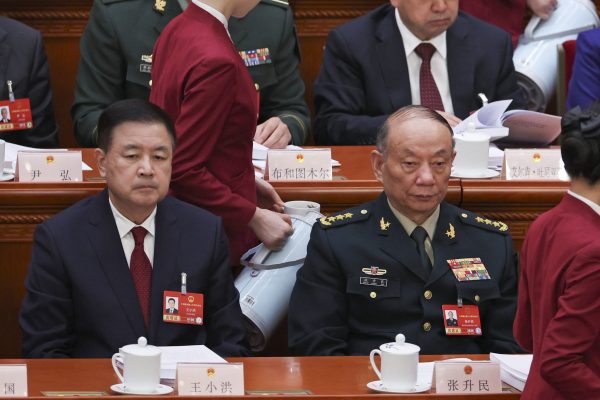
China’s security chief made a rare appearance at the military session
State TV footage also showed Wang Xiaohong, the minister of public security and head of China’s police apparatus, attending the military delegation’s plenary session. The camera lingered on Wang for nearly three seconds, an unusually long close-up that appeared designed to counter recent rumors about his status. Reports had circulated online that Wang was seriously ill or had been politically sidelined, with some speculation that he was suspected of secretly communicating with the United States.
Wang’s appearance may have been a deliberate signal from the regime that he remains in his post. The state news agency Xinhua’s written report and the state broadcaster’s video coverage, however, did not mention Wang by name, which was itself unusual, and contrary to standard protocol for an official of his rank attending such a session.
According to state TV footage, five other State Council department heads also attended the March 7 session: the head of the Cyberspace Administration, Zhuang Rongwen; the head of the State Administration of Science, Technology and Industry for National Defense, Shan Zhongde; the minister of veterans affairs, Pei Jinjia; the education minister, Huai Jinpeng; and the minister of human resources and social security, Wang Xiaoping.
Records show that no State Council officials attended the military delegation session in 2023, the first year after the 20th Party Congress. Beginning in 2024, however, eight ministry-level officials were invited, and nine attended in 2025. Wang Xiaohong was notably absent from both the 2024 and 2025 sessions, making his 2026 appearance a clear break in pattern.