Wang Huning, the chairman of the Chinese People’s Political Consultative Conference (CPPCC), the CCP’s political advisory body, is one of the Party’s seven most powerful officials. His public bow to Xi Jinping, the CCP’s general secretary and China’s top leader, on March 4, 2026 was captured on state television and spread rapidly online, becoming the defining image of this year’s Two Sessions. The same session also saw Xi and his loyalists whispering and passing handwritten notes in full view of cameras, while new reports allege that Wang’s daughter and her family have been forcibly relocated to Beijing.
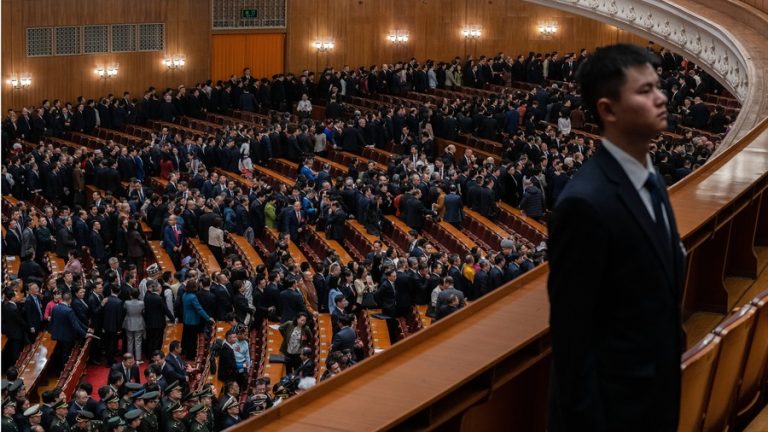
State TV footage shows that after delivering his speech at the CPPCC opening ceremony in the Great Hall of the People, Wang walked back from the podium along the side of the presidium. As he passed in front of Xi’s seat, he stopped abruptly, let his arms hang at his sides, and bent at the waist. Xi responded with little more than a slight nod before turning his gaze forward.
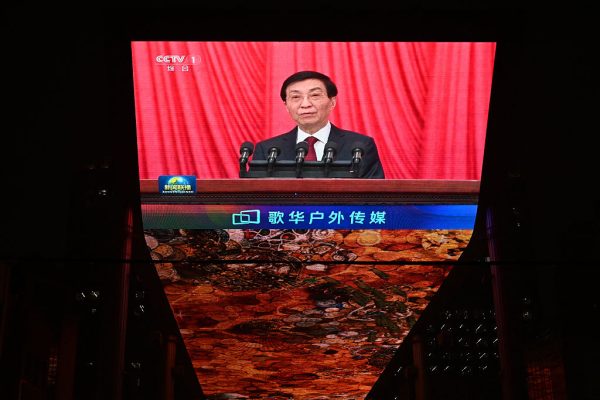
Wang Huning’s bow sparked immediate ridicule online
Under CCP protocol, the CPPCC chairman and vice-chairmen sit in the front row of the presidium, while the other members of the Politburo Standing Committee, including Xi, sit in the second row. This placed Xi’s seat directly behind Wang’s, creating the slightly awkward arrangement that set the stage for the encounter.
The video spread rapidly on X (formerly Twitter), drawing biting commentary. Users mocked the display as proof that even the highest-ranking CCP officials are reduced to personal servants under Xi’s one-man rule. “Wang Huning just gave a live performance showing exactly what officials are in a dictatorship: their superior’s slave,” one widely shared post read. Others connected the bow to the recent downfall of Zhang Youxia, the former vice chairman of China’s top military command body, the Central Military Commission: “No surprise. The Zhang Youxia affair scared him to death.”
Xi’s loyalists whispered and passed notes during the session
The same session produced another striking scene. According to footage captured by Hong Kong’s Ming Pao and the Nikkei Asia from inside the Great Hall, Wang Huning was seen repeatedly leaning over to whisper to Xi Jinping, who sat to his left, after listening to prime minister Li Qiang deliver a work report. Wang then appeared to relay information to Ding Xuexiang, the executive vice prime minister seated to his right, who in turn passed the message along to Han Zheng, the vice president.
Success
You are now signed up for our newsletter
Success
Check your email to complete sign up
Shortly afterward, Wang apparently needed to reach Chen Yiqin, a State Council member seated further back. Rather than leave his seat, he recruited a state TV cameraman walking the aisles to act as a courier, handing over a small written note. Chen wrote a reply on another slip of paper and sent it back via the same cameraman. Wang then handed Chen’s note, which contained four lines of handwritten text, directly to Xi. Xi read it, exchanged a few words with Wang, and returned it.
The spectacle of China’s top leaders whispering and using a cameraman as a messenger boy during what is supposed to be a solemn political ceremony struck observers as remarkably undisciplined. For a regime that stages its legislative sessions as showcases of unity and order, the scene was jarring.

Reports allege Xi moved Wang Huning’s daughter to Beijing as a hostage
Online sources have recently claimed that Wang Huning’s daughter and her family, who had been living in Shanghai, were ordered to relocate to Beijing under the pretext of “protecting the families of central leaders.” The order reportedly came from the CCP’s General Office, which is controlled by Cai Qi, the Politburo Standing Committee member who serves as Xi Jinping’s most trusted political enforcer and runs the Party’s day-to-day administrative apparatus.
The credibility of the claim cannot be independently verified. Analysts point out, however, that the General Office under Cai Qi functions as Xi’s personal control mechanism over the Party elite, and that moving a senior leader’s family to Beijing under “security” pretenses is a well-established CCP method of keeping officials in line. If the reports are accurate, Xi may view Wang as a flight risk, someone whose intelligence and political survival instincts make him dangerous in a crisis.
U.S.-based political commentator Jiang Feng offered a blunt analysis: Xi fears that when the regime starts to wobble, the first person to quietly write a “letter of surrender” to the Americans will be a brilliant political operator like Wang Huning. By seizing Wang’s “soft spot,” his family, Xi is sending a warning.
This interpretation also helps explain why Wang would publicly humiliate himself with the bow. A man of Wang’s stature and reputation as the CCP’s chief ideologist would not ordinarily debase himself so visibly. The most logical explanation is that he felt he had no choice: his leverage had been taken from him.