By Cai Siyun, Vision Times
China is expected to produce 12.7 million university graduates in 2026, an increase of 480,000 from the previous year. But as new graduates enter an already strained job market rife with youth unemployment and dwindling wages, a proposal from a Chinese official urging students to “return to their hometowns to start businesses” has triggered widespread criticism online.
According to Chinese media outlet Sina, Song Bao’an, a deputy to the National People’s Congress, academician of the Chinese Academy of Engineering, and president of Guizhou University, suggested on March 9 that university graduates, particularly those from western China, should be encouraged to return to rural areas to find their own employment opportunities.
The proposal immediately sparked heated debate among Chinese netizens, many of whom compared it to past political campaigns that sent urban youth to the countryside. One user wrote sarcastically: “Is this the new ‘educated youth going to the countryside’ movement?” Another asked: “How are fresh graduates supposed to start businesses? With what money?”
RELATED: China’s Post-Holiday Job Market Collapsed Across Guangzhou and Shenzhen
Success
You are now signed up for our newsletter
Success
Check your email to complete sign up
Others ridiculed the idea. “There’s nothing in the countryside, what exactly are they supposed to build a business on?” questioned another netizen.
Shrinking ppportunities
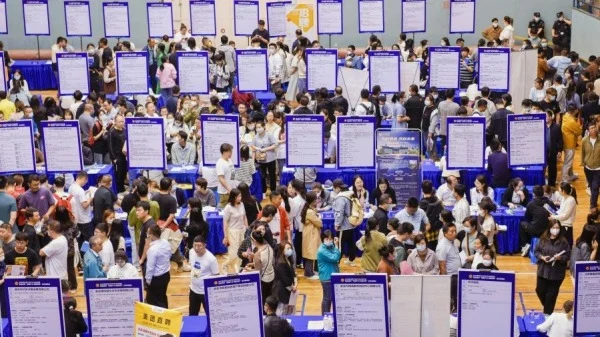
China’s graduate population has exceeded 10 million annually since 2022, according to official data. In 2025, universities produced 12.22 million graduates, and the number is projected to reach 12.7 million in 2026, placing immense strain on the employment market.
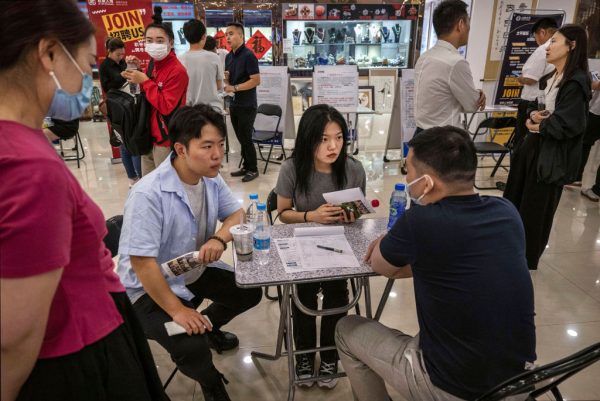
Online videos circulating on Chinese social media platforms show massive crowds at job fairs across the country. In some cases, university graduates reportedly account for half of all applicants for factory positions, reflecting the increasingly competitive labor market.
Employment counselor Mr. Li described the situation as particularly difficult for liberal arts majors. “It’s hard for liberal arts students to find jobs,” said Li. “Starting salaries are often only around 3,000 yuan a month, sometimes even less.” He added that for many graduates from ordinary universities or vocational colleges, job prospects depend heavily on strong project experience or personal connections.
“If you can’t secure something during the spring recruitment season, you may end up going through labor dispatch agencies,” said Li.
Graduates settling for meager wages
Many young job seekers say wages are far lower than expected. A communications engineering graduate identified as Xiao Li said he recently interviewed for two positions offering monthly salaries of just 2,800 yuan and 3,000 yuan, leaving him discouraged. “I graduated in 2026 from a second-tier university in Sichuan,” he said. “Originally I wanted to take the civil service exam or pursue graduate school, but the results weren’t good.”
RELATED: Chinese Youth Say ‘No Next Life’ as Debt, Unemployment, and Despair Spread Across China
Another graduate, Xiao Zhang, said his university arranged an internship in a hotel kitchen in Shanghai. The work schedule runs 10 to 11 hours a day, while pay remains minimal. “I studied culinary and nutrition education,” he said. “As an intern I get 3,400 yuan a month with meals and housing included. After becoming a full-time employee, the salary drops to about 2,900 yuan after deductions.”
For some graduates, the search for stable employment has stretched for years. A job seeker surnamed Chen said he has been unemployed for four years since graduating. Positions he has found in Zhejiang offer extremely low pay. “My ideal salary is 6,000 yuan a month, but the only way to reach that might be working in a factory tightening screws,” he said.
Chen said many online job postings have also proven to be misleading. “Most job listings online are deceptive. I’ve been scammed many times. Kitchen jobs start with take-home pay of only about 2,000 yuan, while office positions pay barely 2,100 yuan.”
Youth unemployment sky high
China’s youth unemployment rate surged sharply beginning in 2022, reaching a record 21.3 percent in June 2023. Soon afterward, authorities stopped publishing the youth unemployment rate. It was later revised and reintroduced in January 2024, excluding students from the calculation.
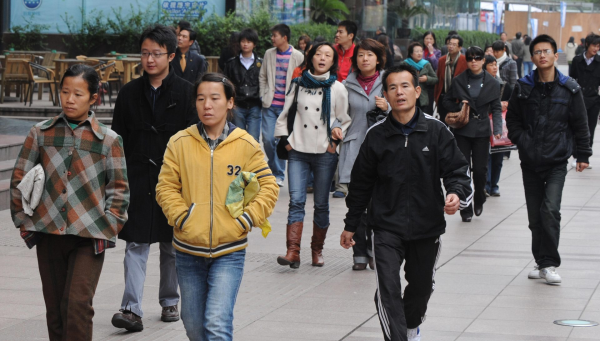
Even under the revised method, youth unemployment remained elevated throughout 2025. It peaked at 18.9 percent in August before declining slightly to 16.5 percent by the end of the year, still significantly higher than historical averages. Critics argue that the official figures underestimate the true scale of unemployment.
As China’s economy slows and employment opportunities shrink, an increasing number of young people are adopting the so-called “lying flat” (tang ping) lifestyle, meaning a passive rejection of corporate competition and work pressures by doing the bare minimum to defy societal expectations.
Embracing ‘lying flat’
The concept generally includes avoiding major life commitments such as buying property, purchasing cars, marrying, or having children, while limiting consumption and stepping away from traditional career ambitions. Supporters view the movement as a way to resist economic pressure and social expectations.
The trend has resonated widely among younger generations and has increasingly challenged official narratives emphasizing hard work and economic growth.
Authorities have also taken steps to curb online discussions about economic difficulties. Since 2025, several social media influencers who discussed economic conditions and unemployment have reportedly had their accounts suspended.
Despite official criticism, the “lying flat” mentality continues to spread, reflecting broader frustration among young Chinese facing uncertain economic prospects across the country.