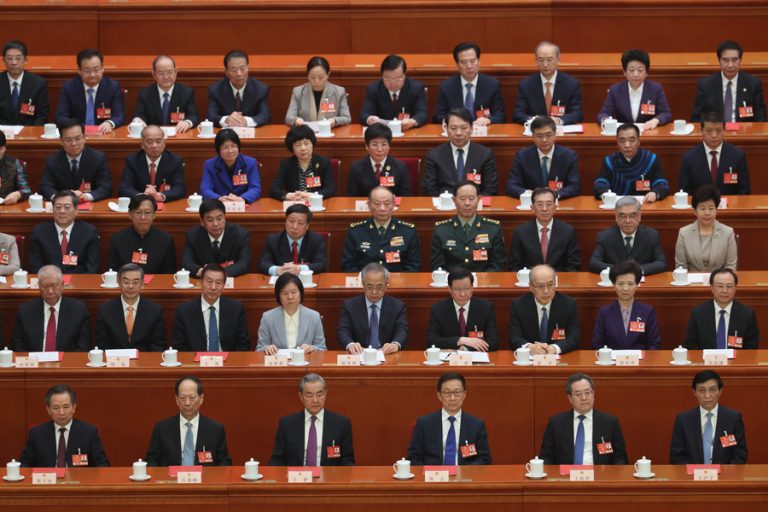
Xi Jinping, the CCP’s general secretary and China’s top leader, visited the Jiangsu province delegation on March 5, 2026, flanked by only one official: Cai Qi, the Politburo Standing Committee member who runs the CCP’s General Office and serves as Xi’s most trusted political enforcer. In 2023, three senior officials had accompanied him. In 2024, two. In 2025, two again. The shrinking entourage coincided with two other developments at the Two Sessions: the unexplained absence of Hu Chunhua, a CPPCC vice chairman who had accompanied Xi to a joint group session in both 2024 and 2025, and the sudden reappearance of Jing Junhai, a former provincial Party boss who multiple sources had reported as detained.
The year-by-year details tell the story. In 2023, three officials accompanied Xi: Cai Qi and Ding Xuexiang, both Politburo Standing Committee members, plus He Lifeng, a Politburo member. In 2024, the group was Cai Qi plus two vice-national-level officials: Jiang Xinzhi, who serves as a CPPCC vice chairman and deputy head of the CCP’s Organization Department, and Mu Hong, a CPPCC vice chairman who runs the CCP’s Central Reform Office. In 2025, it was Cai Qi and Mu Hong. In 2026, only Cai Qi remained.
The pattern tells a clear story: the circle of officials trusted to be at Xi’s side during the regime’s most visible political theater has steadily contracted until only one man is left.
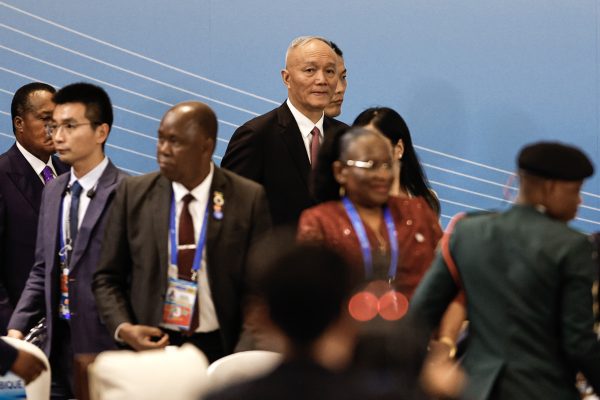
A former vice prime minister broke her three-year pattern of accompanying Xi
On March 6, Xi attended a joint group session of the CPPCC’s agricultural, health, and social welfare sectors. Accompanying him were CPPCC chairman Wang Huning, Cai Qi, and six vice-national-level officials including Shi Taifeng, a Politburo member who heads the CCP’s United Front Work Department. Hu Chunhua was absent.
Hu Chunhua, a former vice prime minister who was appointed CPPCC vice chairman in 2023, had accompanied Xi to this same joint group session in both 2024 and 2025. Her absence this year broke the established pattern.
Success
You are now signed up for our newsletter
Success
Check your email to complete sign up
According to state media, Hu did attend the CPPCC opening ceremony on March 4 and the NPC opening session on March 5, where she sat on the presidium. That same day, she participated in a small-group discussion of the China National Democratic Construction Association sector, where she used standard loyalty language, referencing the “Two Establishments” and “Two Safeguards,” Party slogans that affirm Xi’s supreme authority.
U.S.-based commentator Jiang Feng reported that sources in Beijing political circles have leaked word of a compromise among CCP factional forces: a proposal to elevate Hu Chunhua back to the Politburo and appoint her as the CMC’s first vice chairman, filling the gaping vacancy on China’s top military command body. An even more startling claim holds that Xi has agreed in principle to eventually resign as CMC chairman.
These claims cannot be independently verified. But the fact that such rumors are circulating among well-connected observers in Beijing reflects the intensity of the power struggle within the CCP’s upper ranks. Jiang Feng explained the logic behind the Hu Chunhua speculation: with the military’s senior leadership decimated by purges, the various remaining military factions need a figure with no military factional ties to serve as a neutral broker and caretaker. A career civilian bureaucrat like Hu would fit that role precisely because she is an outsider to the military establishment.

A provincial leader rumored to be detained appeared at the Two Sessions
The Two Sessions produced one more jarring scene. On March 6, Jing Junhai, the former Party secretary of Jilin province who currently holds the largely ceremonial title of deputy head of the NPC’s Education, Science, Culture, and Public Health Committee, attended a Jilin delegation subgroup meeting and delivered a speech. He made a point of referencing “Xi as the core.”
This was remarkable because Jing had been the subject of repeated reports that he had been detained and was under investigation.
On Feb. 14, 2026, Canada-based dissident activist Sheng Xue posted on X that Jing Junhai had been taken into custody roughly six hours earlier, allegedly over remarks he made to Singaporean contacts that were interpreted as expressing dissatisfaction with Xi’s policies. On Jan. 29, U.S.-based commentator Cai Shenkun reported that Jing, who had been the subject of “being taken away” rumors multiple times, had finally been detained for real. On Jan. 28, Australia-based commentator Jiang Wangzheng also reported that Jing was under investigation again.
Jing’s public reappearance at the Two Sessions was clearly intended to send a political signal from the regime, though the precise message remains ambiguous.
Jing’s career trajectory is deeply intertwined with Xi’s patronage network. His hometown, Baishui County in Shaanxi province, is adjacent to Xi Jinping’s hometown of Fuping County. In May 2012, just months before Xi took power, Jing was appointed head of the Shaanxi Provincial Party Committee’s Propaganda Department and oversaw a major expansion of the memorial complex for Xi’s father, Xi Zhongxun, the late CCP revolutionary elder.
Jing’s career took off after that: he served as Beijing’s deputy Party secretary, then governor and Party secretary of Jilin province. In June 2024, at age 63, he was abruptly removed from his Jilin posts and shifted to a backbench legislative position, fueling speculation about his political standing.