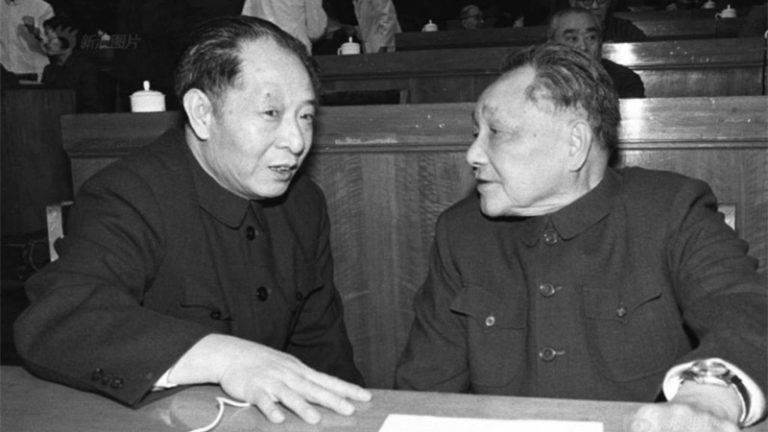
At a small meeting, Deng Xiaoping raised a proposal. Hu Yaobang expressed agreement, replying simply, “I agree.” Those two words concealed a deeper political crisis.
Zhao Ziyang later believed that Deng’s conversation with Hu about taking over as chairman of the Central Advisory Commission actually signaled that Hu Yaobang would be replaced at the 13th Party Congress.
Note: Zhao Ziyang once jokingly referred to himself as a “grand secretary-general,” a phrase that exposed the awkward realities of Chinese politics in the 1980s. Although Zhao held the title of general secretary, he often functioned more like a senior aide, carrying messages between Deng Xiaoping and elder leaders such as Chen Yun while real authority remained in their hands.
On one occasion, Chen Yun asked Zhao to convene a Politburo Standing Committee meeting, but Deng Xiaoping simply said, “Don’t hold it.” Zhao could only shrug and reply: “I’m just a grand secretary-general. The two of you will discuss it and let me know.” Chen Yun reportedly repeated the phrase to himself afterward, creating an extremely awkward moment.
One widely circulated account holds that the immediate cause of Hu Yaobang’s removal was his agreement with Deng Xiaoping’s proposal to retire. During a small internal meeting, Deng raised the idea of stepping down. Everyone present urged him to stay—except Hu Yaobang, who said he agreed. Those two words made Hu a target among the Party elders.
Success
You are now signed up for our newsletter
Success
Check your email to complete sign up
This may explain why Chen Pixian later delivered speeches in Tianjin proclaiming Deng Xiaoping to be the Party’s leader. Many elders did not want Deng to retire. One reason was his enormous prestige. Another, perhaps more important, was that if Deng stepped down, the other elders would likely be expected to retire as well. To protect their own interests, they could not allow Deng to leave office. Hu Yaobang’s agreement with Deng’s retirement therefore touched the interests of many senior leaders.

A deeper reason of Hu Yaobang’s removal
Zhao Ziyang later told Yang Jisheng, author of The Political Struggles of China’s Reform Era, that the deeper reason for Hu Yaobang’s removal was that Deng Xiaoping and several elders had completely lost confidence in him. The loss of trust centered on two issues: Hu’s perceived weakness in opposing liberalization and his conversation with Lu Keng, editor-in-chief of Hong Kong’s Bai Xing magazine.
On the first issue, Deng believed that if the elders were gone and Hu Yaobang presided over affairs, liberalization in China would inevitably spiral out of control. Deng’s disappointment in Hu gradually deepened.
The first criticism came in 1981, when Deng faulted the ideological and theoretical front for being too weak. The second arose during the campaign to eliminate “spiritual pollution.” The third involved opposition to liberalization. Each time, Deng criticized areas under Hu Yaobang’s responsibility, and his dissatisfaction grew stronger.
The materials criticizing the ideological front did not come from Hu Yaobang but from Hu Qiaomu and Deng Liqun. When Deng inquired about the situation, they confirmed that the problems described in the reports were real. Deng later instructed Hu Qili and Qiao Shi to convey criticism to Hu Yaobang twice, saying that he had been too weak toward liberalization and had failed to deal with certain individuals.
The first message, delivered by Hu Qili, stated bluntly: “To take such a permissive and weak attitude toward liberalization is the fundamental weakness of a general secretary.”
The campaign against “spiritual pollution” widened the gap between Deng and Hu even further. Deng Xiaoping had originally proposed the campaign, but it later expanded excessively and lasted only 28 days before being abandoned. Deng himself eventually acknowledged that the campaign had become unpopular.
Yet afterward, Hu Yaobang repeatedly commented that the campaign’s formulation had been “unscientific” and that it had expanded too far.
Activists lose their positions
In December 1984, during the Fourth National Congress of the China Writers Association, the atmosphere created by Hu Yaobang’s speech allowed many people who had been criticized during the anti–spiritual pollution campaign to voice their grievances. During the association’s election, activists who had supported the campaign lost their positions.
Some Party elders strongly objected. They believed the writers’ congress amounted to a repudiation of the anti–spiritual pollution campaign. Because the event had been chaired by Hu Yaobang and Hu Qili, dissatisfaction among the elders was directed toward Hu.
In 1985, Deng Xiaoping asked Qiao Shi to deliver another message to Hu Yaobang. “People outside are saying Yaobang represents the enlightened faction within the Party,” Deng said, “and they are using his banner to oppose us.” Deng then asked: “Why doesn’t Yaobang speak about opposing liberalization?”
During the Beidaihe meetings that year, after Hu Qili and Qiao Shi relayed Deng’s message, Zhao Ziyang advised Hu Yaobang: “You should study this and give Xiaoping an explanation.” Hu initially agreed, but later left for Xinjiang and never responded.
Zhao later asked him directly: “The old man has raised this several times. You still haven’t made a statement. What are you thinking?” Hu did not answer.
The second issue that undermined Deng’s trust was Hu Yaobang’s conversation with Lu Keng, editor of Hong Kong’s Bai Xing magazine.
On May 10, 1985, Hu Yaobang received Lu in Zhongnanhai for a two-hour recorded interview. During the conversation, Hu discussed tensions between reformers and conservatives during China’s reform process.
After returning to Hong Kong, Lu Keng wrote a 20,000-word article titled “An Interview with Hu Yaobang,” praising Hu while criticizing conservative forces. When the article circulated among senior Party leaders, it caused a major uproar.
In 1986, Yang Shangkun returned from Beidaihe and asked Zhao Ziyang whether he had read the interview. Deng Xiaoping reportedly told Yang: “Lu Keng used praise of Yaobang as a cover to oppose us. If I’ve made any mistake in recent years, it was misjudging Hu Yaobang.”
From that point on, Deng’s attitude toward Hu changed sharply.
In fact, because many elders believed Hu Yaobang had been ineffective in opposing liberalization, they had already begun to consider replacing him.
A fateful visit
In the spring of 1986, Hu Yaobang visited Zhao Ziyang at his home and said Deng Xiaoping had spoken with him about future arrangements. At the 13th Party Congress, Deng planned to withdraw from the Politburo Standing Committee and step down as chairman of the Central Advisory Commission—though he did not mention leaving the chairmanship of the Central Military Commission. Hu Yaobang would take over that position.
Hu would no longer remain general secretary in the next term. Deng reportedly said: “If the two of us do this together, we can bring a large group of veteran comrades into retirement.”
Hu Yaobang initially accepted the arrangement. He later told Zhao Ziyang: “After this arrangement, you will become general secretary.”
Zhao replied that such a transition would not be appropriate. Although he was slightly younger than Hu, both were essentially in the same age group—between 60 and 70. Zhao suggested that Hu Qili might instead take the position.
Hu Yaobang said Hu Qili could not assume the role immediately. Zhao then proposed abolishing the position of general secretary at the 13th Party Congress and allowing members of the Standing Committee to rotate leadership duties. Hu replied that the idea sounded good.
Zhao later concluded that Deng Xiaoping’s conversation about Hu taking over the Central Advisory Commission had actually been a plan to replace him at the 13th Party Congress through a gradual transition. Deng framed the proposal in terms of rejuvenation, but Hu interpreted it simply as generational renewal and failed to grasp its deeper meaning.
Hu Yaobang’s removal in January 1987 therefore became almost inevitable. The Lu Keng interview and the student demonstrations merely accelerated the elders’ decision, turning what had once been planned as a gradual transition into a forced resignation.
Afterward, Zhao Ziyang said: “Xiaoping originally treated Yaobang very well. The outcome resulted from differences in political views, especially regarding intellectuals. The dispute began with the campaign against spiritual pollution and continued with the Lu Keng interview. That interview was a fuse. The 1986 student demonstrations were another fuse. The demonstrations alone would not have been enough to remove Yaobang.
“My break with Xiaoping was different. Until the events of June Fourth, Xiaoping still trusted me. He believed that June Fourth revealed my true position. He said I had ‘exposed myself.’ His split with Yaobang developed gradually over several years. Trust declined year by year until it disappeared completely.”
Hu Yaobang ultimately became a victim of what Zhao Ziyang described as “elder politics.”
Although he was nominally the Party’s top leader, real authority rested with a group of veteran revolutionaries including Deng Xiaoping, Chen Yun, Li Xiannian, Deng Yingchao, Yang Shangkun, Peng Zhen, Wang Zhen, Bo Yibo, and Song Renqiong.
Among them, Deng Xiaoping held the greatest authority, followed by Chen Yun and Li Xiannian. As chairman of the Central Military Commission, Deng served as the core of the elder leadership.

Once an agreement was reached
Major decisions were effectively settled once Deng Xiaoping and Chen Yun reached agreement. Other elders expressed their views through them. Leaders on the front line of government largely carried out the elders’ wishes.
If the elders were satisfied, those leaders could remain in office. If not, they could be replaced at any time.
Because Deng was more open to reform while Chen Yun was more conservative, disagreements between the two placed first-line leaders in an especially difficult position. They could not offend either man, creating what Zhao Ziyang described as the dilemma of “serving two masters.”
Zhao once described his own predicament under this system:
“At that time many veteran comrades were still around, which made it very difficult for a general secretary to work. When I was acting general secretary, Chen Yun asked me to convene a meeting, but Xiaoping said not to hold it. Chen wanted meetings so he could speak there. Xiaoping preferred not to hold meetings and instead talk to us directly.
“When I didn’t convene the meeting, Chen asked me why. I said: ‘I’m just a grand secretary-general. If you want a meeting, you and Comrade Xiaoping should decide first and then inform me.’ Chen repeated my words to himself: ‘A grand secretary-general.’”
Hu Yaobang was the first victim of this system.
The next would be Zhao Ziyang.
By Yang Jisheng