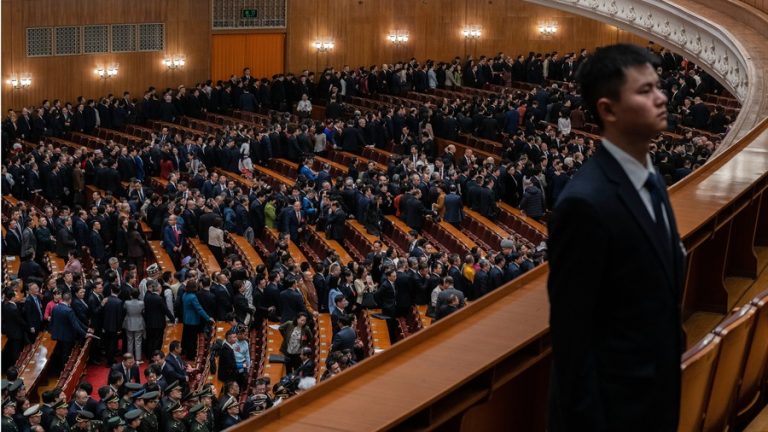
On March 9, 2026, China’s rubber-stamp legislature, the National People’s Congress, held the second full session of its fourteenth term at the Great Hall of the People in Beijing. Zhao Leji, the Congress’s standing committee chairman and one of the seven members of the Politburo Standing Committee, the Party’s innermost circle of power, delivered the committee’s annual work report. In it, he disclosed that 58 delegates had their credentials terminated between March 2025 and February 2026: 55 were removed and 3 resigned. The Congress currently holds 2,878 sitting delegates.
The scale becomes clear in comparison. The Congress’s reports for 2024 and 2025 recorded 24 and 30 terminations respectively in their preceding years, a combined total of 54. The 58 terminations reported this year surpass that two-year sum. The trajectory is unambiguous: the internal purge is widening.
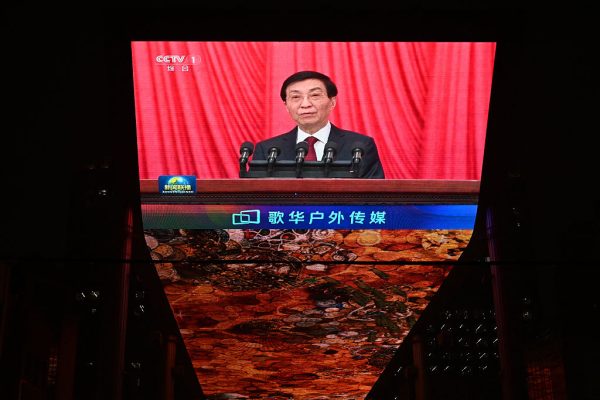
The military has suffered the deepest losses, with 36 of its legislative delegates removed
The military’s contingent in the Congress has taken disproportionate losses. According to the Congress’s official delegate roster, the People’s Liberation Army, China’s regular military, and the People’s Armed Police, a separate paramilitary force responsible for internal security, currently hold 243 combined seats in the legislature, down from 281 at the start of this congressional term, a reduction of 38. Of those 38, 36 were formally removed from their positions.
The remaining two were reassigned following retirement or transfer from active service rather than removed for political reasons. Chen Yu, a former staff sergeant of a brigade under the military’s 71st Group Army, retired in September 2025 and has since moved into the Anhui provincial delegation. Li Dong, a senior colonel who served as political commissar of the College of Systems Engineering at the National University of Defense Technology, joined the Hunan provincial delegation and attended its first plenary session on March 3, 2026.
The scale of military removals has not gone unnoticed. One widely circulated comment on X, the social media platform used by Chinese-language users outside the mainland’s censorship firewall, read: “36 people removed. This is the signal that trust within the CCP’s power structure has completely collapsed. A regime that must purge such a high proportion of the representatives of its own armed forces is a regime gripped by systemic anxiety. Xi Jinping no longer trusts anyone, including those he personally selected for the inner circle of power.”
Success
You are now signed up for our newsletter
Success
Check your email to complete sign up
Two senior officers who have been publicly announced as having fallen from power continue to appear on the official military delegate roster despite their disgrace. Zhang Youxia, the former vice chairman of the Central Military Commission, the Party’s supreme command body over China’s armed forces, and Liu Zhenli, a former commission member who previously served as commander of the ground forces, both remain listed. Their continued presence on the roster while stripped of real authority is a bureaucratic anomaly the Party has not yet formally resolved.

An official’s published account of feeling ‘dizzy with happiness’ near Xi captures the psychological climate
Against the backdrop of this purge, a separate episode illustrated, with unintentional clarity, the atmosphere inside the Party apparatus.
On March 7, 2026, the official website of Pingxiang University in Jiangxi province published a personal account by Wu Daishe, a member of the Chinese People’s Political Consultative Conference, the Party’s political advisory body, which holds formal sessions alongside the legislature but exercises no real power, and deputy chair of the Jiangxi provincial committee of the Jiusan Society, one of eight nominally independent political parties permitted to exist in China on the condition that they accept Communist Party leadership without challenge.
Wu wrote that upon attending a Political Consultative Conference group session on March 6, he discovered that his nameplate had been placed directly across the table from that of Xi Jinping, the Party’s general secretary and China’s top leader. The realization left him, he wrote, “enveloped in happiness” and feeling somewhat dizzy. He went on to praise Xi’s command of technical detail, describing him as projecting the bearing of a professional scientist.
Jiangxi state television broadcast an interview with Wu. The video spread rapidly on X, drawing responses ranging from contempt to dark humor.
“The instincts of a servant are on full display,” one commenter wrote. “Kneeling so long that seeing Xi’s nameplate triggers a dizzy spell of ecstasy. Tail wagging like a dog. Meanwhile the legislature piles up with useless proposals about lowering the marriage age and boosting births, while the economy collapses and people struggle to survive.”
Another wrote: “This cannot be an isolated case. From this man alone you can tell that Xi has long since been surrounded by flatterers and will never again hear a true word spoken to him.”
A third offered a shorter reading: “That was the dizziness of fear.”

The purge statistics and the loyalty performance are two sides of the same system
The connection between Zhao’s purge figures and Wu’s published rapture is direct. Fifty-eight delegates removed in a single year, more than the previous two years combined, and the military stripped of 36 representatives, produces a specific psychological climate. Officials who watch colleagues disappear do not respond with indifference. They respond with performances of loyalty whose intensity is calibrated to the perceived danger.
Wu’s account reads, on the surface, as a man eager to demonstrate devotion to the Party’s general secretary. Read against the purge statistics disclosed in the same week, it reads as something else: the reflexive self-protection of an official acutely aware of what happens to those who fail to perform adequately.
One online commenter put it plainly: “A close-up view of the meat grinder.”
By Li Deyan