A 23-year-old man in Shanghai disappeared on March 3, 2026, one day after completing a medical examination, reigniting organ harvesting fears in China. His case has become a flashpoint for public anger over the country’s epidemic of unexplained disappearances and the CCP regime’s refusal to investigate them.
Zhang Taotao went missing on March 3 around midday near a bridge on Lianggang Avenue in Shanghai’s Pudong district. His family told Chinese social media users that he had completed a medical exam the previous day. The next morning, he set out for work and never arrived. His phone went dead. His electric scooter was found at the scene, untouched. His medical exam results were never released by the facility.
Multiple bloggers on the Chinese social media platform Douyin, including accounts with large followings, published appeals for information. One noted the sequence of events and asked directly whether Zhang had been “precisely targeted.” Another wrote that a young person vanishing without warning, without a goodbye, and without a trace “is not a story; it is a family in despair.”
Chinese internet users connected Zhang’s case to the CCP’s well-documented practice of forced organ harvesting. Comments included: “The real culprit behind missing people is the organ transplant system” and “His organs have probably already been removed.”

Missing young men across six provinces in a single week
Zhang Taotao’s case is far from isolated. In the first ten days of March 2026 alone, young men disappeared under unexplained circumstances in at least six Chinese provinces.
Success
You are now signed up for our newsletter
Success
Check your email to complete sign up
On March 6, a 20-year-old man named Jiang Guilin left his home in Peixian county, Jiangsu province, and vanished. His family had no leads five days later.
On March 7, a 19-year-old named Zhang Hao received a phone call at his home in Chongzhou, Sichuan province, walked out, and was never heard from again. His phone went dead shortly after.
On March 3, a 13-year-old middle school student named Cheng Shaojie left his family’s home in Zhen’an county, Shaanxi province, around 10 p.m. and disappeared.
On March 4, an 18-year-old named Wang Wenhao, 182 centimeters tall, went missing in Fuzhou, Jiangxi province. Five days later, his family still had no contact.
On March 6, a 21-year-old named Ge Yini left his home in Yinzhou district, Tieling, Liaoning province, carrying only his phone. He left behind his ID card and charger.
The pattern extends well beyond March. A widely circulated video documented 63 disappearances across eighteen Chinese provinces in a single ten-day window, from February 11 to February 20. The missing included children as young as 11, teenagers, and young adults in their prime.
The cases included pregnant women. On Feb. 17, a 27-year-old woman named Cui Chunmiao, eight months pregnant, disappeared in Hebei province. On February 5, a 32-year-old mother named Jia Yacong, five months pregnant, vanished along with her seven-year-old daughter Xian Zhengyuan in Puyang, Henan province. Eight days later, neither had been found.
A former police insider says the government does not search for missing children
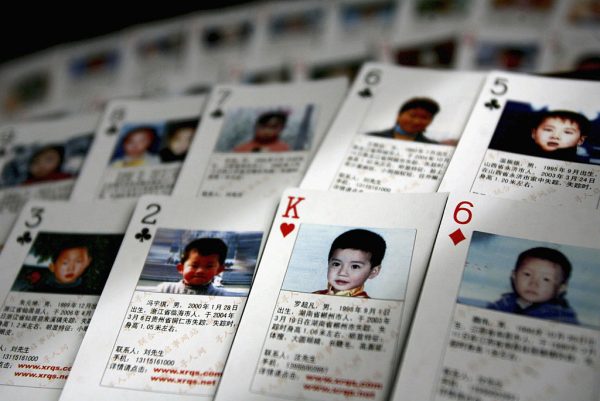
China’s own official data acknowledges the scale of the problem. The China Missing Persons White Paper (2020) reported that one million people were recorded as missing in China that year. Online sources estimate the 2024 figure reached 3.09 million. According to a 2013 report by China National Radio, approximately 200,000 children go missing in China each year, and only 0.1 percent are ever found.
China operates approximately 700 million surveillance cameras across the country, one of the most extensive monitoring systems on earth. The fact that millions of people vanish without being located has provoked deep public skepticism about the regime’s intentions.
A man identified by the pseudonym Eric MY, who previously worked at a local public security bureau’s law enforcement center in Jiangsu province, provided testimony to overseas media outlets in July 2025. He stated that missing children are not found because the authorities make no effort to search for them.
“Why can’t they be found? I’ll tell you: their organs were harvested. This is real,” Eric said. He explained that organ harvesting operations are directed from above, and investigators are ordered not to pursue these cases. Older people who go missing due to mental health conditions may receive attention, he added, but cases involving children and young adults are blocked because their organs are the healthiest and most valuable.

The CCP claims China is ‘one of the safest countries in the world’
On March 9, during the annual session of China’s rubber-stamp legislature, the Supreme People’s Procuratorate, the CCP’s top prosecution body, reported that prosecutors approved 664,000 arrests and filed 1.404 million prosecutions in 2025, year-on-year declines of 11.7 percent and 13.9 percent respectively. The report concluded that China is “one of the safest countries in the world.”
Chinese internet users responded with fury. Comments included the blunt assessment, “shameless.”
The regime’s safety claims collapse under the weight of daily Chinese reality: shoddy construction collapses, unannounced dam releases that drown entire villages, pandemic lockdown abuses, toxic food contamination, mass disappearances, forced organ harvesting, forced demolitions of private homes, and a rising tide of random violent attacks against civilians.
In the CCP’s China, lives, property, and basic dignity have no reliable protection. The growing wave of Chinese citizens fleeing the country speaks more clearly than any government report.
By Li Muzi