A growing body of evidence suggests that China’s military has been conducting secret low-yield nuclear explosive tests at its remote Lop Nur facility in the Xinjiang region of northwest China, in potential violation of the Comprehensive Nuclear Test Ban Treaty, the international agreement that prohibits all nuclear explosions. Simultaneously, Beijing is expanding its nuclear arsenal at a pace no other country currently matches.
A cascade of official US disclosures points to China’s secret nuclear tests
The public record began to crystallize in late 2024. Then-president-elect Donald Trump told CBS’s 60 Minutes in a November interview that other countries were conducting nuclear weapons tests the world largely did not know about. “Russia is testing, China is testing,” Trump said, adding that the tests were underground and difficult to detect. Days later, Senator Tom Cotton, chair of the Senate Intelligence Committee, disclosed that the Central Intelligence Agency had assessed that both China and Russia had conducted what the agency termed “super-critical nuclear weapons tests,” a category of test that produces an actual explosive yield rather than merely a subcritical laboratory experiment.
The disclosures then accelerated. On Feb. 6, Thomas DiNanno, the State Department’s undersecretary for arms control and international security, told a conference in Geneva that China had detonated nuclear explosions with yields measured in the hundreds of tons of TNT equivalent. DiNanno added that China’s military had used a technique called “decoupling,” in which tests are conducted inside large underground cavities designed to absorb and muffle seismic signals, specifically to defeat the global monitoring systems that exist to catch exactly this kind of activity.
On Feb. 17, Christopher Yeaw, the assistant secretary of state for arms control and nonproliferation, named a specific date and location. One of the alleged tests, he said, may have occurred on June 22, 2020, at the Lop Nur nuclear testing facility in Xinjiang. Lop Nur is a vast, heavily secured area in China’s far northwest desert that served as Beijing’s primary nuclear test site throughout the Cold War.
Seismological monitoring stations recorded an event measuring approximately 2.75 on the Richter scale that day. Analysis of the seismogram, Yeaw said, indicated it was a super-critical detonation that produced a real explosive yield, rather than a routine geological tremor.
Success
You are now signed up for our newsletter
Success
Check your email to complete sign up
That same day, the Comprehensive Nuclear Test Ban Treaty Organization, the international body responsible for monitoring global compliance with the test-ban agreement, issued its own statement confirming that its worldwide sensor network had independently detected two very faint seismic events on June 22, 2020, separated by roughly 12 seconds.
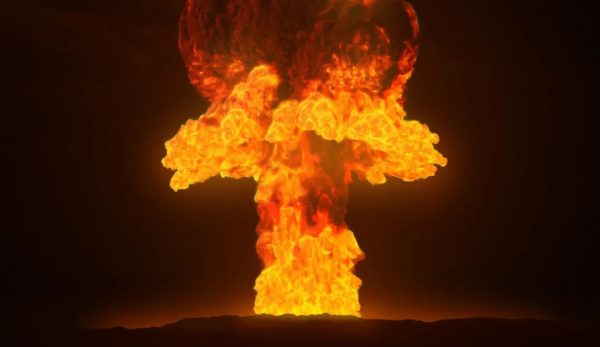
Beijing has denied the test allegations and refused to allow international inspections at Lop Nur
China’s government has rejected all of these characterizations. Peters points out that Beijing has also declined to invite international observers to Lop Nur to verify or refute the allegations on the ground. That refusal carries weight: the Comprehensive Nuclear Test Ban Treaty includes a formal consultation-and-clarification mechanism designed precisely for situations like this one, providing a channel through which a state accused of violations can request independent scrutiny and clear its name. China has declined to use it.
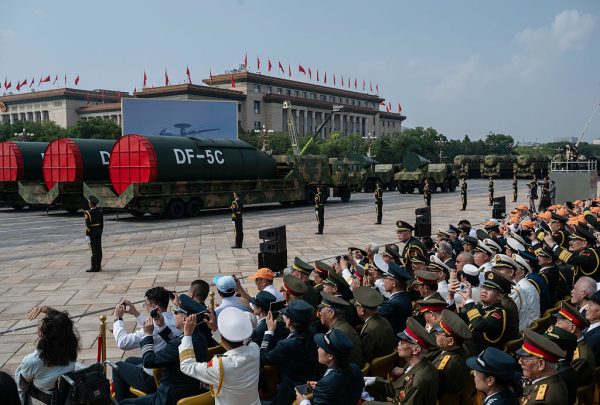
Beijing’s alleged secret testing program does not exist in isolation. China is currently expanding its nuclear forces faster than any other state by nearly any available measure. The Chinese military has constructed hundreds of new intercontinental ballistic missile silos, the hardened underground launch tubes used to store and fire long-range nuclear weapons, across its western interior.
It has expanded its sea-based nuclear deterrent, deploying submarine-launched ballistic missiles capable of reaching targets across the Pacific. It has also fielded new missile systems with the range to strike targets across a broad arc stretching from Japan through the American territory of Guam to Australia.
Peters places the testing allegations within what he describes as a systematic and deliberate pattern of military modernization. Throughout this expansion, Beijing has refused to participate in any multilateral arms control negotiations, declined to engage in strategic stability discussions with either Washington or Moscow, and rejected every proposal for mutual transparency measures that would allow outside parties to verify the scope and character of its buildup.
Why secret low-yield tests matter: China may be refining new nuclear warhead designs
The significance of clandestine low-yield tests lies in what they allow weapons designers to accomplish. A full-scale nuclear detonation is large enough to register clearly on seismic monitoring networks worldwide and would constitute an unambiguous, politically catastrophic treaty violation. Low-yield tests, kept small and concealed in underground cavities using the decoupling technique, allow a country’s weapons engineers to validate new warhead designs, refine performance data, and improve reliability, all without crossing the threshold of a detectable large explosion. If China’s military is conducting such tests, it is acquiring qualitative improvements to its arsenal, in addition to the sheer numerical growth already documented by American defense analysts.
Washington has not closed the strategic gap China’s nuclear program is opening
Peters concludes with a direct warning. If China’s military leadership is secretly validating new nuclear weapon designs while publicly denying any testing program, the United States and its allies already face a strategic gap they have not begun to address. American force structure and deterrence posture, he argues, must be adjusted to ensure that no future confrontation exists in which Beijing holds a decisive nuclear advantage. Failing to act on the available evidence now, Peters writes, risks leaving Washington unprepared for precisely the situation that Beijing may be quietly engineering.
By Gao Yun