On March 12, 1925, Sun Yat-sen, the founding father of the Republic of China, died in Beijing. As the nation mourned, a document titled “Letter to Soviet Russia” surfaced, calling on his Nationalist Party (Kuomintang) to “fight shoulder to shoulder with Russia.” Historians and China policy experts now argue that this letter was ghostwritten by Mikhail Borodin, the Soviet Union’s chief political adviser in China, polished by the political operative Wang Jingwei, and signed by Sun in a state of near-unconsciousness. The letter cemented the CCP’s claim to be Sun’s legitimate heir, split the Kuomintang, and set China on a path toward communist revolution. Sun’s widow, Soong Ching-ling, went on to play a central role in sustaining that false narrative for decades.
Soviet and CCP operatives drafted the letter while Sun Yat-sen lay dying
In March 1925, Sun Yat-sen was dying of liver cancer at Peking Union Medical College Hospital. His consciousness was severely impaired. The people around his deathbed were not focused on recording his final wishes. They were working to lock in a pro-Soviet political direction for the Kuomintang before he died.
The “Letter to Soviet Russia” was, according to historians and leaked internal party records, composed by Mikhail Borodin, who at the time controlled much of the Guangzhou government’s finances and military resources as the Soviet Union’s chief adviser to the Kuomintang. Wang Jingwei, a senior Kuomintang politician who later became infamous for heading Japan’s puppet government during World War II, translated Borodin’s English draft into Chinese and adjusted the tone to resemble Sun’s voice.
Sun Yat-sen was unable to hold a pen. Soong Ching-ling, his wife, and the Soviet operatives present pressured him to sign the document at his bedside. They needed his endorsement to prevent the Kuomintang’s right wing, led by senior party elder Hu Hanmin, from abandoning the pro-Soviet line after Sun’s death. According to internal meeting records and private conversations among party elders, Sun signed in a state of mental confusion, with someone physically guiding his hand.
Party insiders noted that Sun’s actual concern at the time was the military movements of the northern warlord Feng Yuxiang, not the Soviet alliance. The letter’s key phrase, in which Sun supposedly instructed the Kuomintang to “work hand in hand with you [the Soviets] forever,” was widely regarded within the party as language Borodin inserted to protect Soviet interests in China after Sun’s death. The document gave the Soviet Union the status of “mentor” to the Chinese revolution and provided cover for CCP infiltration of the Kuomintang.

Success
You are now signed up for our newsletter
Success
Check your email to complete sign up
The CCP used Soong Ching-ling to claim Sun Yat-sen’s legacy and undermine the Republic of China
CCP official histories celebrate Soong Ching-ling as a “great communist fighter.” Kuomintang accounts remember her as the party founder’s wife who betrayed her political family. Historians who have examined declassified archives have reached a different conclusion: Soong Ching-ling was systematically cultivated by the Soviet Union and the CCP to undermine the legitimacy of the Republic of China.
After returning from the Soviet Union in 1929, Soong Ching-ling was, according to available evidence, effectively operating under the direction of the Communist International. Reports indicate she applied for CCP membership in the 1930s, though the party kept her affiliation secret to preserve her public identity as “Madame Sun Yat-sen.” Within the CCP, she was regarded as “a comrade of special status.” A leaked record from an early united front strategy meeting quotes Zhou Enlai, who later became the CCP’s first prime minister, as saying: “The role she alone can play is something we could not replicate by deploying a hundred underground party cells in Kuomintang-controlled territory.”
After Sun Yat-sen’s death, the CCP elevated Soong Ching-ling’s public profile to serve its own political needs. The party was still small and needed to operate within the Kuomintang’s political framework. CCP strategists calculated that by controlling Soong Ching-ling’s public statements, they could present themselves as the true inheritors of Sun Yat-sen’s “Three Principles of the People” while denouncing Chiang Kai-shek, the Kuomintang military leader who had unified much of China, as a “traitor” to Sun’s legacy.
Ming Juzheng, a prominent China affairs scholar, has pointed out that during World War II, the “China Defense League” organized by Soong Ching-ling was nominally an anti-Japanese resistance effort. In practice, it funneled a large share of overseas donations and material aid to the CCP’s base in Yan’an. Ming has argued that Soong Ching-ling was the CCP’s single most effective propaganda asset. She used the prestige of being Sun Yat-sen’s wife to give the CCP’s violent seizure of power the appearance of inheriting Sun Yat-sen’s democratic ideals.
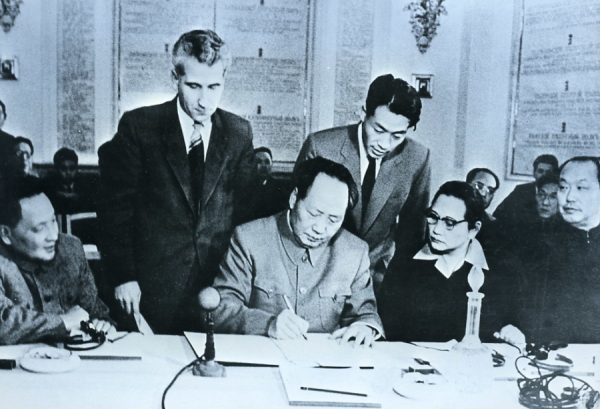
Scholars say Borodin inserted unconditional pro-Soviet language to lock in future Kuomintang leaders
Ming Juzheng has also emphasized that Sun Yat-sen’s original policy of “alliance with Russia, accommodation of the Communists” was conditional. The Soviet Union had to guarantee it would not impose a communist system on China. The deathbed letter removed that condition and reduced the policy to unconditional alignment with Moscow. This became the founding document for the CCP’s claim to political legitimacy.
Cheng Xiaonong, a U.S.-based Chinese scholar, has argued that Borodin’s control over the Guangzhou government’s finances and military meant that whoever succeeded Sun would be compelled to follow a pro-Soviet path or lose Soviet aid entirely. The letter was designed to make the pro-Soviet line mandatory for any future Kuomintang leader, regardless of that leader’s own preferences.
Cheng has also noted that Soong Ching-ling’s refusal to support Chiang Kai-shek after the 1927 Kuomintang split (known as the Ninghan separation) was driven by the fact that Chiang had blocked the Soviet plan to bring communism to China, not by any belief that Chiang had betrayed the revolution.
Soong Ching-ling’s English-language propaganda undermined US support for the Republic of China
Yu Maochun, a former senior China policy adviser in the U.S. Secretary of State’s office, has pointed out that the CCP has used Sun’s deathbed letter for decades to claim it is Sun Yat-sen’s “true successor.” Historical archives, however, show that Sun had grown wary of Soviet communist violence in his final years, and the letter’s tone sharply contradicts his longstanding Confucian and democratic convictions.
Yu has argued that the CCP used Soong Ching-ling’s reputation in the West to carry out a highly effective campaign of strategic deception. Through organizations like the China Defense League, she communicated a specific message to the United States and the international community: the CCP is democratic, it represents land reform and modernization, and Chiang Kai-shek is a dictator. Yu has said this messaging directly weakened American support for the Nationalist government after World War II.
Soong Ching-ling’s English-language media appearances were particularly effective at shaping international opinion. She used Western press access and her status as “Madame Sun Yat-sen” to pressure the Chiang Kai-shek government from outside China, turning international public opinion into a source of domestic political instability for the Republic of China.
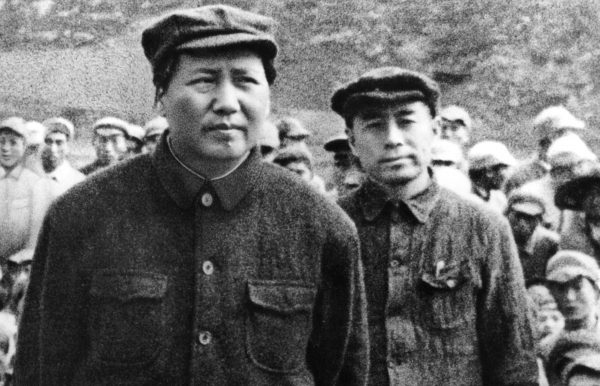
Soong Ching-ling’s presence on Tiananmen in 1949 gave the CCP its claim to Sun Yat-sen’s legacy
Multiple scholars at Taiwan’s Academia Sinica Institute of Modern History have argued that Soong Ching-ling’s decision to remain in mainland China in 1949 and participate in the Chinese People’s Political Consultative Conference, the CCP’s political advisory body, completed the Party’s capture of the Republic of China’s political legitimacy. Without Soong Ching-ling, the CCP would have had great difficulty presenting itself internationally as the heir to Sun Yat-sen’s legacy. The Party needed someone who personally represented Sun Yat-sen to stand alongside Mao Zedong as the new regime was proclaimed.
Soong Ching-ling’s appearance on the Tiananmen Gate reviewing stand on October 1, 1949, sent exactly that message to the world: the Chinese Communist Party, led by Mao Zedong, was the continuation of Sun Yat-sen’s cause. Scholars at Academia Sinica have described this as one of the most consequential acts of political deception in modern Chinese history.
By Fu Longshan