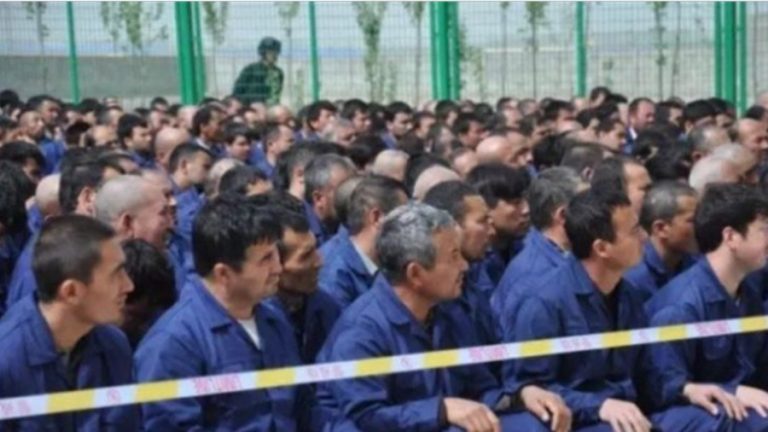
A Chinese artist now in Berlin says he secretly filmed what appears to be a forced labor operation at a suspected “re-education camp” outside Urumqi in December 2024. Guo Zhenming told Radio Free Asia he saw hundreds of people in matching uniforms clearing snow along a railway behind razor wire, divided into supervised squads. Police later searched his home.
Separately, testimony from a former detainee published by Taiwan’s investigative outlet The Reporter describes guards telling deaf and mute prisoners their organs were “perfectly intact.” Forced organ harvesting remains a pervasive fear inside Xinjiang’s detention system.
Guo Zhenming told Radio Free Asia he left China in June 2024, traveling through Georgia, Armenia, and Turkey before obtaining a German visa. He arrived in Germany on March 1 and holds an 18-month arts fellowship.
From May 2024 to February 2025, Guo spent roughly eight months in Xinjiang, originally planning a personal film project. In December 2024, while scouting locations near a railway on Urumqi’s outskirts, he encountered an unusual scene. Fresh snow had fallen. From about a kilometer away, he saw a large group clearing snow from the tracks and moved closer.
“I saw razor wire at a location where several hundred people were working,” he said. “They wore something like sanitation uniforms, but they weren’t sanitation workers. They were divided into more than ten squads, each with a supervisor. I filmed for two minutes before I was spotted.”
Success
You are now signed up for our newsletter
Success
Check your email to complete sign up
The supervisor inside the perimeter ordered him to stop and told him to wait for police. Guo fled by car.
Two photographs he provided from Berlin show approximately 30 people in matching yellow jackets lined up along snow-covered tracks. Razor-wire fencing surrounds the area. Workers are organized into multiple groups with supervisors nearby. Urban buildings and industrial facilities are visible in the background.
Guo estimated more than 200 people were working at the site. “People who saw my footage said right away it looked like a study class or concentration camp clearing snow,” he said. “Based on their physical features, they appeared to be Uyghur. I was about five meters from them.”
About a month later, police and cultural affairs officials searched his residence. Guo believes the administrative punishment he received was connected to the filming. He says he still has the video and plans to submit it to international media or human rights organizations.
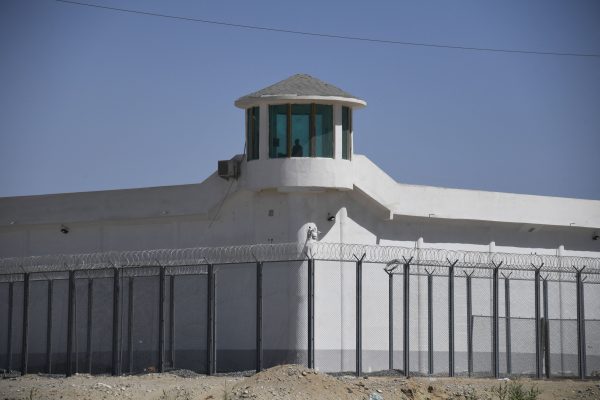
Another Chinese citizen documented the camps before fleeing to the US
Other ordinary Chinese citizens have taken similar risks. In October 2020, a young man named Guan Heng drove alone into Xinjiang and, using satellite coordinates published by BuzzFeed News, located multiple suspected former camps. He photographed high walls, guard towers, and razor-wire fencing with a telephoto lens.
Guan said the footage would be meaningless if never published. Releasing it inside China, however, meant arrest. He left the country in 2021 and published his footage en route to the United States, providing corroborating evidence for international human rights investigations. Rights organizations estimate more than one million Uyghurs and other Muslim minorities have been detained in Xinjiang. Beijing has repeatedly denied the allegations.
Camp guard told deaf detainees their organs were ‘intact’
Testimony published by Taiwan’s The Reporter paints a grim picture of camp life. Gulzira Auelhan, detained in a camp on July 19, 2017, at age 40, described daily forced “study reports” and “thought confessions.” Reports that failed to meet standards were rewritten. The passing standard: praise the Chinese Communist Party, extol the “beautiful life” in Xinjiang, and describe how well detainees were treated.
Because every detainee recited reports aloud, inmates could hear each other’s “crimes” and backgrounds. Two former detainees said camp populations ranged from ages 17 to 80 and included wheelchair users, elderly women with broken legs, and deaf and mute individuals.
Auelhan said she personally heard guards tell deaf and mute detainees: “You people may be deaf and mute, but your organs are perfectly intact.”
Forced organ harvesting is a pervasive fear in Xinjiang. An independent international tribunal, the China Tribunal, investigated the practice and listed Uyghurs alongside Falun Gong practitioners as probable sources of organs taken by the Chinese state.

Beijing plans to triple Xinjiang organ transplant capacity by 2030
The British newspaper The Daily Telegraph, citing data from the international human rights organization End Transplant Abuse in China (ETAC), reported that the Chinese government plans to build six additional “medical centers” with organ transplant facilities in Xinjiang by 2030. The number far exceeds regional population needs.
Xinjiang currently has three such facilities. If Beijing follows through on its December 2024 decision, transplant capacity will triple within roughly five years. Four of the six planned centers are in Urumqi.
The Uyghur Tribunal, an independent people’s tribunal held in London in 2019 and chaired by British barrister Sir Geoffrey Nice, concluded China performs as many as 100,000 organ transplants per year, nearly three times the official figure. The tribunal found sufficient evidence that Chinese authorities forcibly harvest organs from detained individuals, sometimes while victims are still alive. Uyghurs and Falun Gong practitioners are the most common targets.
By Li Muzi