By Jintao Pai, Vision Times
Chinese authorities have placed Lei Siwei, a member of the Gansu Provincial Standing Committee and vice governor, under investigation for “serious violations of discipline and law,” according to a March 17 announcement by the Chinese Communist Party’s Central Commission for Discipline Inspection (CCDI).
Analysts are noting that Lei’s sudden downfall has drawn attention not only because of his senior position but also because of the unusual timing of his detention. The investigation came shortly after Lei failed to appear at China’s annual “Two Sessions” political meetings, prompting speculation about possible connections to other missing officials.
Lei, born in 1966, spent much of his career in Gansu Province working in environmental protection and natural resources administration. He previously served as general manager of the Baiyin Nonferrous Group and later as Party secretary of Jiayuguan city.
In June 2025, Lei was promoted to the Gansu Provincial Standing Committee, giving him vice-ministerial rank. His tenure at that level lasted only eight months. Following the announcement, his personal profile was quickly removed from the Gansu provincial government website.
Detained in Beijing
Success
You are now signed up for our newsletter
Success
Check your email to complete sign up
Lei’s absence from the National People’s Congress session had already drawn attention. As a delegate to the 14th National People’s Congress, he arrived in Beijing with the Gansu delegation on March 3.
According to circulating accounts, Lei was detained by CCDI investigators shortly after checking into his hotel in the capital and did not participate in any of the Fourth Session of the 14th National People’s Congress activities.
Observers noted that the CCDI appears to be increasingly conducting investigations quietly and with strict confidentiality. Rather than dispatching investigators to Gansu, authorities reportedly detained Lei directly in Beijing. Reports suggest Lei’s case may be connected to the earlier corruption investigation of Zhao Jinyun, a former Gansu vice governor.
Political undercurrents
According to publicly available records, Zhao used her official positions between 2005 and 2024, sometimes together with her husband, to assist companies and individuals in obtaining project contracts, mining exploration rights, and tax-related approvals. Authorities said the pair accepted more than 54 million yuan (approximately $7.5 million) in illegal payments.
Zhao was placed under investigation in October 2024 and sentenced in January 2026 to 15 years in prison for bribery and insider trading. Despite Zhao’s investigation, Lei received his promotion to the provincial leadership in June 2025.
Some online commentary claims that both Zhao and Lei were linked to networks associated with Tang Renjian, who served as governor of Gansu between 2017 and 2020 and was also later investigated. During Tang’s tenure, Zhao and Lei held senior roles within state-owned enterprises and provincial departments, and both were reportedly promoted during that period.
Earlier reports by Chinese state media had already highlighted irregularities in the province’s mining sector. Several counties in Gansu were accused of illegal resource extraction, environmental damage, and insufficient ecological restoration, issues that authorities said required accountability from local officials.
Senior officers missing
Lei was not the only political figure absent from the Two Sessions this year. Some observers have pointed out that another senior official, reportedly at a higher rank than Lei, was also missing from the annual meetings. Online discussions have speculated about several figures, including regional leaders connected to earlier political controversies.
Unverified claims circulated on social media alleging that Chongqing Mayor Hu Henghua might also be under investigation, linking his name to alleged corruption cases in Hunan.
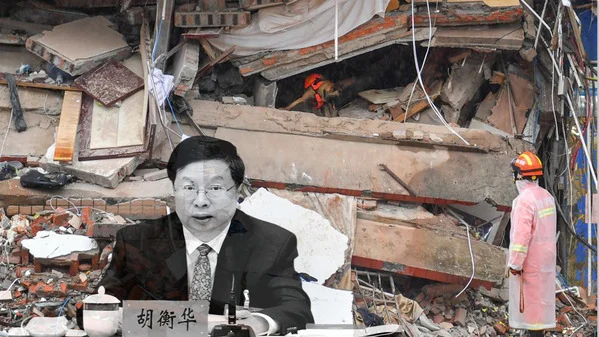
However, those rumors remain unconfirmed. On March 16, Hu chaired a meeting of Chongqing’s municipal talent development leadership group, appearing publicly in his capacity as deputy party secretary and mayor.
Hu, born in 1963, holds ministerial-level rank and serves as Chongqing’s mayor and head of the municipal government’s party group. As a delegate to the National People’s Congress, his status places him at a higher political level than Lei.
Hu rose through the ranks in Hunan before being transferred across provinces after gaining the attention of CCP leader Xi Jinping. In 2021 he was appointed Chongqing mayor following the resignation of his predecessor.
Earlier disciplinary action
Hu’s political career has previously been affected by disciplinary scrutiny. In 2022, Chinese authorities held several senior officials accountable for a 2022 building collapse in Changsha, Hunan Province, that killed 54 people and injured nine others. Investigators concluded that local leaders had failed to adequately enforce safety regulations and conduct inspections of illegal construction.
In May 2023, Hu was among four officials disciplined for leadership responsibility connected to the accident, though the violations dated back to earlier years of his career in Changsha.
State media reported that Hu had “failed to effectively implement central government directives on illegal building rectification and housing safety risk management.” The disciplinary action resulted in an internal Party warning.
Political observers note that personnel changes and corruption investigations often occur alongside factional struggles within China’s political system. Online commentary also reflects growing uncertainty about the fate of senior officials. “Once rumors begin circulating about officials being investigated, people are left confused and unsure what to believe,” one commentator wrote.
For now, authorities have only confirmed the investigation into Lei Siwei, but whether additional senior officials could become targets of future probes remains to be seen.
Editorial note: Views expressed in this article are the opinions of the author and do not necessarily reflect the views of Vision Times.