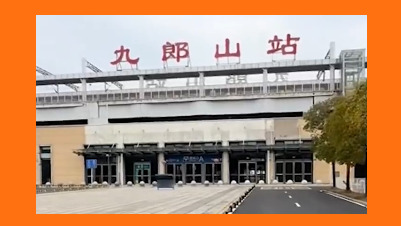
A railway station in central China built with more than 125 million yuan in investment, about $17 million, has been shut down after only a few years in operation, with daily passenger numbers reportedly in the single digits.
Jiulangshan Station, part of the Changsha-Zhuzhou-Xiangtan intercity railway network in Hunan province, ceased operations in March 2022, according to local authorities. The station opened in December 2016 and operated for roughly five years.
Local residents and online users recently drew attention to the closure, prompting inquiries from Chinese media outlet The Beijing News. Officials from Zhuzhou’s transport bureau confirmed that the primary reason for the shutdown was extremely low ridership, with daily passenger flow at times falling below 10 people.
Public records show that the station was temporarily closed for passenger services between Aug. 6 and Aug. 20, 2021, due to pandemic-related restrictions. By the 2022 Lunar New Year travel period, average daily passenger volume remained under 10.
Authorities said operating costs per passenger were disproportionately high, making the station economically unsustainable. As a result, railway operators decided on March 5, 2022, to suspend passenger services indefinitely.
Success
You are now signed up for our newsletter
Success
Check your email to complete sign up
A staff member from the Hunan Intercity Railway Company attributed the problem to a mismatch between planning and actual development. While new stations are often designed not only to meet current travel needs but also to stimulate long-term regional growth, the official said such forward planning must remain within reasonable limits.
Local residents offered a more direct assessment. Some complained that the station was built in a remote, wooded area far from the city center, with almost no densely populated residential zones within a one-kilometer radius. “No one comes here to take the train,” one resident said.
A commentary published by Sina Finance noted that Jiulangshan Station is not an isolated case. Across China, more than 20 railway stations have been left unused or shut down due to remote locations, lack of supporting infrastructure, and insufficient passenger demand.
The report said that reviving such stations is difficult. China’s urbanization and population growth have entered a new phase, making it harder to replicate earlier development models that relied on building infrastructure first and attracting population and industry later.
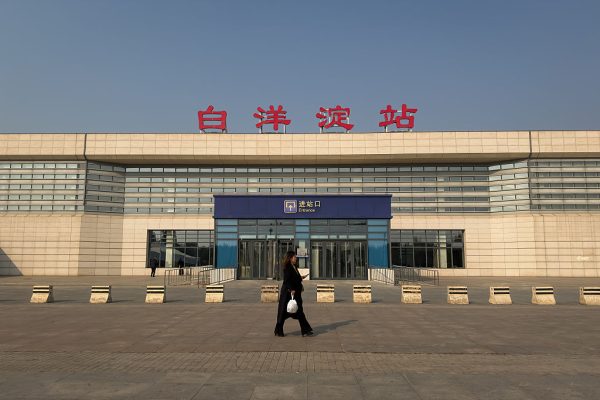
At the same time, many intercity rail lines depend heavily on local government subsidies. With fiscal pressures tightening in many regions, stations already struggling with low ridership face increasing uncertainty over long-term viability.
In response, regulators have begun tightening approval standards. Late last year, China’s National Development and Reform Commission raised the threshold for new intercity rail projects, requiring a projected annual two-way passenger density of at least 15 million trips. Projects that fail to meet 50 percent of expected traffic within five years, or to achieve cash-flow balance within ten years, may face suspension of future approvals.
The policy shift is widely seen as an effort to curb overly aggressive infrastructure expansion.
For stations already built but underused, analysts say local governments will need to reassess planning decisions and identify potential accountability. Some suggest integrating existing stations into regional development strategies by prioritizing nearby urban development and public services, rather than continuing to build new infrastructure.
Online reactions have been sharply critical. Some users questioned the original approval process, while others accused local authorities of wasteful investment.
“What were they doing before construction? This kind of blind investment should be investigated,” one comment read.
Another user wrote, “These stations are built in the middle of nowhere, while crowded areas still lack access. Now that the real estate market is down, those remote places are even more deserted.”
Others expressed cynicism about incentives behind such projects. “The money has already been made during construction. Losses afterward don’t matter, because it’s not their money,” one user said. “That’s how GDP gets inflated.”
By Cai Siyun