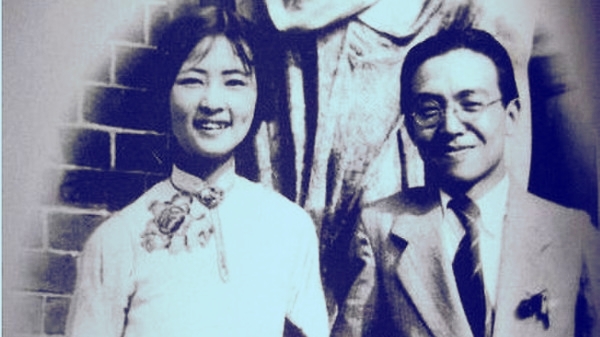
Liang Sicheng and Lin Huiyin entered the 20th century as heirs to both tradition and modernity. Trained abroad, rooted in Chinese intellectual lineage, they returned with a singular purpose: to document, protect, and preserve China’s architectural heritage. They believed that a modern nation could be built without severing itself from its past.
That belief shaped every decision they made. It also determined how their lives unraveled.
Misplaced faith in a new regime
In 1948, as the Chinese Civil War approached its conclusion, Liang faced a choice shared by many prominent intellectuals. The Nationalist government urged him to leave Beijing. He declined.
He later described the decision not as political, but as hopeful. He expected that a unified China would require knowledge, expertise, and cultural continuity. Neither he nor Lin Huiyin approached the moment as political actors. They saw themselves as professionals with a responsibility to contribute.
The Chinese Communist Party presented itself as receptive to that role.
Success
You are now signed up for our newsletter
Success
Check your email to complete sign up
In December of that year, Party officers arrived at Liang’s home carrying military maps. They asked him to identify key historic sites in Beijing so that artillery could avoid them. The request suggested restraint, even respect. For Liang, who treated ancient buildings as living records of civilization, the gesture carried weight.
Shortly afterward, the couple was asked to compile a national inventory of significant cultural relics. They completed the work in weeks, mobilizing students and working through Lin’s worsening illness.
Senior officials reinforced the impression. Conversations with figures such as Peng Zhen were framed in intellectual terms, with references to Liang Qichao’s writings. The message was clear: the new regime recognized the authority of culture and scholarship.
Liang accepted that message. He did more than cooperate. He aligned himself with it.
Devotion to the state’s image
After 1949, Liang Sicheng and Lin Huiyin committed themselves to state projects with intensity and discipline. They approached their work as participants in a national reconstruction.
Liang led the team that designed the national emblem. His health had long been fragile, but he worked continuously. Lin, already weakened by tuberculosis, transformed their home into a design studio, directing students from her bed as drafts of Tiananmen, the five stars, and industrial motifs took shape.
Their design was adopted.
They then turned to the Monument to the People’s Heroes. Liang insisted on structural and symbolic coherence. Lin designed the decorative program, drawing from classical motifs and adapting them into a new political context.
In these projects, their intellectual framework remained intact. Tradition could be translated. A new political order could incorporate cultural continuity.
Liang wrote in his diary that the distinction between “them” and “us” had disappeared. In 1959, he formally joined the Chinese Communist Party.
what the state required, and what it rejected
The assumptions underlying their work did not hold.
Liang and Lin’s central concern had always been the preservation of Beijing as a historical city. In 1950, Liang and urban planner Chen Zhanxiang proposed preserving the old capital while constructing a new administrative center outside it. The plan treated Beijing as a living historical environment, not an obstacle to development.
The proposal was rejected.
The direction was explicit. The capital would be remade. Old structures were not to be integrated, but removed. City walls, gates, and traditional neighborhoods were designated as remnants of a past that had to be cleared.
Liang argued against demolition. He warned that the destruction would be irreversible, that future generations would not be able to recover what was lost. Lin, already seriously ill, pressed the case directly with city authorities. When told the walls symbolized feudalism, she suggested repurposing them as public space. The argument failed.
Beginning in 1953, Beijing’s walls were dismantled.
For Liang, the outcome was not abstract. He had once helped prevent the wartime bombing of Kyoto and Nara, preserving the historical centers of foreign cities. In Beijing, he could not prevent the destruction carried out by his own government.
He returned repeatedly to the sites as they were demolished, observing what could no longer be defended.
Lin Huiyin did not live to see the full extent of the transformation. On April 1, 1955, she died in Beijing at 51. Her illness had long been advanced. Those around her understood that the collapse of the world she had worked to preserve had become inseparable from her final years.
From recognition to denunciation
After Lin’s death, Liang Sicheng remained within the system he had chosen to join. The system no longer required what he represented.
His architectural views, once incorporated into state projects, were recast as ideological error. He became associated with what was labeled “bourgeois aestheticism.” The critique did not focus on technical questions. It redefined his work as politically incorrect.
When the Cultural Revolution began in 1966, the redefinition became action.
At Tsinghua University, Liang was publicly denounced. He was paraded before students and colleagues, identified as a “reactionary academic authority.” His home was searched. Objects collected over decades, including artifacts of historical value, were confiscated or destroyed.
A ceremonial sword linked to Lin Huiyin’s family was presented as evidence of concealed intent. The accusation was not required to be credible. It only needed to exist.
Liang lost his salary, his residence, and access to his research. He was relocated to inadequate housing. His physical condition deteriorated.
Accounts from colleagues describe the mechanics of his final years. Suffering from severe respiratory illness, he was transported to public denunciation sessions because he could not walk. He struggled to breathe through extended proceedings dominated by slogans and noise.
On Jan. 9, 1972, Liang Sicheng died in Beijing.
No reconciliation between culture and power
Liang Sicheng and Lin Huiyin did not withdraw from public life. They did not position themselves as opponents. They attempted to work within a system they believed could accommodate their values.
The system did not adapt.
Their work remains visible. The national emblem, the monument in Tiananmen Square, and the documentation of China’s architectural heritage all carry their imprint. At the same time, the urban landscape they sought to protect was fundamentally altered, and their own positions were ultimately reversed.
Their experience does not resolve into contradiction. It establishes a pattern. Cultural authority was accepted when it served the state’s needs and rejected when it did not. The individuals who embodied that authority were treated accordingly.
By Chen Jing