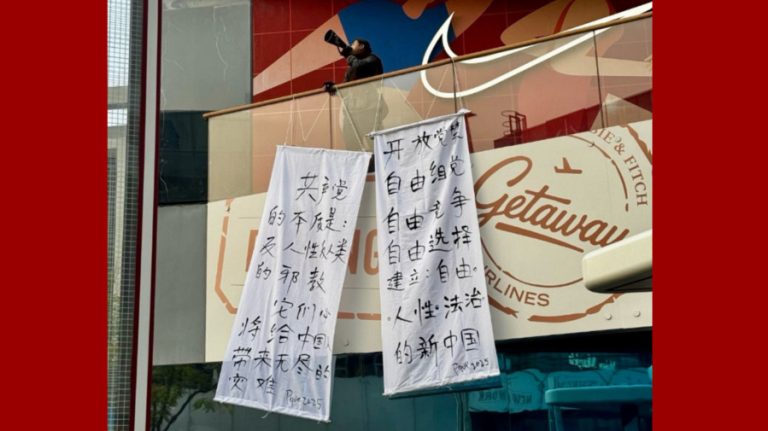
On March 18, 2026, a video that CCP censors had suppressed for nearly five months broke through China’s internet firewall and began circulating on the X platform and TikTok. The footage showed a lone man standing in the heart of Beijing’s Sanlitun Taikoo Li, one of China’s most famous luxury shopping streets, on Oct. 25, 2025. He had hung two large banners and was addressing passersby through a bullhorn. The date was significant: the CCP’s Fourth Plenum, a closed-door meeting of the Party’s Central Committee, had just concluded.
The act immediately drew comparisons to the Sitong Bridge protest of October 2022, when a man named Peng Lifa hung banners on a Beijing overpass calling for the removal of Xi Jinping, the CCP’s general secretary and China’s top leader, and an end to the regime’s extreme “zero-COVID” lockdowns. Peng was seized by security forces and has not been seen or heard from since.
According to the video and photographs that have now surfaced, the protester displayed two banners, each carrying a distinct political message.
The first read: “The essence of the Communist Party is an anti-human, anti-humanity evil cult. It will inevitably bring endless disaster to China.”
The statement distilled into a single sentence the conclusion that millions of Chinese citizens have reached after decades of political campaigns, three years of extreme “zero-COVID” lockdowns that confined hundreds of millions of people to their homes under threat of force, and the ongoing economic collapse and human rights repression under Xi Jinping’s rule. By labeling the CCP an “evil cult,” the protester attacked the regime’s most sensitive vulnerability: the Party sustains its grip on power through ideological indoctrination, maintains control through violence and fear, and strips its subjects of freedom of thought. These are the defining characteristics of a cult, and the CCP’s own censorship of the word “cult” in political contexts reveals how deeply the label threatens the regime.
Success
You are now signed up for our newsletter
Success
Check your email to complete sign up
The second banner displayed a remarkable level of political clarity and maturity: “Open the ban on political parties. Freedom to form parties. Freedom to compete. Freedom to choose. Build a free, humane, and law-governed new China.”
If the first banner was a verdict on a criminal regime, the second was a political program for the future. This protester was articulating a concrete vision for a democratic China, one built on multiparty competition, the rule of law, and individual freedom. The demand to “open the ban on political parties” directly challenged the CCP’s monopoly on political power, the single structural fact that makes all other repression possible.

The Protest Happened in One of the Most Surveilled Spots in China
The location of the protest amplifies its significance. Sanlitun Taikoo Li sits in the heart of Beijing, surrounded by one of the densest networks of surveillance cameras in the world. The district is one of the most heavily patrolled commercial zones in all of China. After the Sitong Bridge protest in 2022, CCP authorities stationed security guards on overpasses across Beijing and intensified surveillance at public gathering points throughout the capital.
Yet this protester still managed to hang two banners and raise a bullhorn in broad daylight. The CCP’s sprawling “stability maintenance” apparatus, the domestic security system that consumes more of China’s government budget than the country’s military, failed to prevent an act of political protest in the most controlled city on Earth. The regime projects an image of total surveillance and omnipresent control. The Sanlitun protest reveals that image to be a facade.
The CCP calculated that by making Peng Lifa disappear, blanketing every overpass in Beijing with guards, and erasing every trace of the Sitong Bridge protest from the Chinese internet, it could crush the impulse toward open political defiance. The Sanlitun incident proved that calculation wrong.
From Sitong Bridge in October 2022 to the “White Paper” protests that erupted across Chinese cities later that same year, when young people held up blank sheets of paper to symbolize everything the CCP forbids them from saying, and now to Sanlitun in October 2025, each act of defiance has built on the last. The regime erased Peng Lifa the man, but his example has continued to inspire Chinese citizens to take extraordinary personal risks.
An ancient Chinese proverb captures the dynamic at work: “When the people no longer fear death, what use is it to threaten them with death?” As more Chinese citizens conclude that the CCP is, as the protester’s banner declared, an “anti-human evil cult,” the regime’s primary tool of control, fear, loses its power.

Five months of CCP censorship failed to kill the video
The protest took place on Oct. 25, 2025. The video did not appear on overseas platforms until March 18, 2026, a gap of nearly five months. That delay illustrates the severity of the CCP’s censorship and information-suppression system, which employs hundreds of thousands of people to monitor, delete, and block content that threatens the regime’s narrative.
CCP authorities clearly believed that by deleting the photos, confiscating the banners, detaining the protester, and scrubbing every trace of the incident from the Chinese internet, they could make it disappear from history. For five months, they succeeded. Then the video reached someone who could get it past the Great Firewall, and the world saw what happened.
The overseas social media user who posted the footage, using the name “YiFeng Su,” expressed what many viewers were thinking: “I don’t know if this brave person is safe, or what charges the Communist Party has pinned on him.”
We do not yet know the Sanlitun protester’s real name, just as we still do not know Peng Lifa’s fate and fear for his safety. Their names have already merged into a shared symbol: the awakening Chinese citizen who refuses to be silenced.
The CCP is dragging China deeper into crisis at a pace that accelerates with each passing year. The economic downturn worsens. The repression intensifies. The regime’s lies grow more transparent. Yet the bullhorn in Sanlitun and the banners on the street carry a clear message: as long as there are people willing to stand in the most surveilled spaces in China and declare that the emperor has no clothes, the collapse of CCP rule is only a matter of time.
By Chen Jing
(This article represents the author’s personal views and opinions.)