U.S. military forces are monitoring 23 port facilities involving China, as well as China’s “space-support” bases across South America, U.S. Southern Command Commander, Marine Corps General Francis L. Donovan, told Congress on Tuesday, March 17.
U.S. Northern Command Commander, Air Force General Gregory M. Guillot, warned at a hearing that China’s missile and other threats to the U.S. homeland are increasing.
Southern Command
Senior national security journalist Bill Gertz wrote an article in the Washington Times on March 17, titled “U.S. Commanders Warn of Rising Chinese Threat in Western Hemisphere,” that General Donovan told Congress Chinese activities and influence pose a growing threat to U.S. national security. He expressed concern over China’s deepening role in developing port facilities and space stations in South America.
At a House Armed Services Committee hearing, he said, “We are very concerned. I believe these all have a ‘dual-use’ nature,” referring to facilities that serve both civilian and military purposes.
Donovan noted that the Pentagon’s National Defense Strategy clearly states the U.S. will counter any power that “acquires or influences key terrain in the Western Hemisphere.”
Success
You are now signed up for our newsletter
Success
Check your email to complete sign up
“The threats facing our hemisphere are real and urgent,” he said, highlighting China as a particularly significant threat.
He added, “Through varying degrees of influence, ownership, and/or operational control, China’s investments in critical infrastructure, important ports, and port facilities give Beijing a foothold in the region and raise concerns about potential dual-use infrastructure—facilities that could be used for intelligence gathering, creating network vulnerabilities, or logistics disruption during global contingencies.”
He said China’s space facilities could be used for satellite surveillance, military reconnaissance, and intercepting sensitive information.
Committee Chairman Mike Rogers emphasized that China is expanding its influence in the region through ports, telecommunications networks, strategic mineral processing, and other strategic infrastructure.
“These investments are not harmless; they are part of a deliberate strategy by Beijing to expand its influence in this hemisphere and undermine U.S. security,” he said.
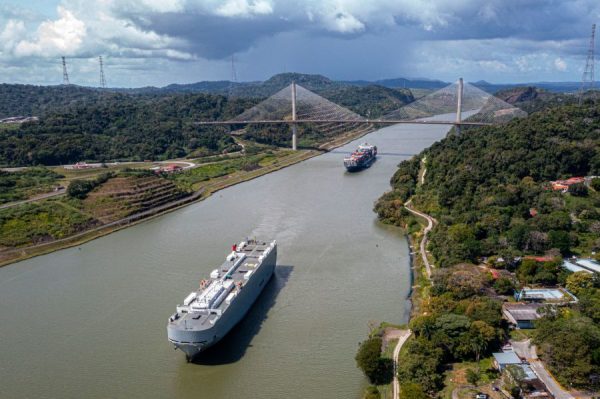
General Donovan called Panama’s recent moves to end Chinese involvement in the Panama Canal a positive development.
He said during the hearing that over the past year, Panama has reduced its dependence on China as an economic and security partner while strengthening its relationship with the U.S., a shift that will better protect canal security. A key action was a recent court ruling barring a Chinese company from operating two strategic port facilities at the canal’s Atlantic and Pacific entrances.
However, he added, “Beijing is still seeking to use every tool of national power to shape a strategic environment favorable to itself, including economic engagement, strategic investment in critical minerals, and strengthening military ties.”
Donovan stressed that ensuring the U.S. can use the canal without restriction remains Southern Command’s top priority.
Northern Command
Air Force General Gregory M. Guillot, Northern Command commander, warned at a hearing that China’s missile and other threats to the U.S. homeland are growing.
Guillot said, “China’s capabilities threatening North America are advancing at an alarming rate. Strategically, China has rapidly expanded its nuclear arsenal to over 600 warheads, most deployed on weapons capable of striking targets within the United States.”
He said the Chinese military is also deploying a variety of new strategic weapons, including missiles equipped with hypersonic glide vehicles, systems capable of penetrating missile defenses, and hard-to-track, intercept space-based strike systems.
Guillot noted that China is enhancing cyberattack capabilities to create deterrence and retaliation options below the nuclear threshold and is beginning deployment of a conventional ICBM equipped with hypersonic glide vehicles, capable of striking Alaska.
He added that in the coming years, China will deploy sea- and air-based cruise missiles armed with conventional warheads capable of striking the U.S. mainland, possibly launched from new “Shang III-class” submarines.
China’s activities in the Arctic are also expanding, with a record five research vessels entering the region in 2025. Guillot said these vessels “are very likely partially supporting future military deployments.”
The report noted that growing coordination between China and Russia over the past year also increases threats to the U.S. homeland, including joint air and naval operations near Alaska.
Guillot said, “While no formal military alliance exists between our main adversaries, both view the United States as a threat to their core security interests. This shared perception could form a basis for wartime cooperation, complicating U.S. military planning and enhancing their respective capabilities to threaten the U.S. homeland.”
Regarding China’s relationship with Brazil, Donovan said Beijing conducted a joint military exercise with Brazil last year called the “Formosa Exercise,” which the U.S. did not participate in.
However, he said that this year, Brazil will no longer hold the exercise with China, and the U.S. military will be involved.
Acting Assistant Secretary of Defense for Homeland Defense Joseph H. Humire told the committee that over the past year, Panama withdrew from China’s Belt and Road Initiative, reduced reliance on Chinese contractors, and removed the Hong Kong-based Hutchison Whampoa Group from control of ports at the Pacific and Atlantic entrances to the canal.
He said, “These ports are now operated by U.S. subsidiaries, representing a major victory for unrestricted U.S. commercial activity and a strategic win for the United States.”
On Trump’s planned “Golden Dome” missile defense system, Guillot said space-based interceptors capable of destroying missiles mid-flight are feasible and “already under development.”